The Places We're Losing Are Becoming Jakob Steensen's Worlds
Danish artist Jacob Kudsk Steensen turns volcanic vents, collapsed glaciers, and extinct birdsong into virtual worlds that blur science, grief, and living dream.

This was originally recorded as a talk which is now available to members here.
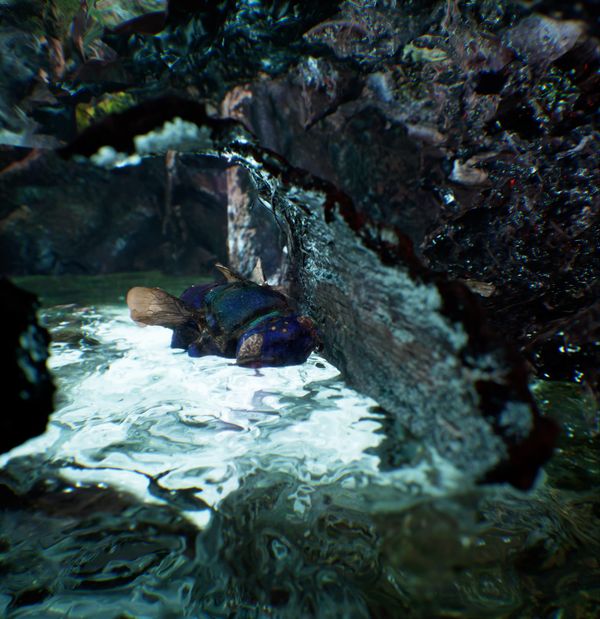
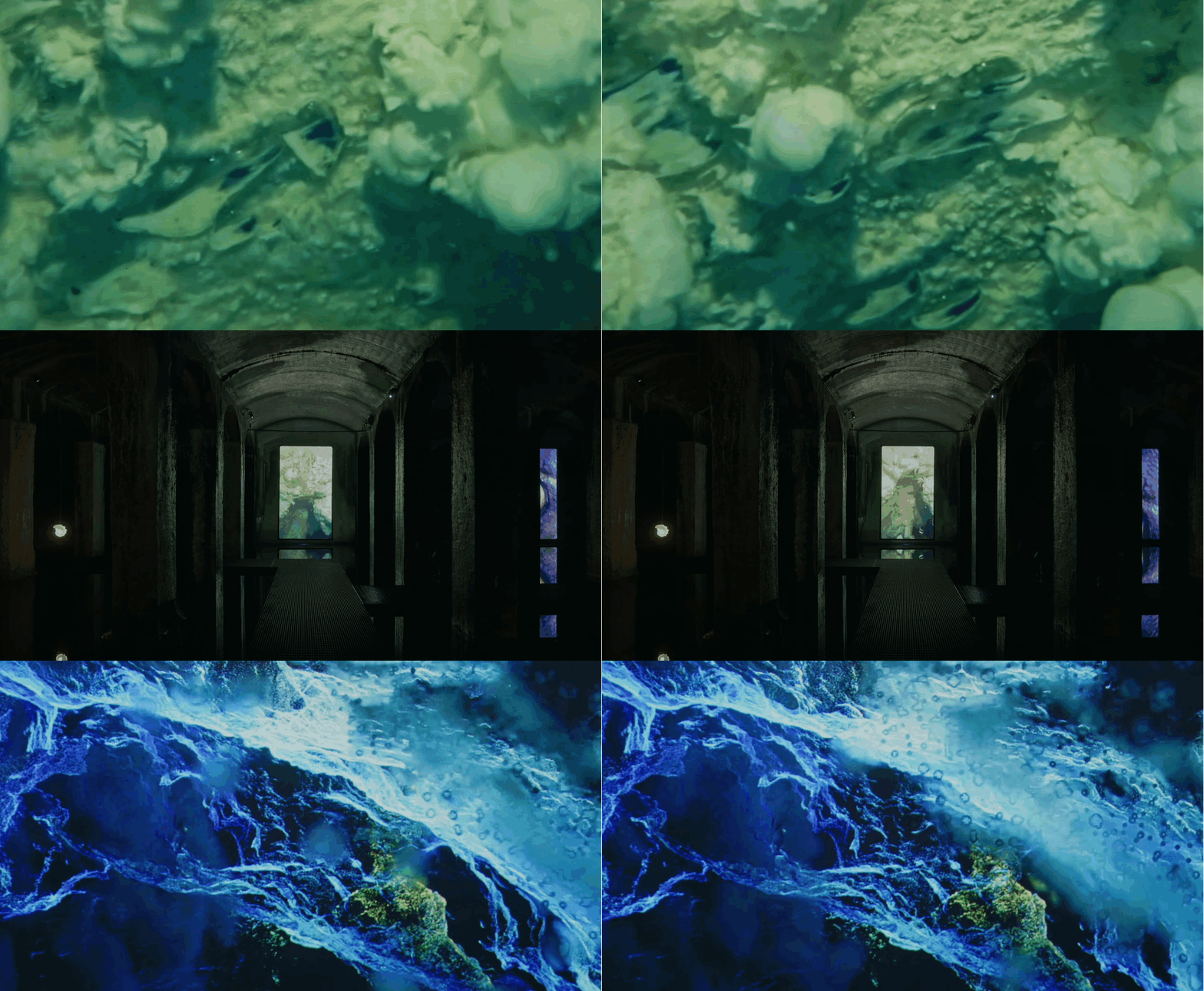
For the past decade, Danish artist Jacob Kudsk Steensen has been treating the video game engine as a medium of ecological fieldwork. His immersive installations grow from years of onsite research—underwater volcanic vents near the Azores, collapsed ice caves in the Swiss Alps, an experimental forest in Minnesota—transforming them into virtual worlds that sit somewhere between scientific document and living dream. We spoke about Otherworlds, a survey on view at the Phi Centre in Montreal that gathers five distinct spaces and spans 15 years; Psychosphere, built from photogrammetry of newly discovered submarine volcanic landscapes; and Song Trapper, part of an expanding game world called Evoker.
Jamin Warren: I want to start with your background, because the way your practice fuses ecology and game engines feels almost generationally specific. We don't usually think of those things as connected—indoor kids tend to stay indoor kids. How did the two come together for you?
Jacob Kudsk Steensen: I grew up in different places with my mom, but I spent a lot of time in a really small town on the West Coast of Denmark, near the water. Less than 2,000 people lived there. My dad is very much into ornithology, and I grew up around wetlands and brackish water. I've worked a lot with wetlands in recent projects because I really know them from a personal level.
At the same time, when I was 12, I bought a copy of Unreal Tournament. It was part of a series of games that exploded full-on interactive, three-dimensional space in a free-roaming, playful, organic way. And it came with a level editor. So you could open up this map or other levels and change them around. It was a "Capture the Flag" game, and I started changing materials.
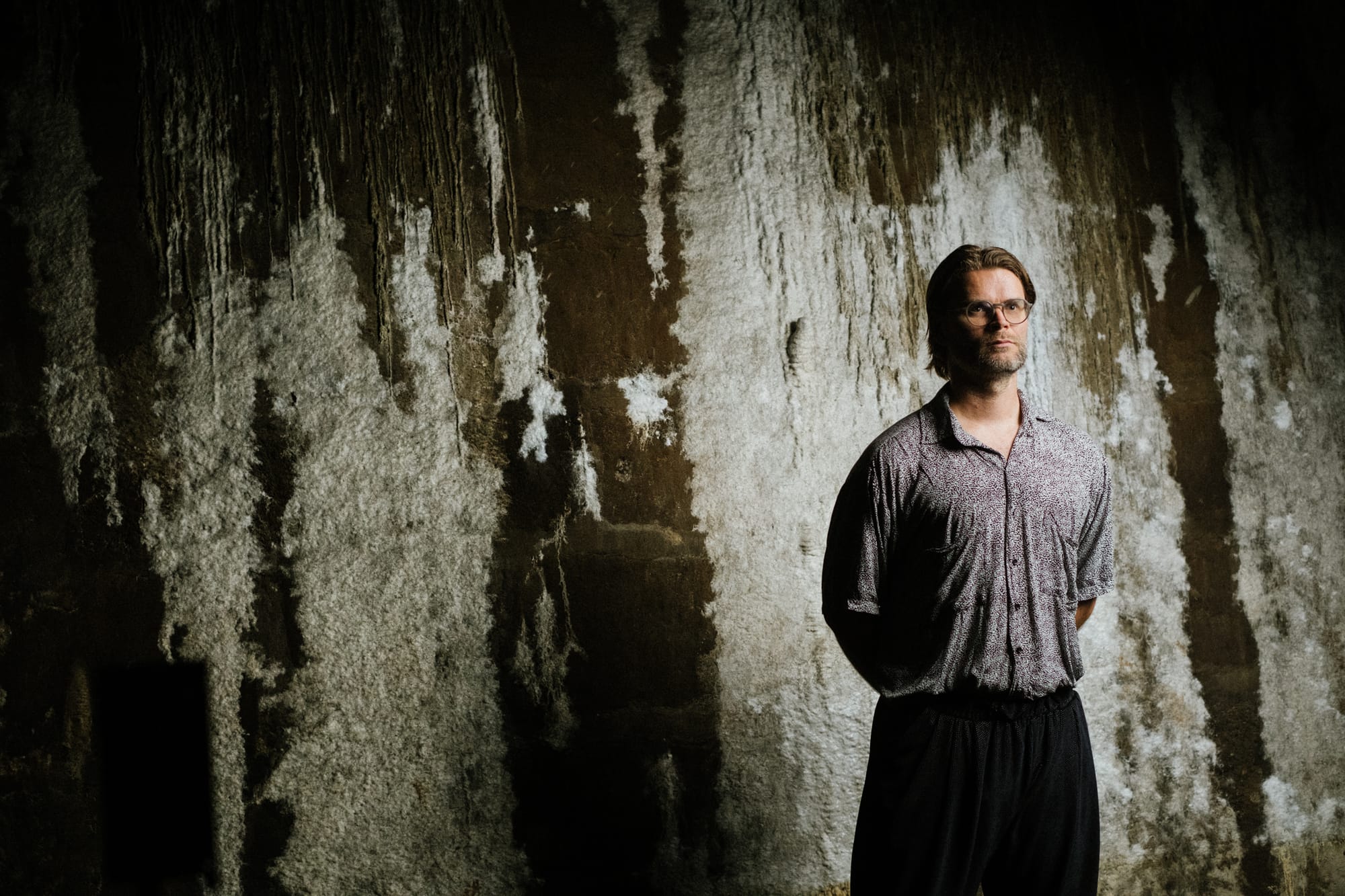
It was never a conscious choice for me to work with video game engines or natural environments. I think I'm just an exact generation where the two really happened. There's a sense of climate awareness, narratives about climate change, and environmentalism—at the same time as there is this explosion of full-on three-dimensional virtual worlds that you can modify. I've used Unreal since it came out. For me, it's like a musical instrument. I very much fell in love with the spatial, environmental part of video game technology.
Can You Grieve a Glacier Through a Game Engine?
One of the throughlines in your work is mourning—or at least proximity to it. The Berola ice cave you digitized in Switzerland has since collapsed, the glacier no longer connected to itself. Two weeks ago, we had a conversation with Kara Stone and Joshua Ashish-Dawson about how digital tools end up being used to grieve disappearing landscapes. Do you think of your archive as a mourning practice? Or is that too heavy a frame for the work?
Through the responses I've had from people, it's definitely a form of mourning. Environmental mourning is a pretty big thing. There's this writer, Melanie Challenger, who wrote a book about this some years ago—she's a friend of mine in Copenhagen. As an artist, I don't know explicitly if it's mourning for me—it probably is. There's a sense of melancholy in some of these works that I'm just feeling.
But I think it's equally a loss of sensibility in a digital world. Especially with generative AI, we're in a visual culture that emphasizes final output, the image as a surface, rather than something really slow and crafted and felt, that comes from an organic process engaging with the world outside the virtual. That's where I live. That's what inspires me. So personally it's a little bit like a loss of magic or craft. I mourn that, and I find that narrative by working in the environments.
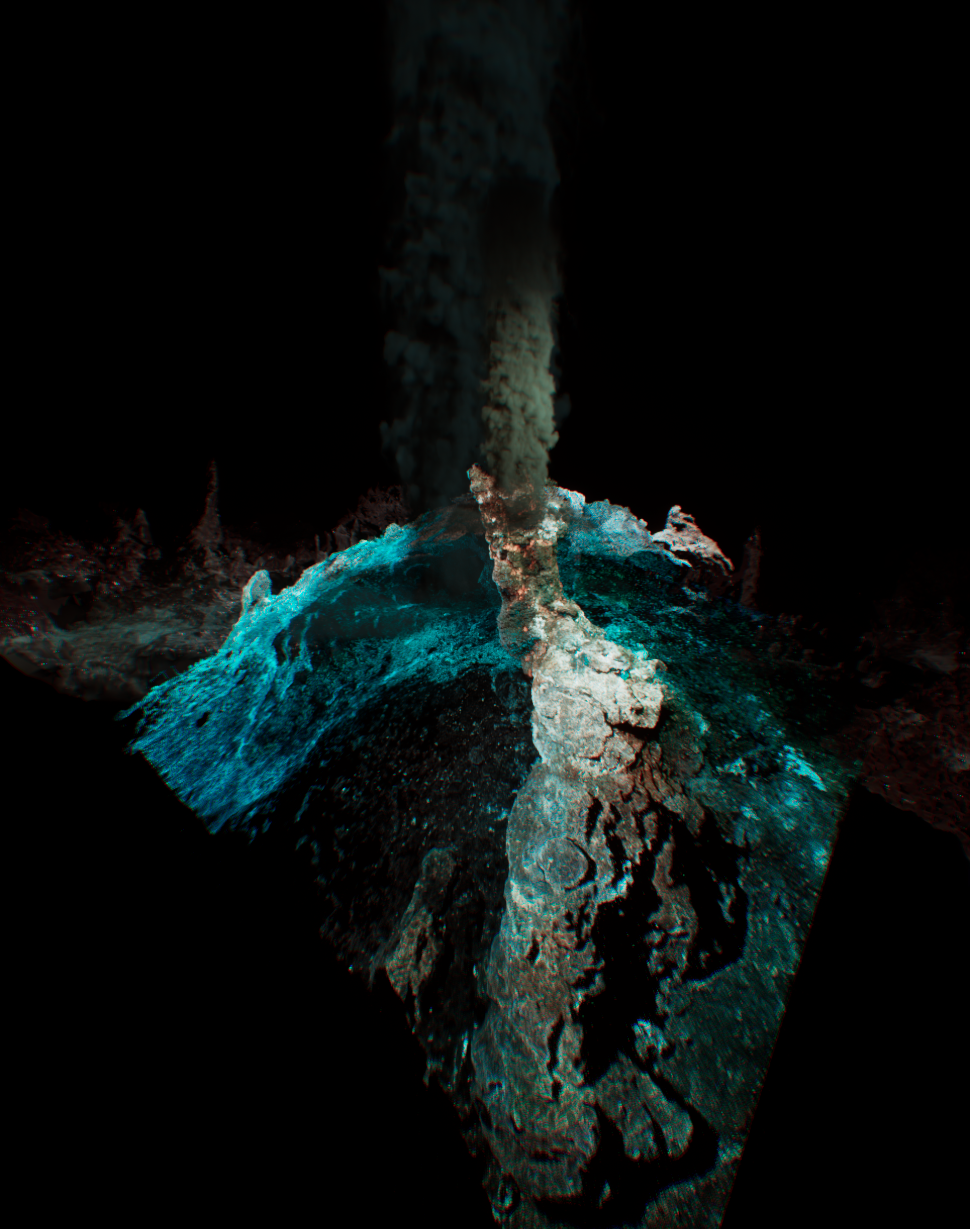
Let's get into Psychosphere. What I love about how you describe this work is that the sensation isn't secondhand—you actually went down. There are only four places in the world where you can dive into a volcanic vent at human-accessible depths, and you spent 10 minutes inside one of them. Before we get to the philosophy that gives the piece its title, I want to start with the body. What does that 10 minutes actually feel like, and how does that physical memory get encoded into the work?
It's a very sensory embodied practice I have, even though the surface is very virtual. I know it spatially through my body. From my point of view, diving into this 16-by-16-foot hole where you have these gases coming out that's dissolving rock and turning them into organic matter was like getting a door to the other side of the moon. To me,, the deep sea is more fascinating than the moon. I'm into strange ecologies and places that are right here. After, it really felt like I had been on the moon. You can only be there for 10 minutes because of these gases, and you smell of egg for three days because it's sulfurous and it's just on your skin. But it's magical.
Killscreen members get the Friday Playlist, the members-only podcast, and the full run of back issues. Two dollars a month.
Why Mix Extinct Fossils, Living Species, and Invented Life in the Same World
Across Otherworlds, you blend extinct fossils, living species, and synthetic life forms—what looks like an editorial choice as much as a scientific or aesthetic one. You're not committing to one register. How do you decide which kinds of beings belong in a given work, and what determines whether a piece pulls from real material, speculative material, or some combination?
It always depends on the core concept or philosophy. Reanimated, about the song of an extinct bird, only used songs of the bird, feathers of it, photographs of an ornithologist that went to this place. Only real material. The concept of Psychosphere—and Melanie's writing a book about this that's coming out this year—is that the origins of sentience originate in the deep sea, where what creates life-force is minerals and non-organic material being transformed under high pressure. Chemistry into life, into DNA and organic material.
If you take that perspective, what creates sentience—lust, a sense of energy in species when we look at each other and recognize each other, a sense of forward motion—is a transformation of energy and matter. This perspective is different than a more dominating approach to intelligence and life called panspermia, which is the idea that there's always sentience of life from somewhere else, this kind of infinite narrative of life coming from space. The concept of the psychosphere is much more: under some conditions, chemistry will create life and transform minerals into DNA.
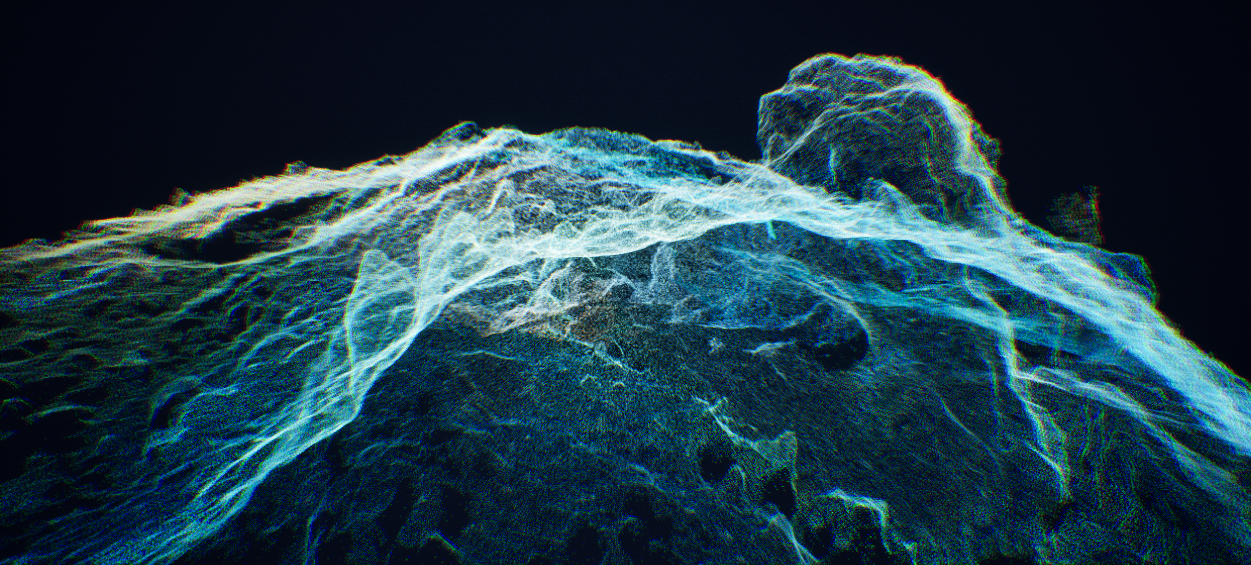
If you take that perspective, you have to transform a lot of different materials across formats. I have to be more freestyle—the eye of a fish, a mollusk, an underwater volcanic vent—and bring all of these into motion. At the exhibition in Sisters in Denmark, we had 40 speakers across three large chambers in a 50,000-square-foot space, with eight projectors. We had 30 sculptures made of glass, silver glass, and resin—amorphous 3D prints from the actual underwater volcanic shapes I made. The virtual worlds control the sound, control the light, control these sculptures. Everything is in constant movement from different species, from different materials, because that's the philosophy of a psychosphere.
A Character Who Can't Speak
The last thing I want to talk about is Song Trapper, which feels like a deliberate pivot. After years of building these large-scale immersive worlds, you're moving back toward something that resembles a more conventional video game—part of a larger game world called Evoker. The story you've written for the Song Trapper character is also unusually explicit by your standards. Tell me about how the project started and what made you want to return to game conventions now.
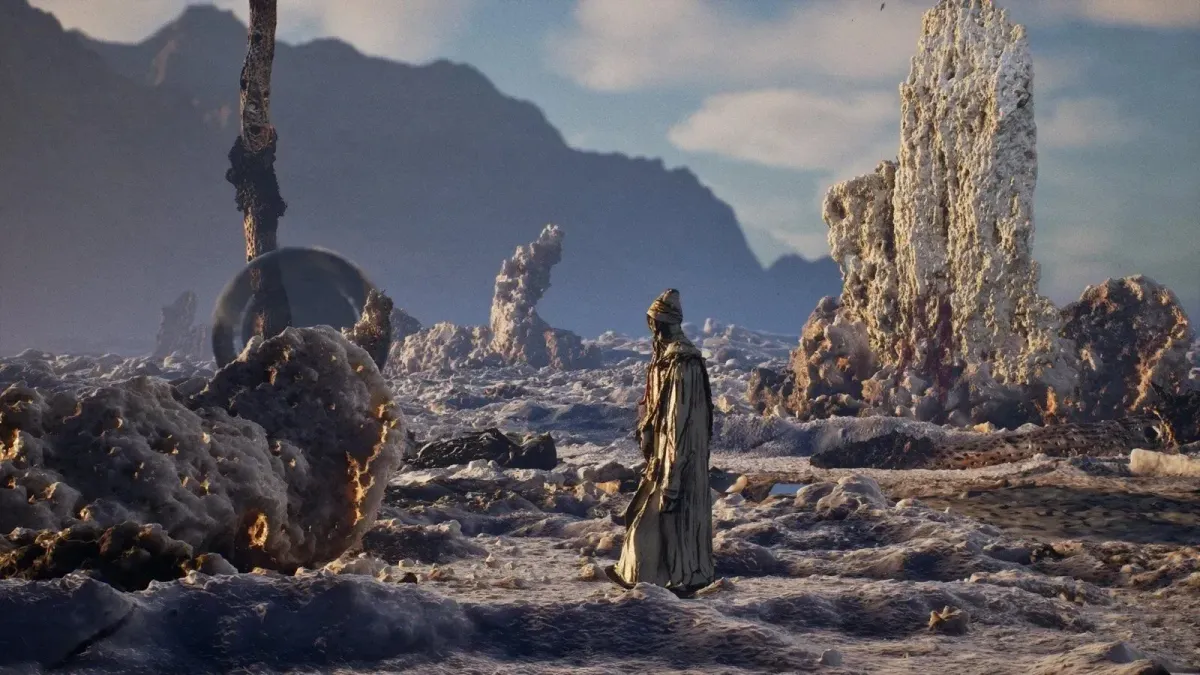
I got invited to do a show at the Fondation Louis Vuitton in Paris, and they wanted a commission for an experimental work. I wrote a story about a character, the Song Trapper, who cannot speak—he can only record, digitize the world, and remix it in order to express himself. It has a struggle with articulation. I made it for two reasons—mourning a sense of loss, and honoring personal gesticulation.
I worked with a professional motion capture actor and dancer, Iris Thomsen in Denmark. We did two days of recording in a big motion capture stage, and I would read my poem out loud. As I'm reading it, she would perform what I'm reading physically. But in the work, there's no voice. She turns voice into body movement. We rehearsed for two days and recorded the final day in one go. Normally, this mocap studio works on LEGO video games and high-end mocap—they've never done a take this long. They do one action, one sentence, and stitch it together. I was like, "No, we're going to do these as long, as raw as possible."
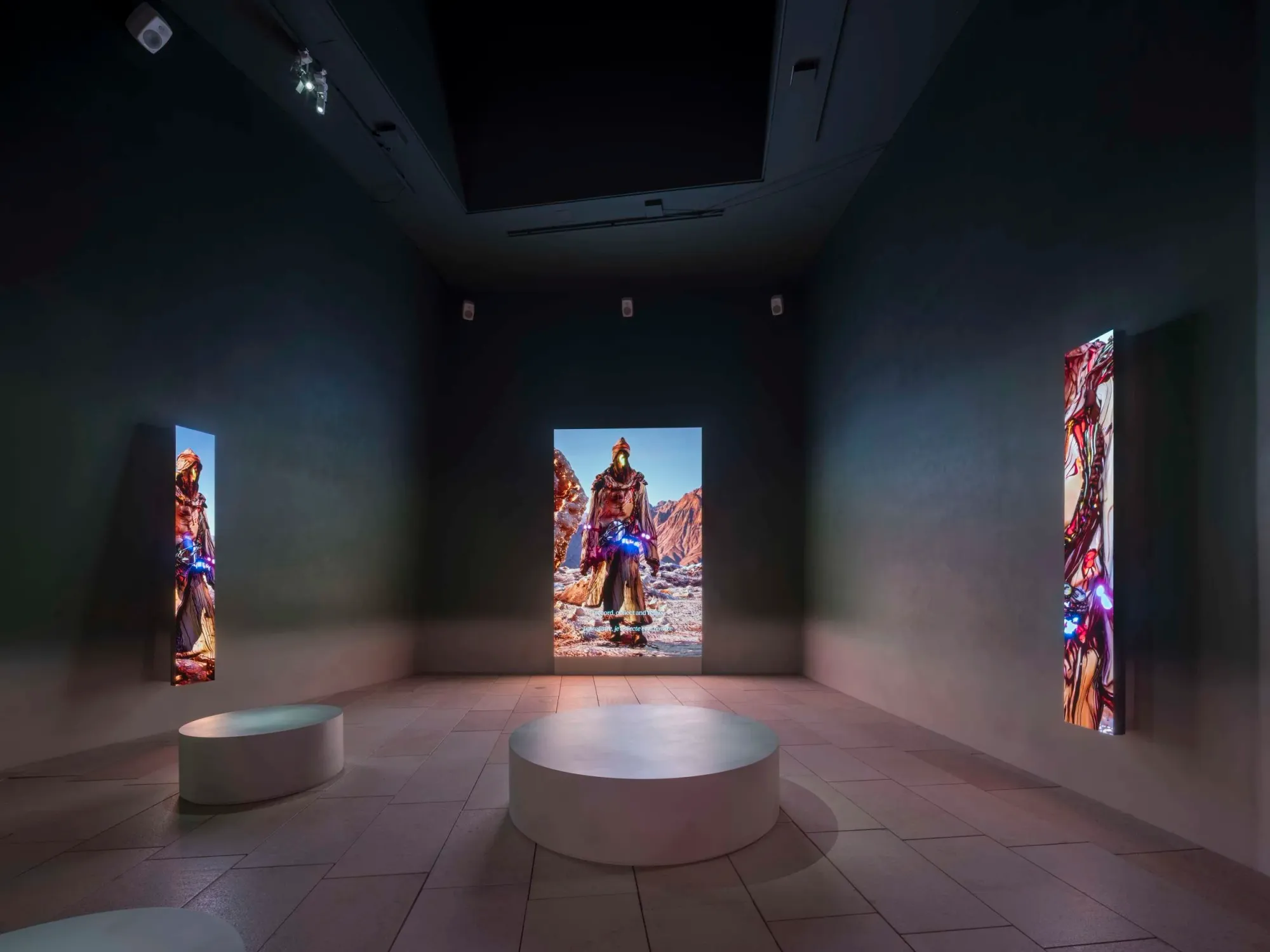
Midway through the work, the Song Trapper meets Nøkken, a figure from Scandinavian swamp folklore, who has always been told through hymns or songs. Nøkken can actually sing. The Song Trapper has a nervous meltdown, then finds itself, realizes it's something different, and celebrates its remixed being. The work ends in this operatic epic ending in the desert, where it dances, and there's this floating hyoid bone—the bone we have in our throat that allows us to sing, that comes from a fish.
For any work I've done, even non-narrative, I have these poems that structure how I compose things with collaborators. It's the first time I made the source of an artwork, and it's my return to wanting to work with games again. Wanting to do an operatic game with these characters. A big part of it will open in Oslo in September and at the Museum of Modern Art in Luxembourg in February. I like the idea of returning to more explicit game conventions and craft, but in this operatic, performative way—poetic dance, an opera singer, hand drawings, all these crafts pulled together in this quirky environmental philosophy.
That was triggered a lot by the explosion of generative AI. I'm really confused by it as a creator. This was my response—we're remixing the world to express ourselves, and it's not bad; it's just something different.
—This interview is edited for grammar, clarity, and style. Jacob Kudsk Steensen's Otherworlds is on view at the Phi Centre in Montreal.
Killscreen covers the artists using game engines to hold on to what we're losing. Once a week, free.
![Brass, Flesh and a Genius Grant [Podcast]](https://storage.ghost.io/c/25/84/2584b75d-4bd6-4cce-8259-f1d1c65abbb5/content/images/size/w600/2026/09/murlo-08-steam-screenshot-03.jpg)