


Of the many senses that games often engage, one of the most common is touch. It is what happens when we pick up a controller, when we run our fingers over a thumbstick, when we feel the light impact of buttons. In many ways, touch is also one of the senses we know best from games of the past, as physical designs.
But capturing the intimacy of touch is an entirely different story. Holding hands, running fingertips along the curve of someone's neck, or even one of those chaste chest-out good-bye hugs. These are all moments the games have sadly struggled to capture: to hold a friend when they're crying, to say goodbye to someone who's dying, to initiate the spark of something new.
The central mechanic in Jonathan Coryn's Player Non Player is caress. You touch characters—hold them, stroke them—and through that contact, you begin to understand how they grieve. It's a disarming premise for a game, and Jonathan Coryn spent six years building it, mostly alone, out of his fine arts training at the École nationale supérieure d'arts de Paris-Cergy and a collaboration with the French electronic duo Agar Agar, whose album shares the game's name and its lore.
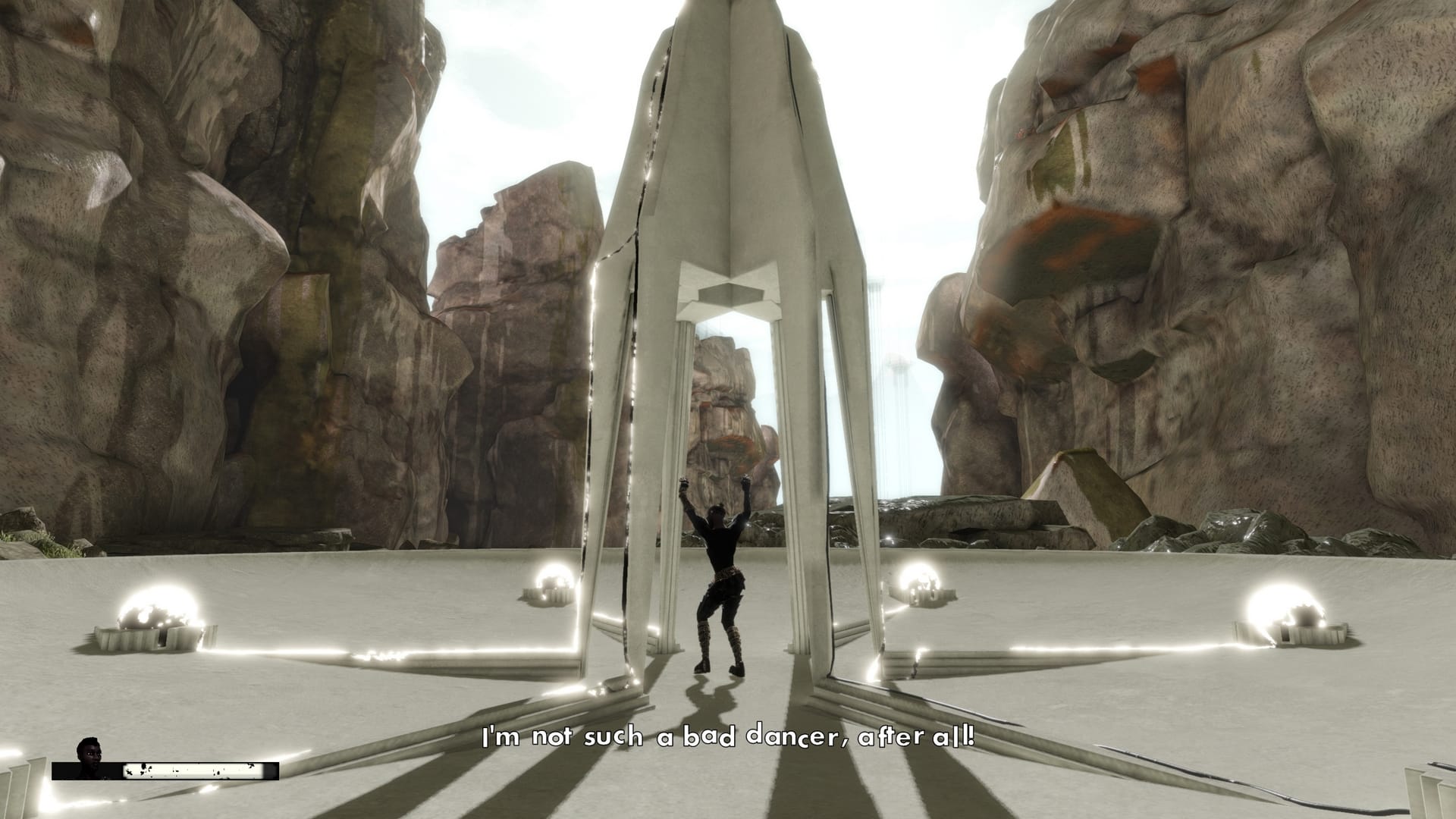
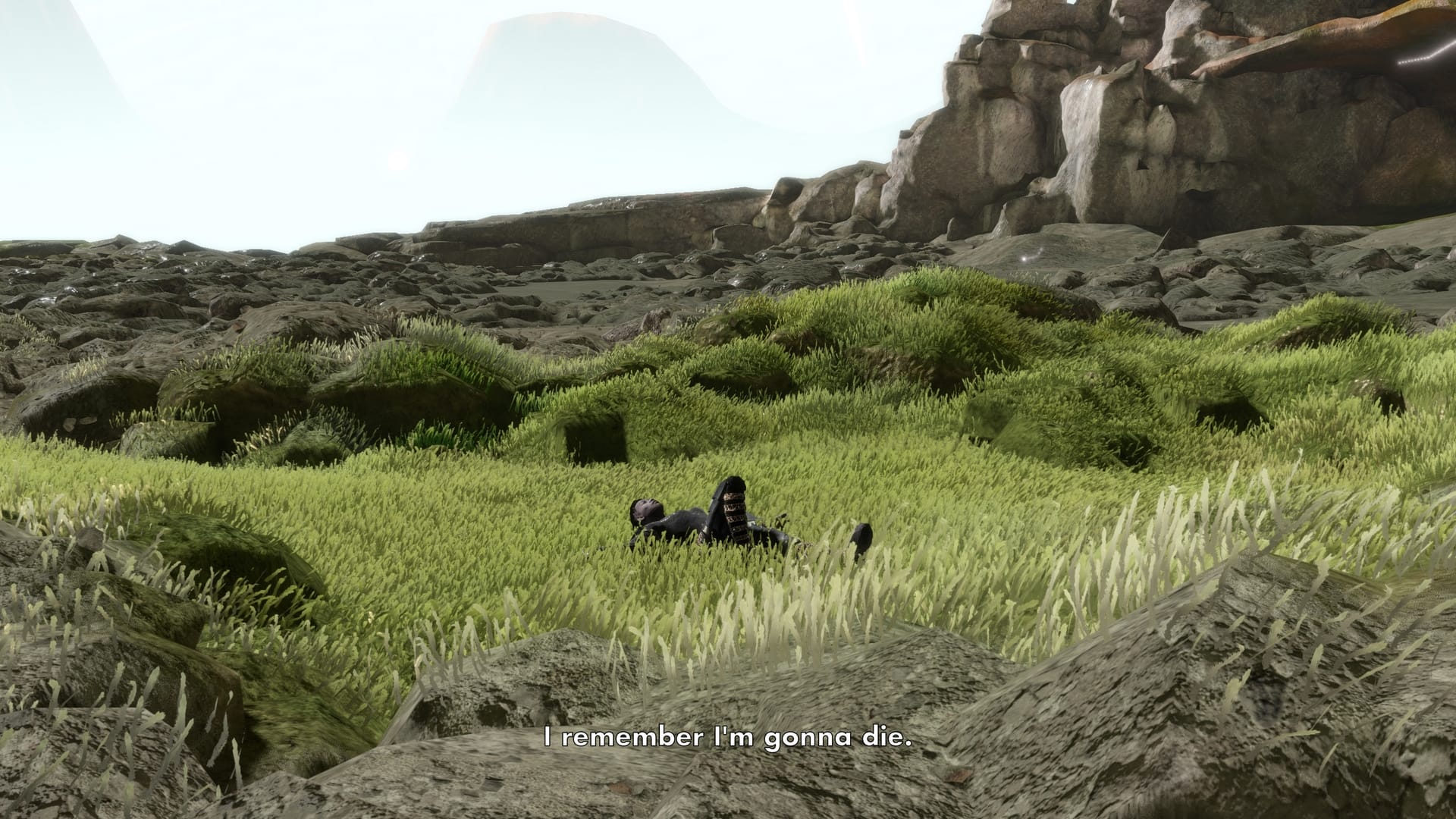
The result is an unforgiving island populated by four tormented figures, a landscape that borrows its desolation from Iceland and its visual grammar from Fumito Ueda's PS2-era worlds. It won the Most Amazing Game award at A MAZE. Berlin in 2023 and has shown at Centre Pompidou and MUDAM. I spoke with Coryn about mortality as a design material, the tension between tenderness and game logic, and what it means to make a space that feels like it's clipping at the edge of reality.
When did you first start thinking about death as a concept to work with in Player Non Player?*
I didn't arrive at death as a theme all at once—it surfaced over the course of the game design process. But I knew quite early on that the game was about intimacy, because the core mechanic I built was the gesture of caressing. That's something I had already worked with during my fine arts studies, and I knew it was a powerful way to create closeness without relying on traditional narrative.
From there, death became the element that sharpened everything. For me, intimacy is never as intense as when it's placed next to mortality—when it's fragile, temporary, at risk. That tension between desire and disappearance is what gives it weight. It's essentially that old dialogue: Eros and Thanatos.
Did you have any personal experiences with grief and longing that informed the work?
I find this question interesting. There's often an expectation that a piece dealing with death must come from a specific personal event, a trauma of some kind. I also notice this question tends to come up more explicitly in video games than in art in general, where death's often treated as something natural. For me, the focus isn't tied to an exceptional or violent loss so much as to something universal: death concerns all of us, constantly.
Noted! I stand corrected.
There's a line in the Silent Hill 2 Director's Cut that stuck with me: Sato Takayoshi says, "Everybody is thinking and concerned about sex and death every day." That's true for me. I think about death every day, even though I haven't experienced what you might call a major or catastrophic bereavement. My grandparents have died, I've lost pets, and I've gone through breakups. But my parents are still alive, and I haven't lost close friends. And even those so-called ordinary losses have been deeply painful.
What strikes me is how intense and unjust those losses already feel, even when they're supposedly in the order of things. I find death profoundly unfair, and the human condition incredibly harsh. I struggle to imagine the death of my parents, the death of people I love, or my own. That difficulty, that resistance, is precisely what keeps death present in my thoughts—and inevitably, in my work, as a form of catharsis.
What did you see as the connection between the characters? Who was the hardest to realize fully?
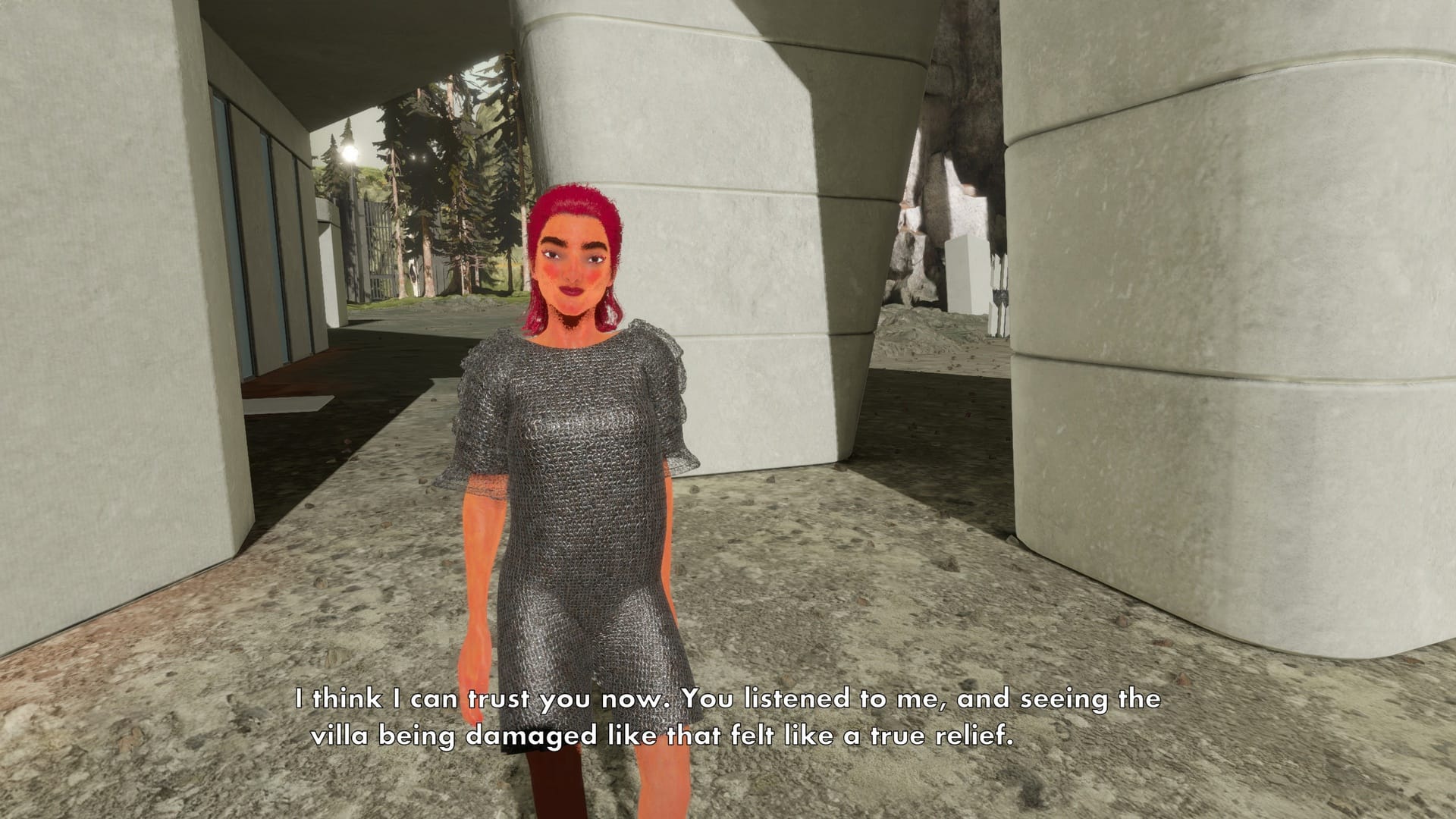
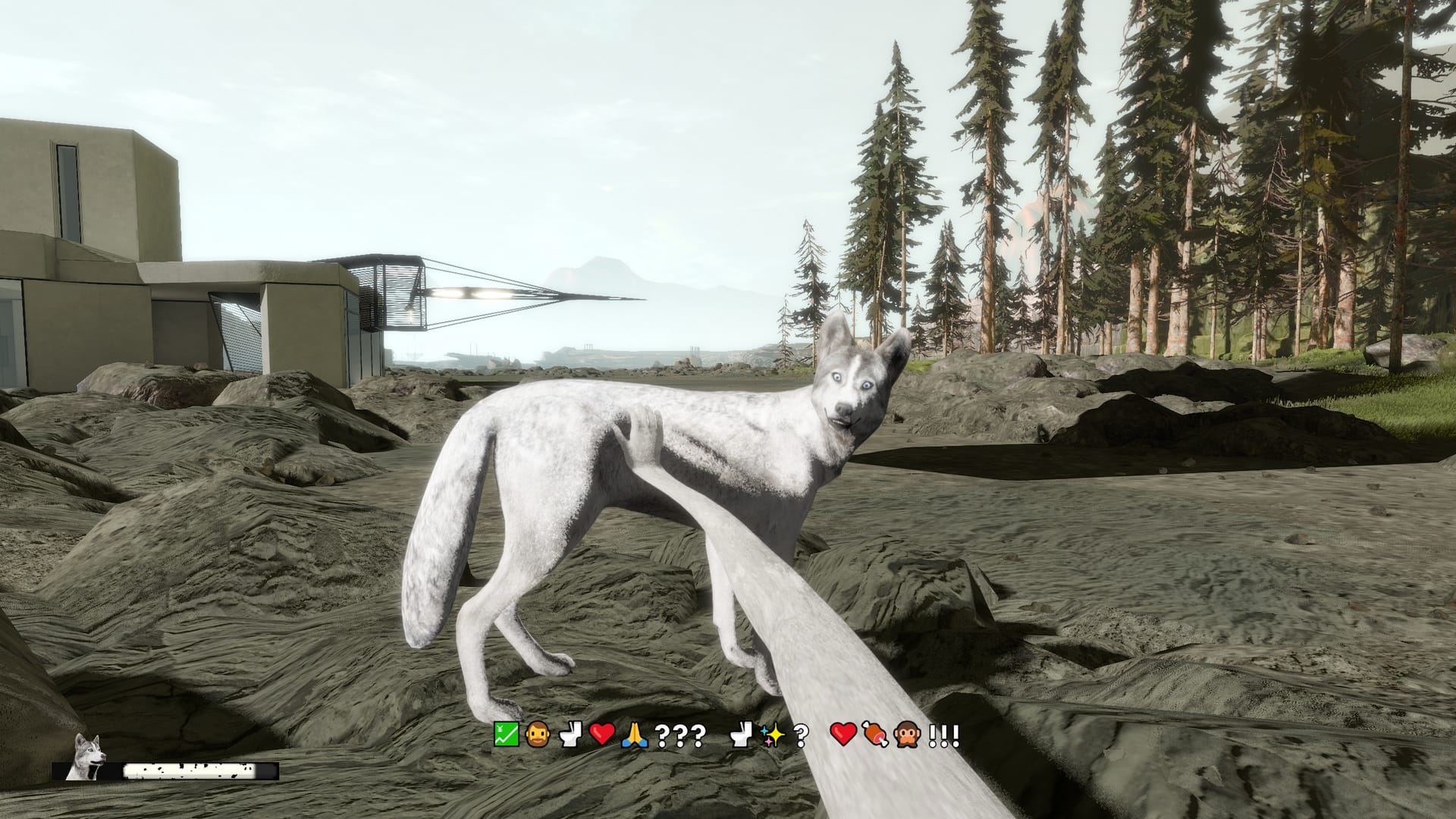
In the game, the characters are essentially facets of a single character. Each one articulates death from a different personal angle: the fear of one's own disappearance, the end of romantic love, the idea of losing one's parents. Once the caress mechanic was in place, it became a natural language for writing those perspectives. The only character that was genuinely difficult to integrate was the dog, because it isn't anthropomorphic—I didn't want to force a human interiority onto it. That's why I treated the dog more as an emotional-care presence: a being shaped by attachment and memory, grieving its owners in a wordless way.
The inclusion of a hoverboard and some of the mini-games are moments where the game-ness of the work breaks through. Are these concessions to an audience that's looking for something more traditional, or something more subversive?
I understand why the hoverboard might read as more "gamey"—it draws on a vocabulary players already recognize, because traversal is a classic design problem in open worlds. But the hoverboard was primarily a practical choice: a way to move through the landscape easily, pleasantly, and clearly, without breaking the contemplative pace. In that sense, it's less about adding challenge and more about supporting how the world is meant to be experienced.
That said, Player Non Player does include moments that are unmistakably more gamey. Because the project was made experimentally, without a prewritten design document, it gradually became a kind of collage—an existentialist approach to game design in which the work becomes what it is through the process. The result is that some elements can feel almost contradictory, or even clash with each other, and I've come to see that tension as part of the game's beauty. It also serves the theme: grief isn't consistent; it's full of abrupt shifts. So when the game suddenly drops you into a very difficult obstacle course in an experience that is otherwise relatively accessible, that contrast becomes a texture of the whole.
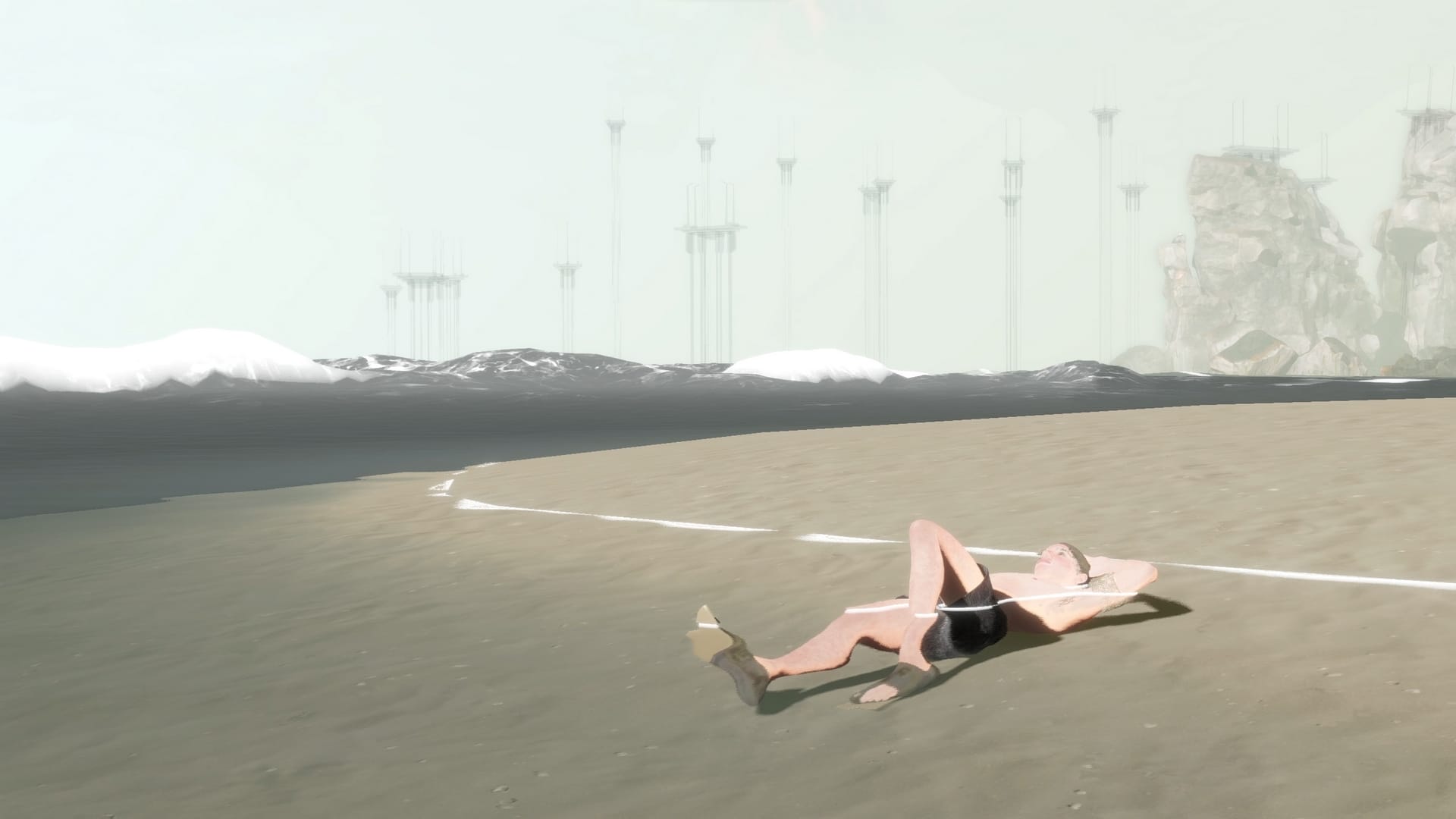
I'm wondering about the landscape. There's a sparseness in many games that feels either aesthetically incurious or a function of ability. You're doing something really interesting in capturing what feels like both a nod to an older generation of games and a real place. Was there a real place you were looking to?
Thanks! I spent an enormous amount of time on the world itself—honestly, probably half of development—modeling the landscape and building its shaders, because I was very attached to achieving what I call "torn 3D": a mix of painterly realism and a deliberately rough, almost released quality in the 3D.
That feeling comes strongly from Shadow of the Colossus—not just because it's a PS2 game, but because to me, Fumito Ueda and his teams are visual geniuses. They achieved a kind of 3D that doesn't obsess over micro-detail but instead leans into pictoriality, into something almost metaphysical: a threshold space that still feels intensely present and materially beautiful.
I almost think of it like paint layers, the physicality of pigment, like Jackson Pollock throwing paint onto a canvas. Ueda's worlds, in Shadow of the Colossus and The Last Guardian, have that material quality even though they're fully 3D.
And the PS2 era helped, because the geometry stays visible and angular. You can clearly feel it's 3D, but when there's presence, the tension between that rough structure and the image's beauty becomes incredibly powerful. That's what I tried to capture in Player Non Player: something that nods to that older sensibility but with contemporary surface work—normal maps and so on.
As for real-world references, the place that gave me that sensation most strongly was Iceland. I think there's a reason so many games borrow from Icelandic landscapes—they're incredibly beautiful and inspiring. But what struck me most when I was there wasn't just the scenery. It was the feeling of being in an edge-world, as if reality itself was slightly clipping, like you could almost pass through it, while at the same time experiencing an overwhelming sense of presence. You feel lost and alone, at the edge of the world, almost at a threshold between life and death—which is exactly where the game's themes live.
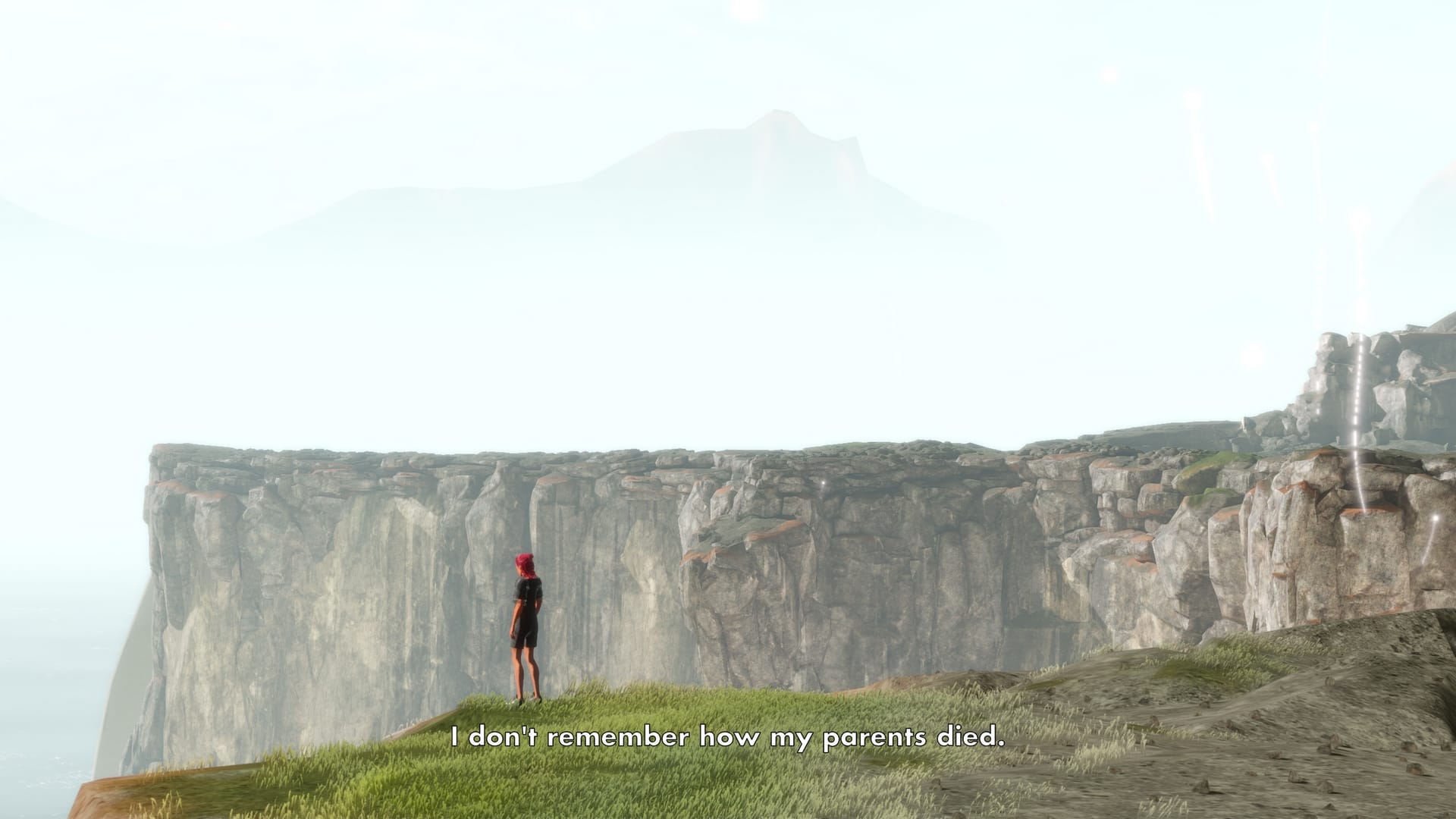
The game has both open space and clearly defined visual zones that you revisit again and again. How did you design these zones to be open-ended while still encouraging players to dig in deeper?
The recurring zones and the open landscape were influenced by Breath of the Wild, which I played intensely right before conceptualizing the game. I found its approach to pathing through space incredibly refreshing, and I pushed it toward something more minimalist. Even though collecting orbs is necessary to finish, they're intentionally distant from a traditional progression curve. The game stays lightly gamified, closer to a contemplative form of movement through space—almost like Land Art. You inhabit the environment, interact with it sensitively, and the reward loop remains modest on purpose, to keep things mostly contemplative and sensory.
It was interesting to see some players read the game as a dating simulator, which I think requires familiarity with that genre or the ability to read romantic interest into the interaction. Certainly, with the shirtless swimmer, there's an immediate suggestion of intimacy, but with the others, not so much. Tell me about whether you intended players to connect affection or friendliness as sexual overture, or whether that's something you wanted to leave more ambiguous.
We sometimes used "dating simulator" as a communication label, because it was the closest familiar frame for players, even though the structure is actually a puzzle game. The Love Bar borrows dating-sim codes aesthetically, but functionally, it's feedback for a lock-and-key logic: what a character dislikes blocks you, and understanding what they like becomes the key that lets you progress. The swimmer leans into the dating-sim register most—more suggestive, tied to romantic grief—and he's also designed as an easy mode, where almost anything counts as a key. That ambiguity is part of the point: tenderness and sensuality can still feel taboo in games, and it's been interesting to see players feel most uncertain with the simplest character.
This interview was conducted over text and edited for grammar and clarity.


