Who Do You Let In: What to Play, August 7
Careful what you let through the door.

I had a wonderful time this week talking with Danny Snelson of UCLA through some of the week's events, starting with that interview with Bennett Foddy, who likened his game tastes to "notes of gasoline." It was a fitting metaphor on top of all the other news covered this week.
One other thing: normally Playlist is for paying members, but I wanted to share more of the work, and this week's selection is playable on the web. Here's a free taste for non-members, and if you like something short and meaningful to play each week, please consider becoming a member!
Playlist 284
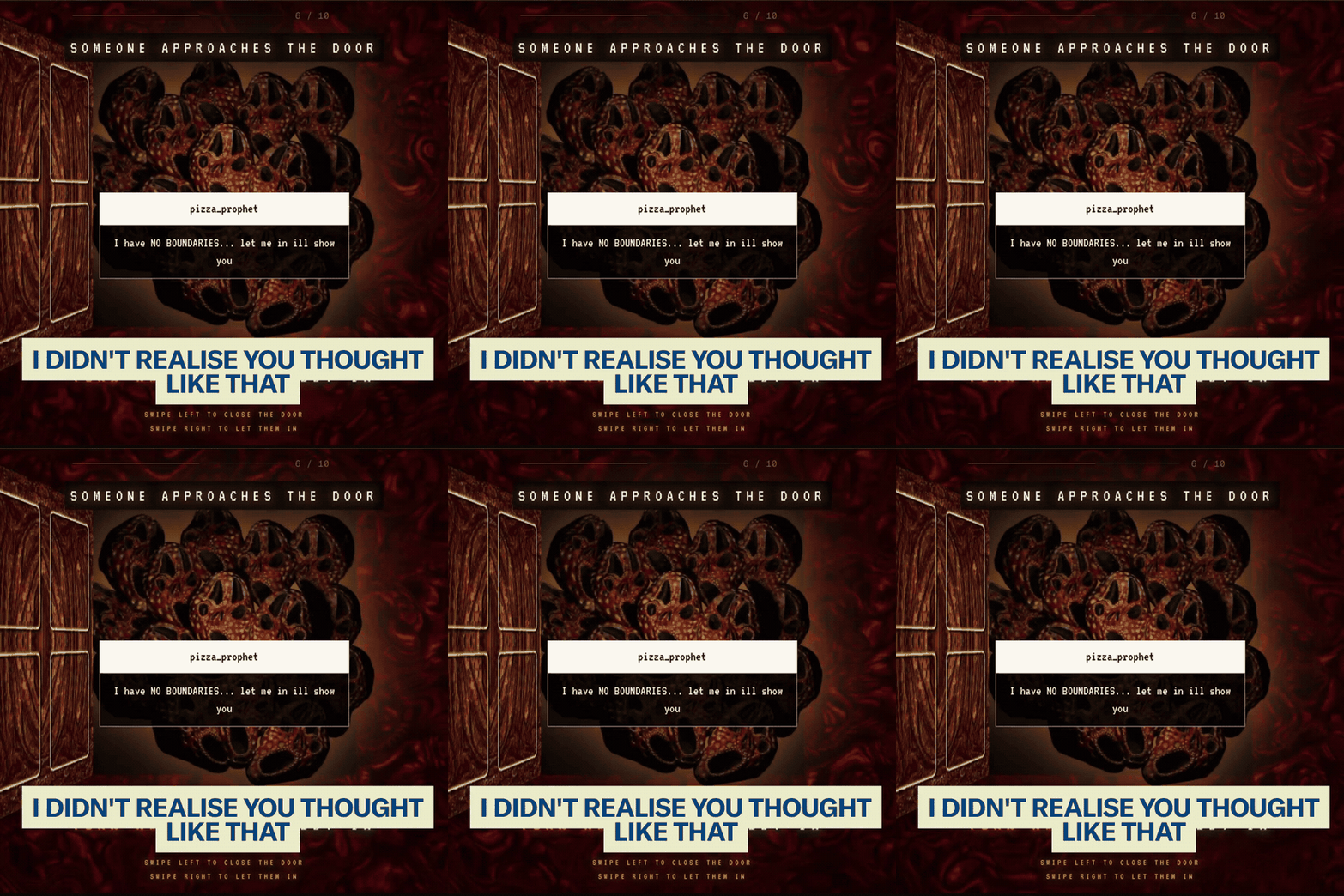
I Didn't Realise You Thought Like That (2026)
Danielle Brathwaite-Shirley
Play Time: 10 minutes (but play multiple times)
In W.W. Jacobs’ 1902 horror story, “The Monkey's Paw,” two elderly parents are given a magical object that will grant them three wishes of infinite promise. Whether it is in the intent of the paw or simply a misaligned agent with poor prompting, the object gives them what they want at a terrible cost. A wish for wealth arrives, but at the cost of their son's life and a workers' compensation claim from his employer. A wish to bring him back generates one of the great scenes in horror literature: an incessant banging from the newly exhumed son. “For God's sake, don't let it in,” the old man screams. He has one more wish.
Jacobs’ story is, of course, about unintended consequences and our desire for control. Writing in 1902 at the end of the Second Industrial Revolution, the British author would have also been aware of the impact of rapid change on labor, public health and the environment. And for that reason, the monkey's paw has remained a useful modern metaphor for the perils of the promises of the future. And it is particularly germane to describe the whiplash of social media and online communities from the unbridled optimism of the Arab Spring to our contemporary moment, when platforms are quickly aligning themselves from openly fascist to simply fascist-adjacent.
Artist Danielle Brathwaite-Shirley has spent her life creating work that flits between her community of black trans artists and the rest of the world. The English artist was bound to be a scientist before finding burlesque and later trans performance. Since leaving the Slade in 2019, the extremely prolific artist has moved quickly from itch.io releases to the main stage of galleries like the Julia Stoschek Foundation and David Kordansky, here in LA. Given the publicity, she is acutely aware of what is possible for good and bile on the internet, and for the newest release, I Didn't Realise You Thought Like That, she answers the powerful question posed by Jacobs’ story: What if you let the wrong one in?
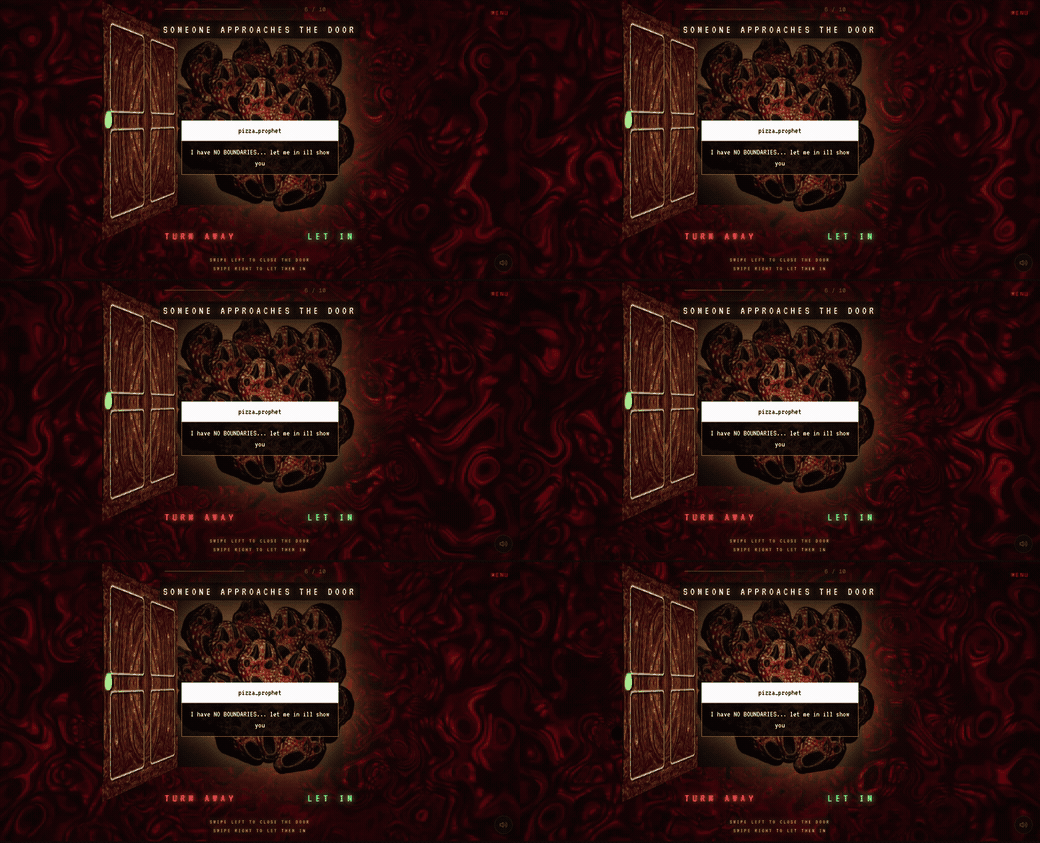
“In the beginning, there was no door,” opens Brathwaite-Shirley's short game. And then one appears. Because that's all that it is: a single object that, on the other side, awaits a host of creature-posters who present themselves behind usernames like SAY IT LOUD and iAmCringe800. They run the ideological gamut, from those looking for safety to those actively seeking to cause harm, much like, well, the actual internet.
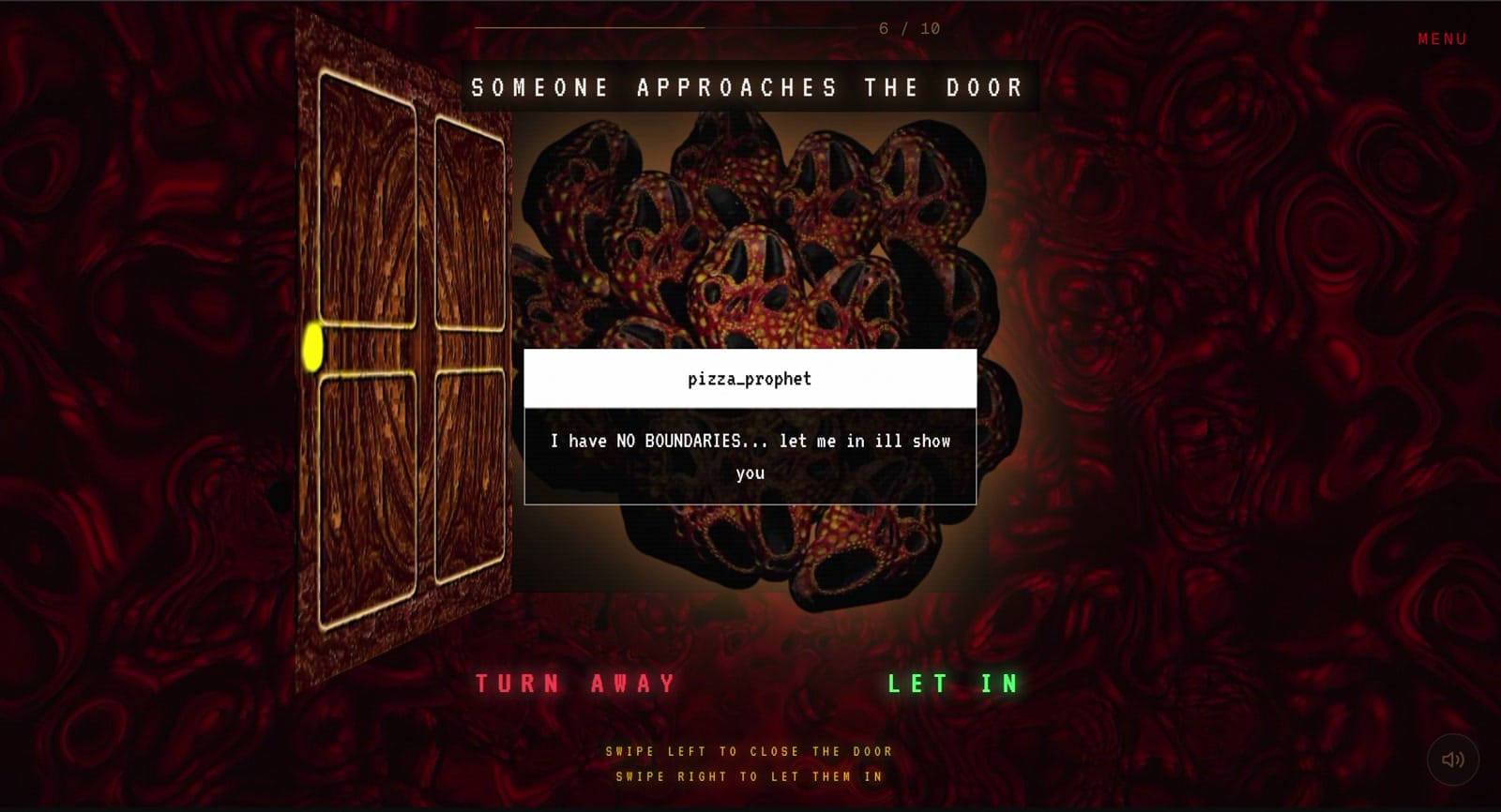
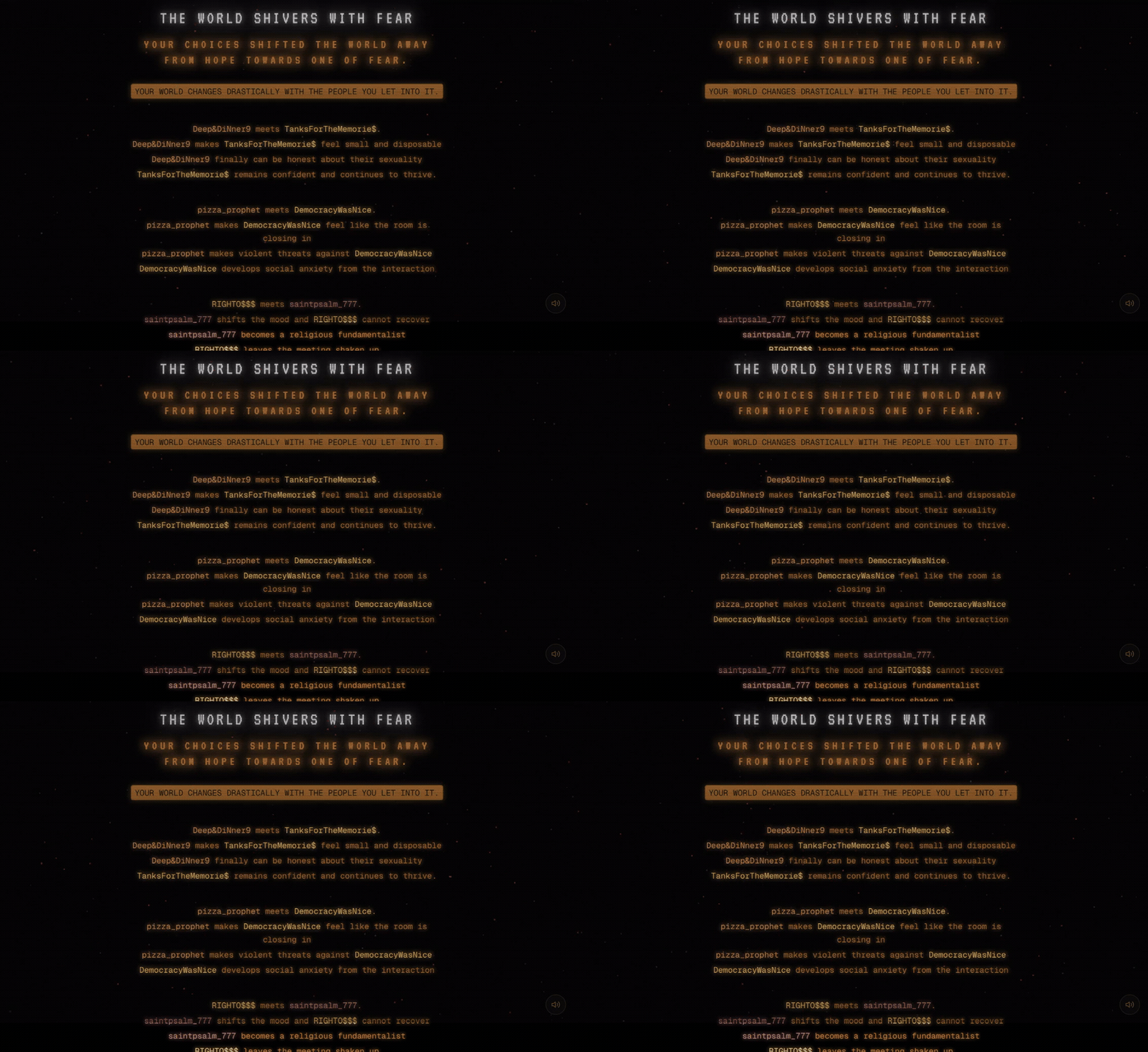
At the end, you're presented with a miniature ant farm that shows how your cohort fares and tells a little story through their interactions. You've chosen each ant individually, and perhaps they're different species? In one of my playthroughs, my entrants vacillated from working out their sexuality to making violent threats to finding God. It's worth writing down who you let in and why, before re-evaluating your decisions. One character presented as a free-speech die-hard, only to be sent cowering after a fierce argument.
The original context for I Didn't Realise is the gallery, as it was first shown at her solo exhibition The Delusion last year. Across several rooms modeled as a haunted house revival of her grandmother's home, the Serpentine show gathered up the concerns of the work that came before it: THE SOUL STATION (2024), her rethinking of the fabled nightclub Berghain as a post-abolition universe, and Black Trans Archive (2020), the archival work we featured in 2021. I, like most people reading this, wasn't able to make it to London for the Serpentine show, so as the work now travels online, the question becomes what changes when the context does.
Much of Brathwaite-Shirley's work centers on creating a type of emotional discomfort in players, usually by asking them for anything from something as simple as their name to a deepest, darkest desire. “I always say I'm in the business of emotions,” Brathwaite-Shirley has said. “The audience is my main medium.” As some, notably the reviewer at the Guardian, missed, the play at work is not simply the asking of the questions. It's who is there to witness. In Shared Fantasy, his ethnography of tabletop role-playing, Gary Alan Fine identifies three simultaneous frames we occupy when we play: the player (your real-world social identity), the game (its rules), and the character (the fictional role). In I Didn't Realise, Brathwaite-Shirley keeps the game and the character fixed and instead removes the observer, letting you play as a truer version of yourself.
One of the big challenges for queer games after Gamergate was that so many games made for small communities attracted global audiences. And cisgender players, for example, burdened those games with the impossibility of asking someone to truly imagine what it might be like to be queer, a question the games may not have been intended to answer. Early work in the field, like dys4ia, “allowed cisgender game fans to imagine they were closer to trans lives than they truly were,” media scholar Teddy Pozo has argued.
Brathwaite-Shirley elides the question entirely. You don't simply need to ask someone to walk a mile in another person's shoes. You just need to ask them the right questions. You don't need to be someone else. You simply need to be who you are, whether the world knows it or not.