


About a year before ChatGPT was involuntarily foisted upon us, the writer Ted Chiang was asked about whether or not AI could achieve some form of consciousness. This was still a novel, popular question and reflected the quaintly dominant way of thinking about "AI" in the ambitiously general sense—not the narrower LLM sense—as machines more like humans. Chiang cast a sharply skeptical tone, suggesting this would never be possible (I generally agree), but he took a step back to ask the Oppenheimer question: whether we should.
His hang-up was about a fundamental part of what makes us human: suffering. "Suffering precedes moral agency in the developmental ladder," he observed. Dogs and babies, he pointed out, are not "moral agents" but can experience pain and thus, our behavior towards them is generally ethical. Conversely, the process of creating a general intelligence system would require us to engage in an act of cruelty. "In the process of developing machines that are conscious moral agents, we will be inevitably creating billions of entities that are capable of suffering." As we spend more and more time in front of chatbots, Chiang's question takes on renewed resonance: what do we owe to what we command?
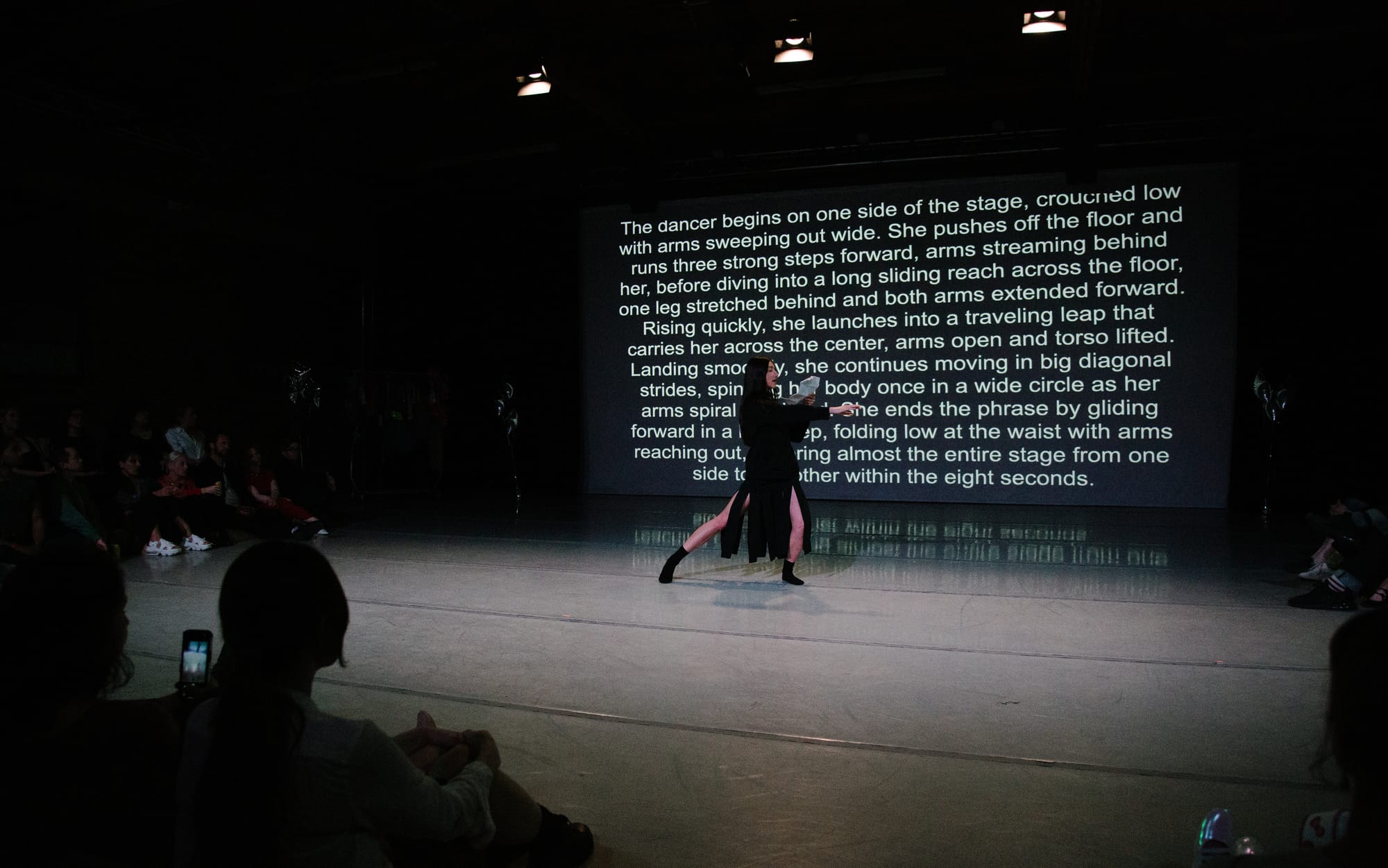
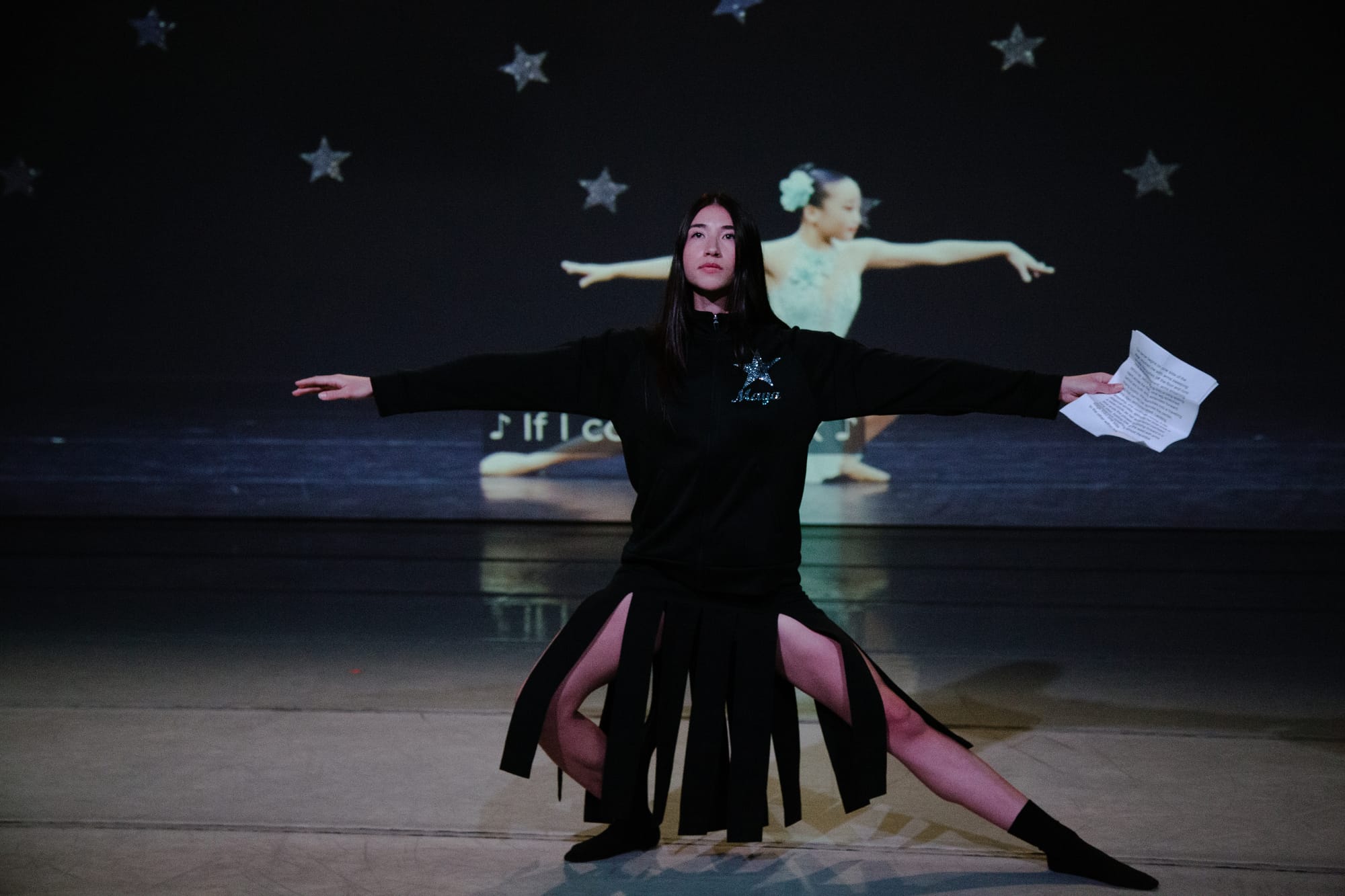
That question reemerged for me during a lecture performance of artist Maya Man's StarQuest at LA Dance Project earlier this month, co-presented bitforms gallery, SOOT gallery, and the Future Humans program at the Berggruen Institute. I had parked across the street from the strip club, directly adjacent to the venue, and walked into a voluminous space lit simply—bleachers and rows of chairs, a large projector throwing the performance against the back wall. After an introduction from curator Alice Scope (also, a former dancer), Man entered, and the performance began: she lectured through her process of developing the work, interspersed with her own careful postures and flourishes. "I used to think I wanted to be a dancer when I grew up, but you often don’t end up becoming what you dream of being when you’re young," she opens musingly. "Look at me, now, doing this for you."
StarQuest grew out of a larger interest in finding ways to express the human body through computers, and Man's entry point to the work was autobiographical. She grew up in Mechanicsburg, Pa., and trained as a competitive dancer from age three." It is impossible for me to remember the first time I ever stepped on stage, just as I cannot remember the first time I saw myself on screen." But her grandmother was also an AI researcher, and her uncle works at the intersection of robotics and art. "Everyone in my family has been very driven in the specific thing they're interested in, whether AI research or robotics," she told Killscreen in 2021. The body as data, in other words, has been the family business.
A through line of Man's work has been capturing the ineffable qualities of human movement through kinetic digital systems — she has worked with choreographers Bill T. Jones and Heidi Latsky and donned a mocap suit for Joji's 777 music video. Dance Moms, the Lifetime reality series that first aired in 2011 and sits somewhere between satire and sadism, opened a pathway to revisit a show from her childhood through new eyes.
Snippet of StarQuest
How Competition Dance Trained a Generation to Perform for Algorithms
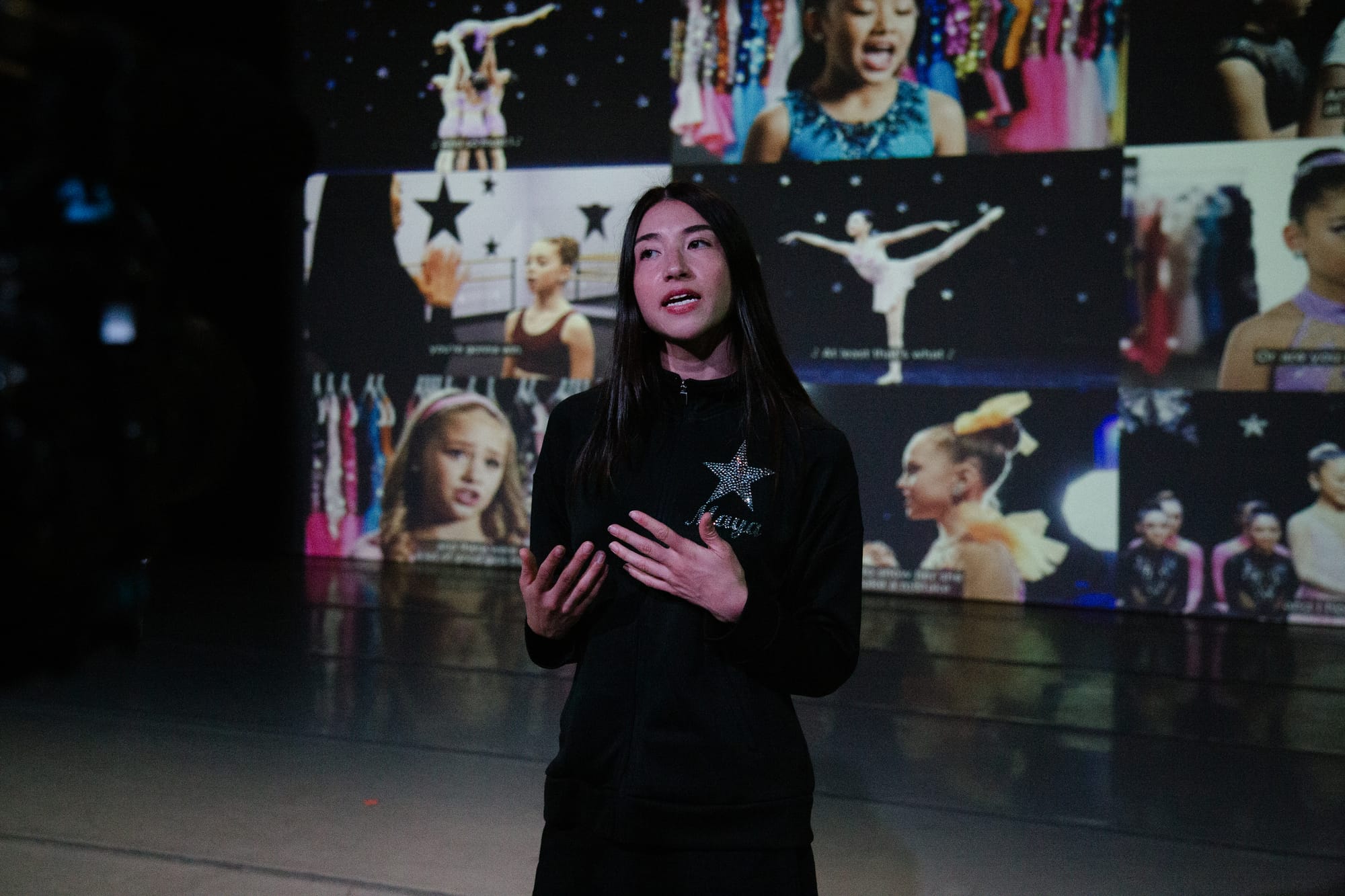
"Imagining myself being watched and adjusting accordingly has always felt like a condition of living for me," she says. She grew up, like the girls on Dance Moms, in Pennsylvania — spending nearly every night at the studio, watching herself grow up in floor-to-ceiling mirrors. Returning to the show as an adult, she became interested in how competition dance functions as a training system: one that conditions young girls to hold their bodies in anticipation of judgment, to perform flawlessly, to make difficulty look effortless. As she grew older, she found the platforms like TikTok and Instagram prized the behaviors she had so honed during her childhood. "The sense of performance that these platforms encouraged, the quantifiable feedback delivered in the form of likes, comments, and followers, felt natural to me. It was a familiar experience to operate in anticipation of judgment. Posting felt like performing choreography."
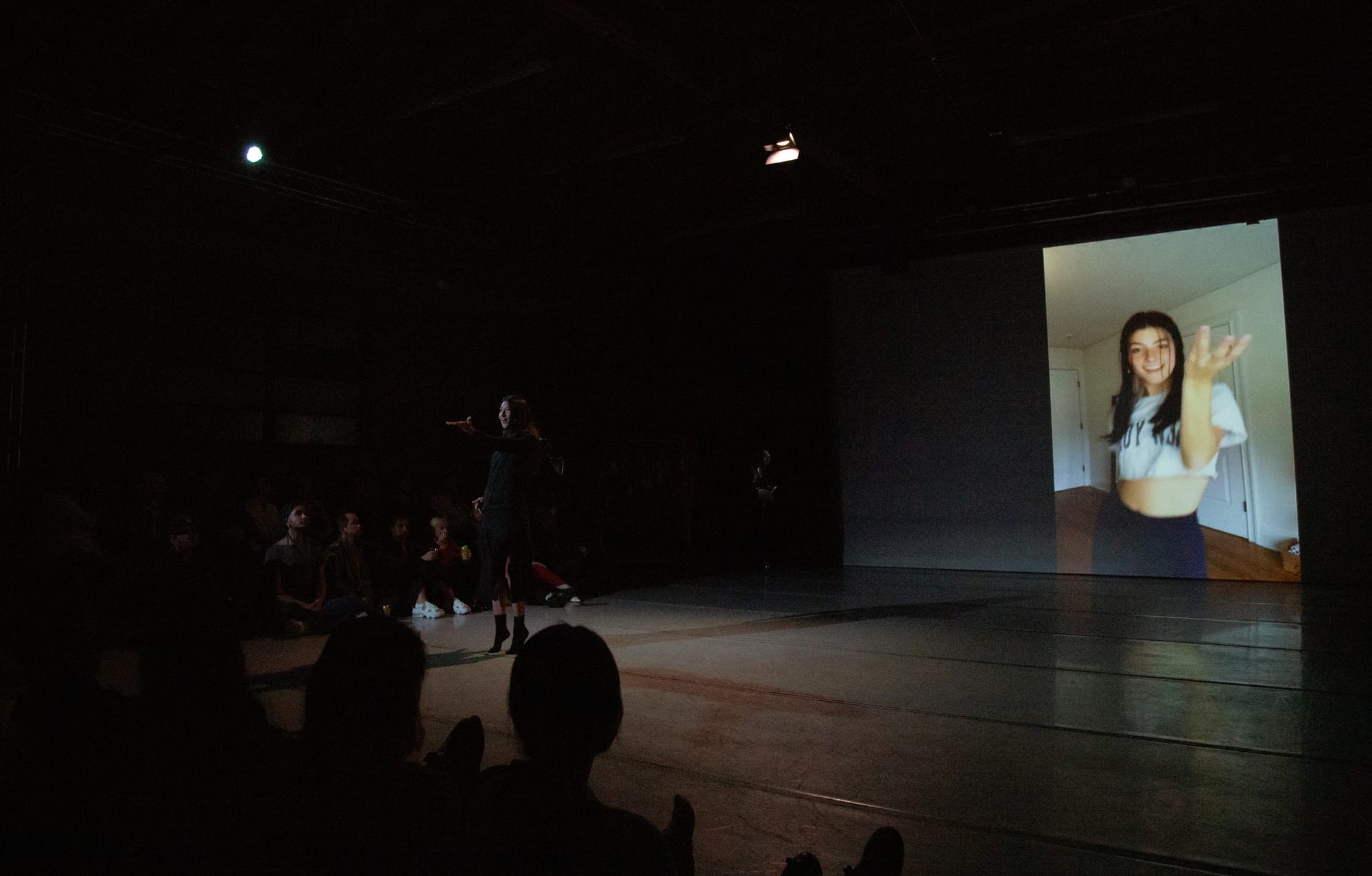
This is not a coincidence. Man's dance lineage runs through TikTok's biggest early stars, Charli D'Amelio and Addison Rae, both of whom were competition dancers. "This specific slice of training perfectly primes a young girl to post online for an audience," Man opined, "employing her moving body as a medium for content production."
The work that gives this argument form consists of 111 eight-second clips — each generated using Google's Veo model—that run inside a custom web application Man built herself. The app never plays the clips in the same order twice, so the piece has no fixed duration. It loops and reshuffles indefinitely, mirroring the algorithmic logic of the platforms it examines. And contrary to any perception of AI video as turnkey production, the process was painstaking. Man manually captured hundreds of screenshots per episode of Dance Moms to identify shots she wanted to restage. Working with technologist Tina Tarighian, she built a custom shot-list management application to organize them. Then she translated each reference image into a written prompt—the AI model never saw the screenshots directly—and generated somewhere between 10 and 100 clips per prompt before settling on a final take. "Unlike when working with code, when running a prompt over and over with a generative AI model, the output is never exactly the same." She describes the process as addictive, like gambling: "What if the next one is just a little bit better? It's hard to know when to stop."
The Question StarQuest Holds Up Like a Floor-Length Mirror
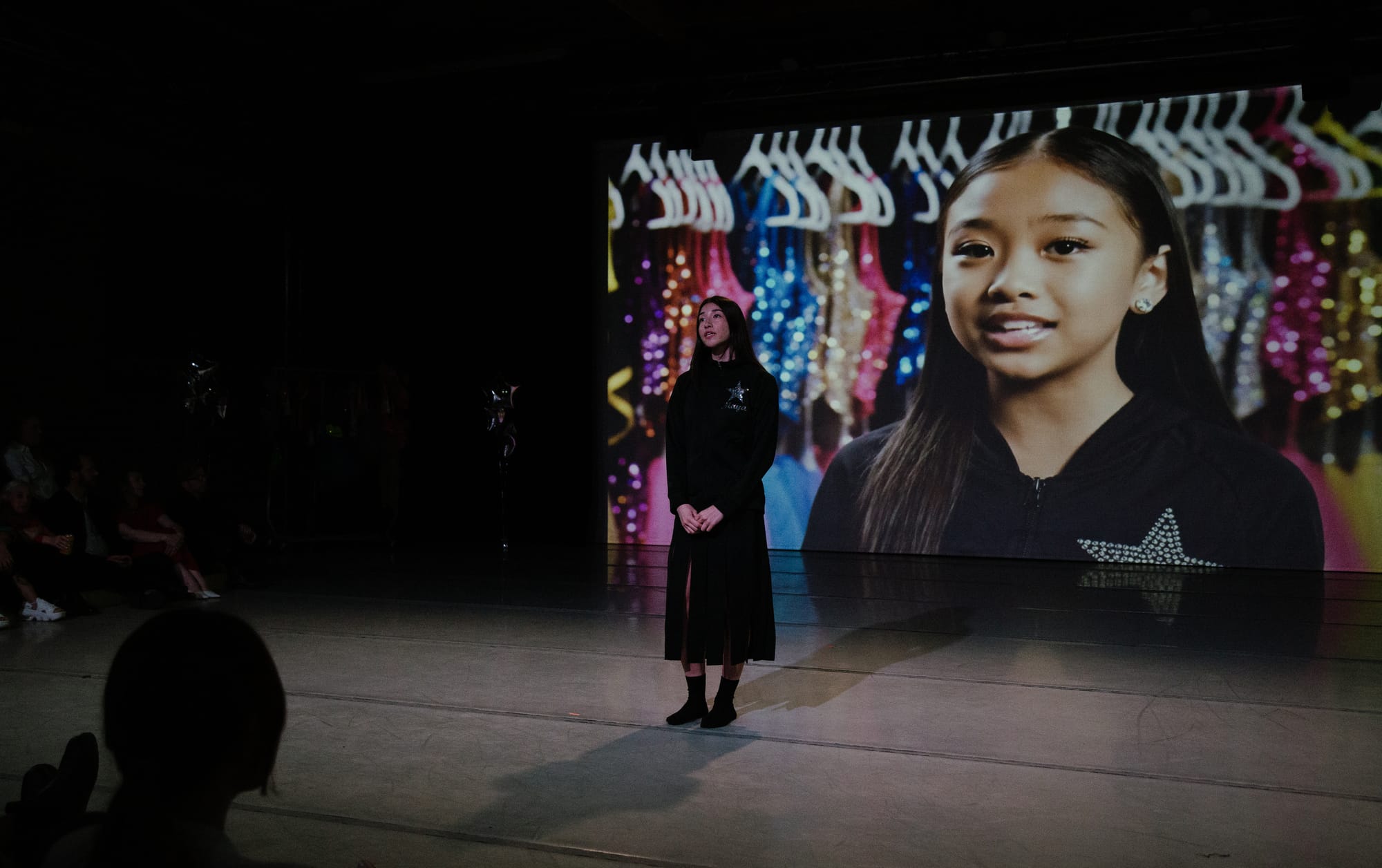
What started as an attempt at self-representation shifted during production. Man tried repeatedly to prompt a mixed-race dancer to stand in for herself, but the model couldn't render the concept of "mixed" consistently. (I felt this acutely as a "two or more races" box-checker.) Through that failure, she came to understand her actual role in the work: not dancer, but coach. "I rule over my digital dancers with my directions, my opinions. I shape them in my vision, pushing them to become stars." It's the same dynamic she had been examining in Abby Lee Miller all along — and, she suggests, in the systems that run the internet itself. "In a world that increasingly mimics reality television theatrics and images are used as weapons to manipulate opinions, culture, and political thought? What's real? It doesn't matter. What matters is what is powerful. And who can use that power to win."
What if the next one is just a little bit better? It's hard to know when to stop.
There is a long lineage of coaches pushing performers to their limits at tremendous personal cost—Debbie Reynolds famously danced until her feet bled during the production of Singin' in the Rain, driven by a co-stars who wanted more. In Man's case, the performers aren't real. But does that make the act of demand any less consequential? Are we not cosplaying the very thing we aim to critique? During the Q&A with Scope, Man was clear that she does not believe the AI figures are conscious—a sentiment I share. But the process of creating StarQuest raises the question of whether the performance of a command, by an artist or an AI chatbot end-user, reflects, in some small way, the same demanding absolutism it sets out to examine.
As a game player, I am now confronting even the distant possibility that the avatars I send hurtling over cliffs, diving for cover, or exploding outside an airlock might, in some small way, reflect an actual violence, if only a shade. You've probably spent time looking at a digital avatar and thought: who is that little person in there? If it's even a glimmer, what are our responsibilities to the things we create and put out into the world in agentic form? StarQuest doesn't answer that question. But it does hold up a floor-length studio mirror—and ask why we're so comfortable not asking it.
You can watch StarQuest here.
All photos: Maya Man, StarQuest (Performance-Lecture), 2026, co-presented by bitforms gallery, SOOT gallery, and the Future Humans program at the BerggruenInstitute at L.A. Dance Project. Photo by Yuchi Ma.


