Christian Marclay's The Clock is a game of looking
Twenty-four hours of film assembled entirely from clocks, and the behavior it produces is not watching at all but sightseeing, closer to a game than cinema.

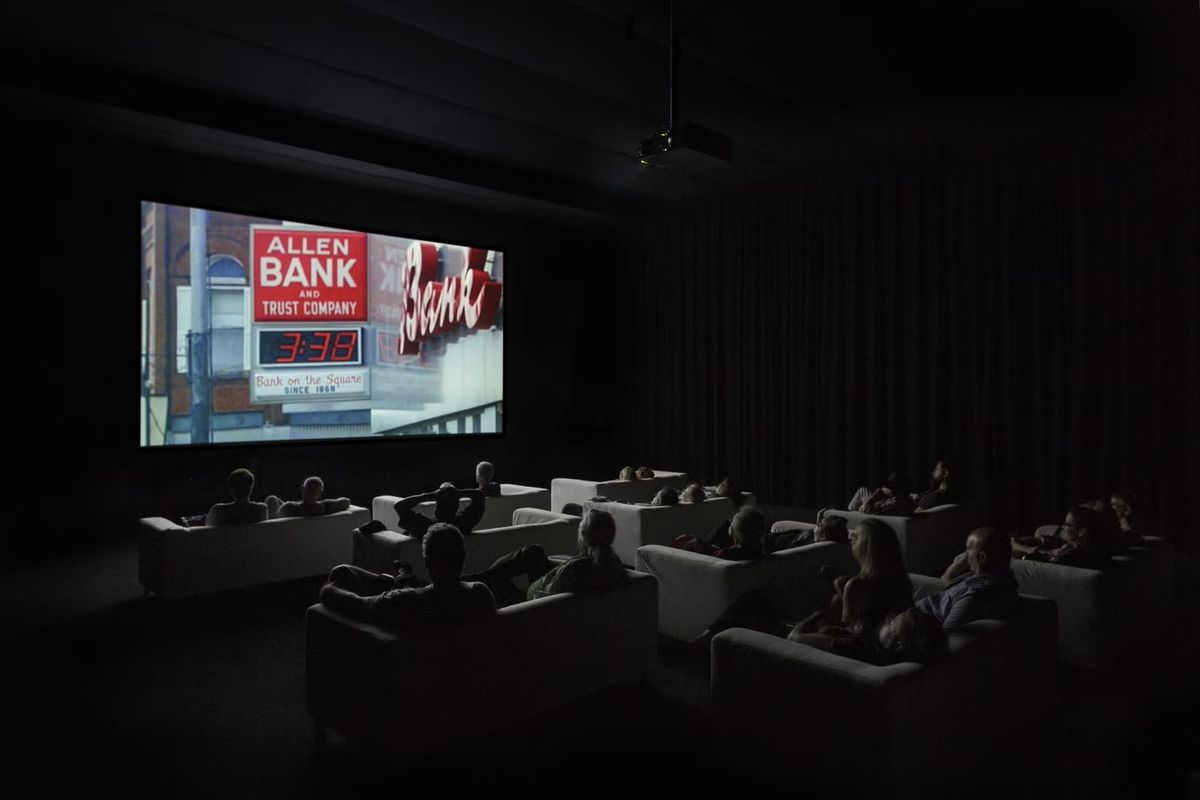
Last week, my friend Alex Porter asked me if I wanted to stop by Christian Marclay’s seminal 2010 film The Clock at LACMA before it closed this past Sunday. I say “stop by” because you can’t really view the entire work in full, even if you wanted to, as it’s a full 24 hours long. Marclay stitched together sequences that show time in motion, in conflict, in dissolve, and in relief, from decades of films. The throughline: every sequence takes place at the exact time in the film as in real life. So when Lee Van Cleef checks his watch in For a Few Dollars More before his shootout, the time reads at 5:38 PM, exactly as it was on mine. (You can see an unofficial attempt at a full list here. It’s nuts.)
It is a bit of a gimmick, admittedly. A bit of a durational free solo, a Herculean effort. It’s also a reminder of the power of curatorial labor at a time that so much of that now goes to AI systems (one can imagine the skepticism around a film like this being released today). But the feel is affecting as time dilates and you settle into a routine of one scene washing over another. “That’s what you’re supposed to do — let go and absorb it and feel like you’re part of this thing,” Marclay has said.
But I read The Clock slightly differently—it’s a fundamentally ludic experience in film, unlike others I’ve experienced. Typically, the “games in film” conversation that Danny and I had the other week focuses on two veins: adaptations or mechanics. Adaptations, you know well, but there are others such as Edge of Tomorrow or Backrooms that take the conventions or philosophies of games to apply them on-screen. Doug Liman’s Edge of Tomorrow (based on the 2004 Hiroshi Sakurazaka manga) hurtles Tom Cruise from one death to another, mimicking the skill acquisition process for games, while Backrooms focuses on clipping through digital surfaces.
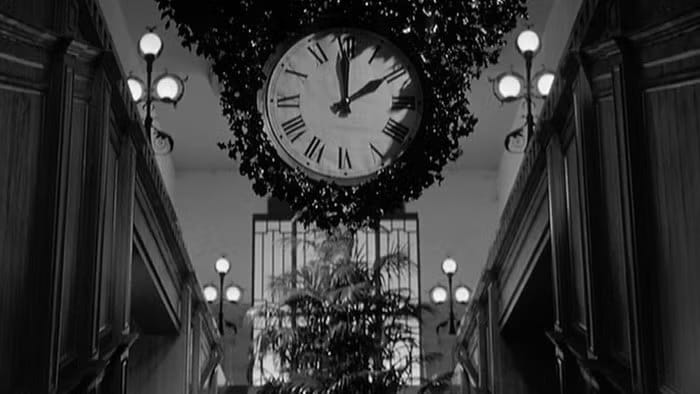
The Clock is something altogether different, in that the behavior that emerges naturally is one of sightseeing. (“It’s like Where’s Waldo,” Alex joked.) Sometimes the many clocks, timepieces, stopwatches, and cuckoos obviously draw attention to themselves, but sometimes it’s more oblique. Roy Hobbs obliterating the clock at Wrigley Field with a home run is not subtle; two sequences from The Man Who Wasn’t There missed me entirely. Your mind is in tension between what the film asks you to do (look at the time) and what the limbic relationship to moving image requires (look at everything else).
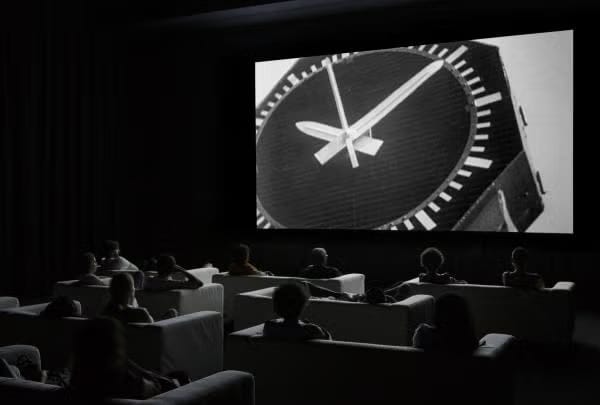
The result is truly mesmerizing. Freed of the responsibility of paying attention to plot, mood, sound, or set, I found slipping into time dilation easy as each sequence bounded into the next, leaving me to decide exactly when I wanted to leave. But this runs counter to Marclay’s attention; it was a wholly lean-in experience that pulled me to interact, not to release. It’s a feeling typically reserved for games where my sense of space can also wander, but unlike any I’ve had in a theatre. By 5:40, Napoleon Dynamite cued, and I was ready to grab dinner, knowing it would be a while before I spent that much time with a watch face again.