Travess Smalley's pixel rugs get a fluorescent monograph
Vetro Editions prints 192 pages of generative weaving in UV-reactive inks, with essays by Casey Reas and Anika Meier.

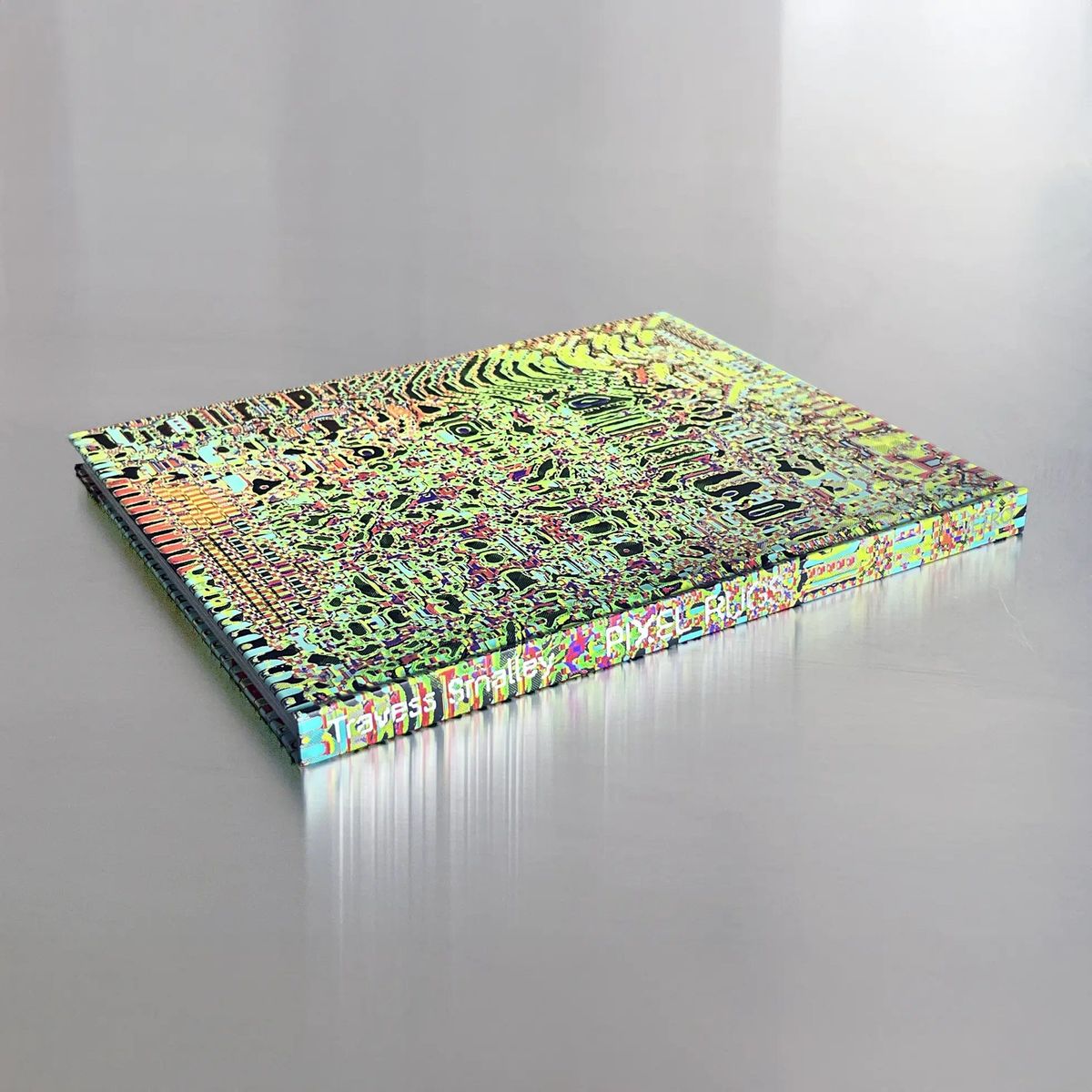
Pixel Rugs is a book that glows. Travess Smalley's first full monograph, out now from Berlin publisher Vetro Editions, collects the artist's generative “rugs”—compositions built from thousands of colored pixels, layered, tiled, and compressed until familiar patterns break down into something luminous and hypnotic. The publisher printed it in Quadrifluox, an experimental five-color offset process using four fluorescent inks plus Pantone 812 C, so the 192 pages hit a neon palette standard CMYK can't reach—and react under UV light— via the announcement
A woven rug and a bitmap are the same data structure—a grid of discrete cells, read row by row—and the Jacquard loom's punch cards are computing's direct ancestor. Smalley has been working that seam since releasing generative pieces on the Tezos platform hic et nunc in the spring of 2021 (the project continues on Teia), and the book traces its evolution through studio sketches and code snippets. Essays by Casey Reas, the Processing co-creator, and curator Anika Meier situate the work beside Harold Cohen's plotter drawings, the procedural maps of early roguelike games, and Op Art's optical buzz.
That roguelike citation is the part I'd underline. A dungeon generator and a rug generator are both rule systems throwing patterned variation at a grid, and the pleasure of both is watching constraint produce surprise. We've argued before that low-resolution grids carry more feeling than photorealism—see how low-fidelity pixels expose games' emotionless arms race. Smalley's rugs make the case in fluorescent ink: the pixel isn't a limitation to escape but a thread to weave with.
Stories that run from the loom to the bitmap and back are exactly the Killscreen beat. The free weekly newsletter brings you the next one.
![The Dating Sim That Won't Tell You Why [Podcast]](https://storage.ghost.io/c/25/84/2584b75d-4bd6-4cce-8259-f1d1c65abbb5/content/images/size/w600/2026/10/02c_last-call-for-the-redding-district_yee_npc-what-color.jpg)