Timur Si-Qin scanned an Amazon ecosystem into sculpture
Mariposita rebuilt a Renaco tree and its pond at full scale for Art Basel Unlimited—photogrammetry turned into an act of devotion.

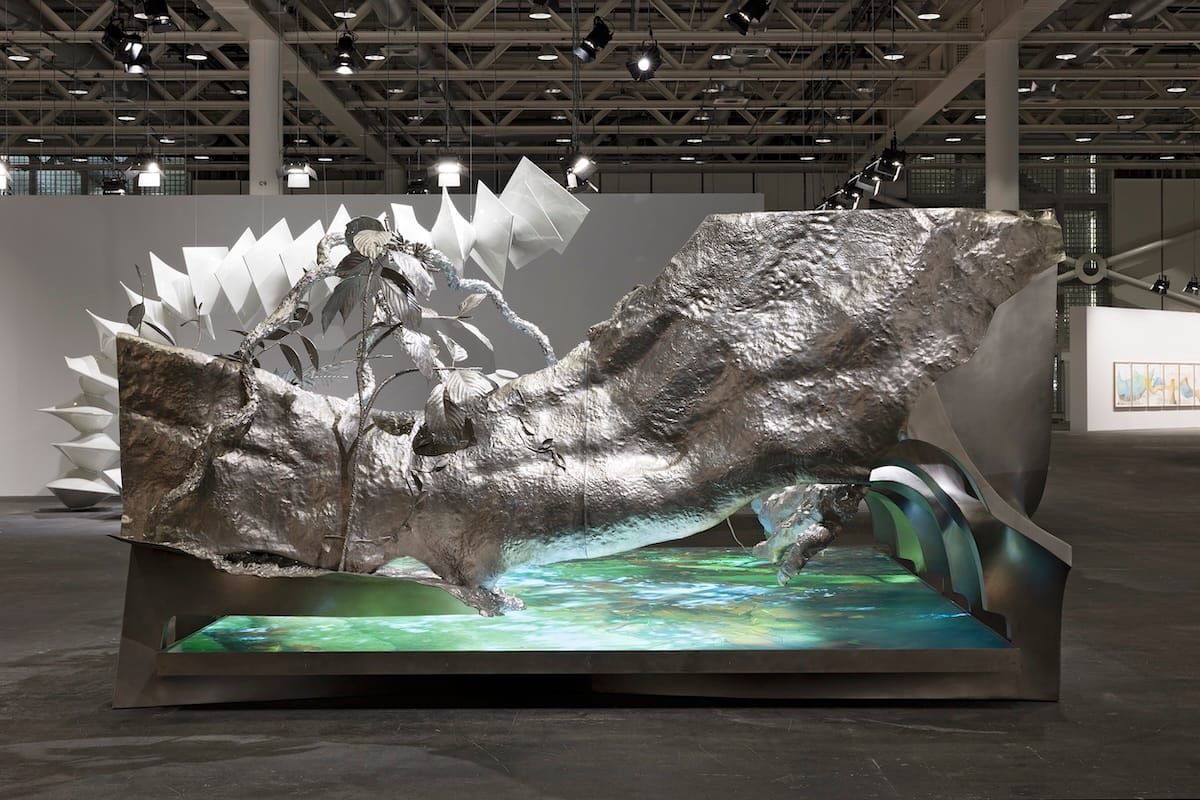
Timur Si-Qin returns to the Peruvian Amazon every year. On the most recent trip, one encounter—a Renaco tree and the pond it stands in, in the Ucayali region—became Mariposita, the installation Société brought to Art Basel Unlimited this June: roots, insects, water, plant matter, and reflected light translated into a sculptural environment at the scale of the living original, 4.4 by 4.2 meters across and 2.2 meters high. The gallery's announcement put the method plainly: to mirror is to name, and to name is an act of devotion. The work showed June 16–21, realized with Magician Space and the support of the Sigg Art Foundation.
What interests me is the pipeline. Si-Qin works almost entirely digitally, building sculpture out of photogrammetry—photographs from many angles resolved by software into three-dimensional form—the same scanning technique that puts photoreal rock faces and forest floors into every big-budget open world. “The ecosystem became more than a subject; it became a kind of guide,” Si-Qin said in an interview with Whitewall during the fair. Games mostly use these tools to turn nature into backdrop. Mariposita points them the other way, treating technology as an extended expression of the species—no more opposed to nature, Si-Qin argues, than a seashell is opposed to the sea.
Si-Qin has spent years arguing that Western culture lost nature at the center of its spirituality, and the tree sculptures are attempts to rekindle it. It's the question David OReilly's Everything asked from inside a game engine, back when we covered an open-universe game about the nature of being. Rendering the living world in full detail can be extraction, or it can be attention. Mariposita bets on attention.
Killscreen covers the places where games’ tools turn up everywhere else—art fairs included. The weekly newsletter is free, and it’s the best way to follow along.
![The Dating Sim That Won't Tell You Why [Podcast]](https://storage.ghost.io/c/25/84/2584b75d-4bd6-4cce-8259-f1d1c65abbb5/content/images/size/w600/2026/10/02c_last-call-for-the-redding-district_yee_npc-what-color.jpg)