
Calling Off the Engagement
How a zombie game pulls me in and pushes me away
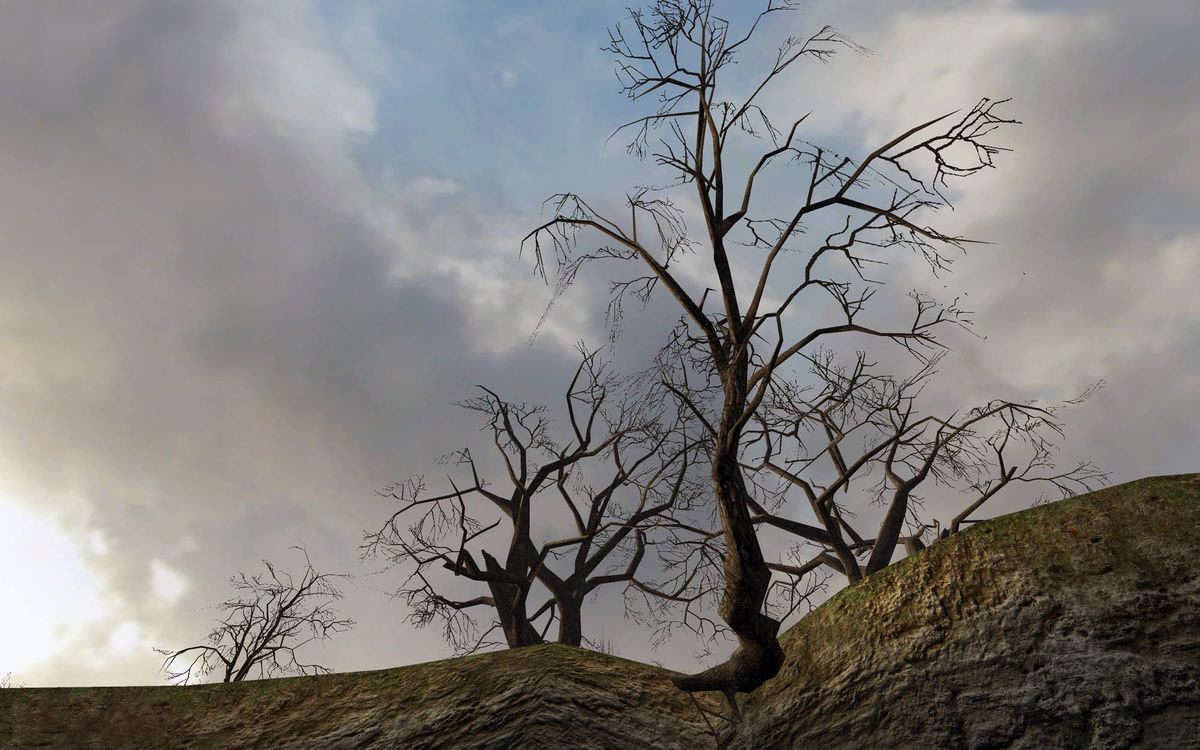
I am sitting on a blue couch between two poles of light. To my right, the afternoon sun enters a window, outlining details in the room—the wooden grains of a shelf, a hair on the kitchen table. The sunlight is cold and blue. To my left, pixels burn Left 4 Dead 2 onto the surface of my small HDTV. The screen shows bullets, blood, and bile lit through green smoke by flashlight. The light feels warm.
High-definition technology leaves no room for ambiguity. It’s rigidly precise, drawing trees and steel girders and a curve of musculature as actual things seen through a window, rather than abstract shapes generated by a machine. In years past, the viewing surface of a cathode-ray tube was curved, as if to emphasize the profound distance between your physical eyes and the digital image of the game. This was a distance that you nonetheless found yourself able to close. The HDTV seems to press the game to the surface so that its pixels are seen at full intensity, reflecting the superfine clarity with which every element is conceived and rendered.
They call that immersion. But the less ambiguous the three-dimensional image, the more paradoxical its flatness—especially an image that has literally no boundaries, whose shape shifts to allow movement into it. The screen wants to be more than a window; it must invite you into itself like a portal, though it disappointingly remains a vantage point. This sets you at a permanent distance. When I play L4D2, my awareness of my real-world surroundings ought to melt into the shape of my character like hardened wax. I should look directly through her eyes and perceive only the bodies, architecture, and atmosphere of the game world. Instead, I sit on the blue couch and watch her world pretend to move.

![Riding a Bike Through San Andreas [Podcast]](https://storage.ghost.io/c/25/84/2584b75d-4bd6-4cce-8259-f1d1c65abbb5/content/images/size/w600/2026/08/brunoabib_films_mea-02.png)