What Does Grand Theft Auto Do When No One Is Watching?
Everyone logged off. The hiker kept walking.

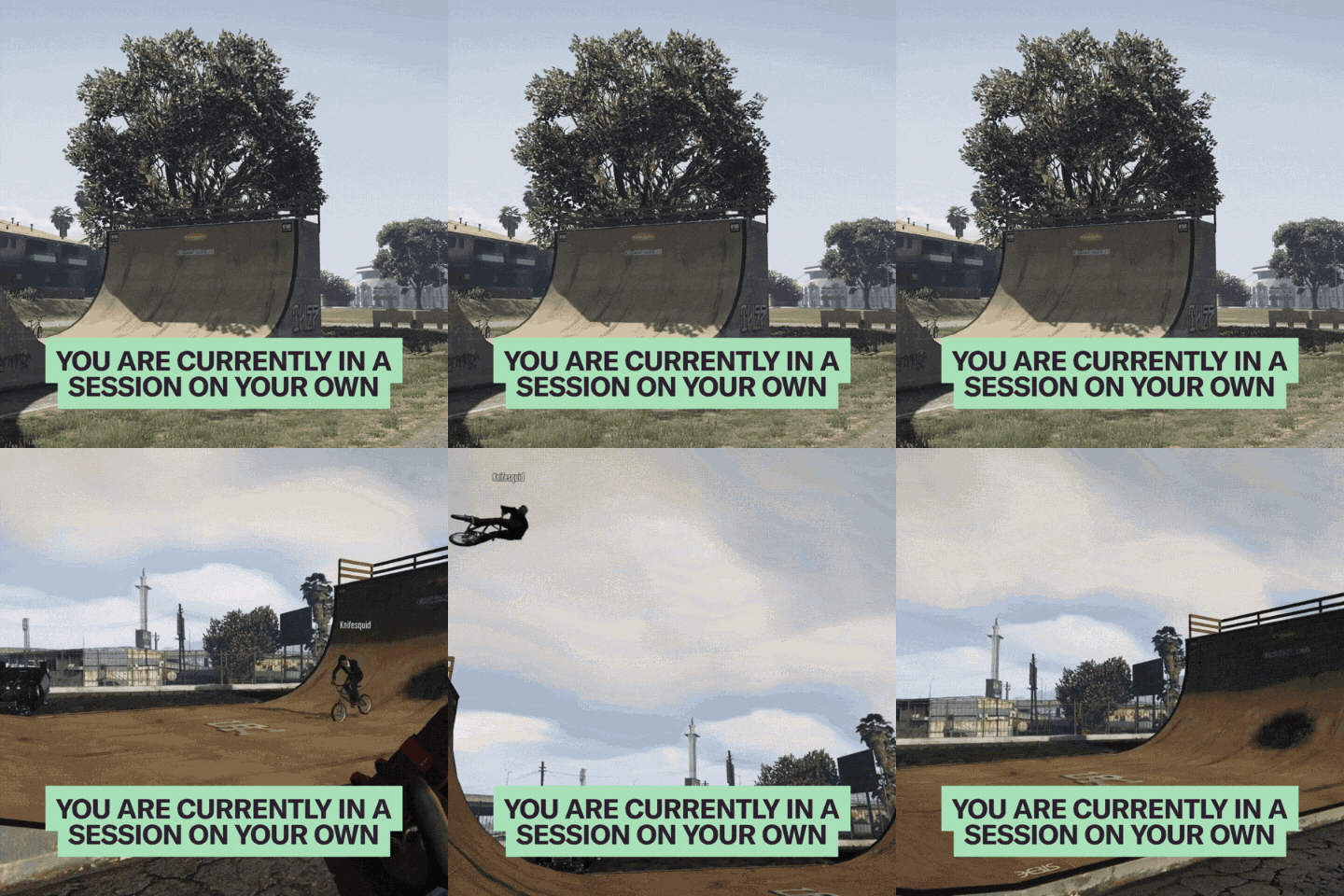
Playlist 293
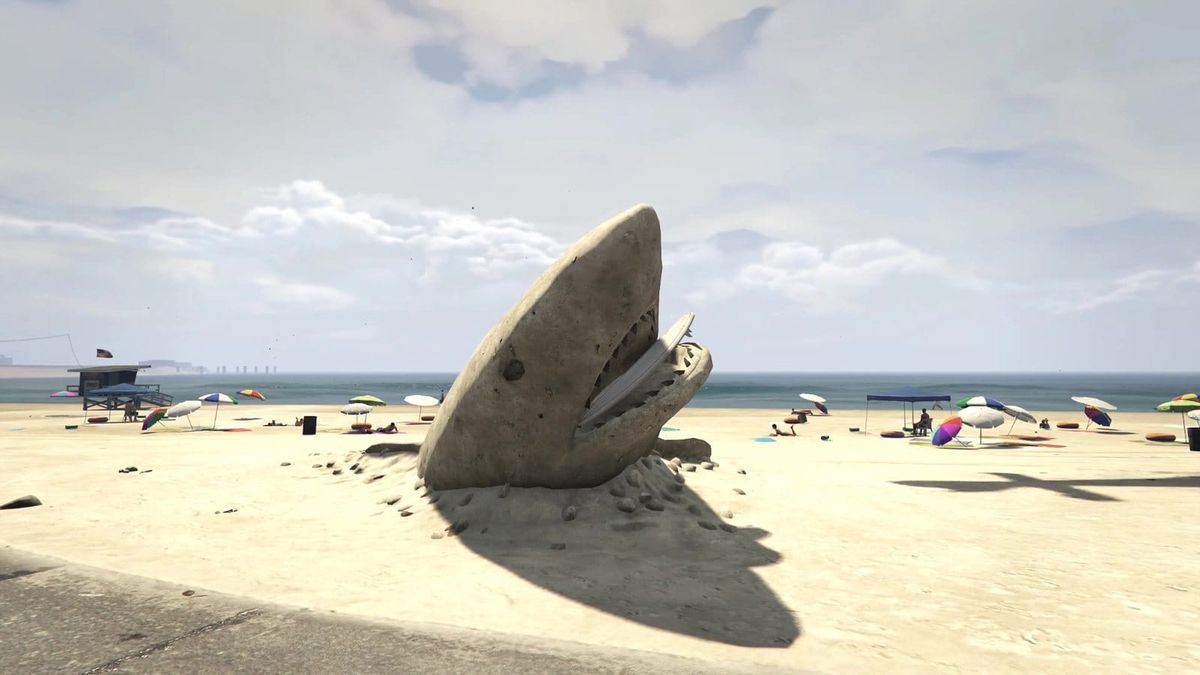
You Are Currently in a Session on Your Own (2026)
Kent Sheely
Play Time: 9 minutes
I feel like I have nothing really interesting to say about Grand Theft Auto, since I've been living with the franchise my whole life. Each new entry boasts a grand (har har) new city with roughly the same style of play: driving and shooting. I'd argue most of us know what to expect. In perilous times, repetition offers some comfort, even if we only see a new title every decade or so. Even so, as someone interested in experimental and independent game culture, I'm more interested in the game itself as a canvas, a place to be distorted, contained and shredded.
So finding a new way to approach the world is quite difficult, especially for artist and filmmaker Kent Sheely, who has been working in game worlds since 2006. For most of the last decade, his working material has been Grand Theft Auto Online, the initially bug-ridden launch of a virtual world that became so successful that it functions as a piggy bank for the GTA parent. Sheely has logged something like 3,000 hours in it, most of them running heists with a rotating crew of friends.
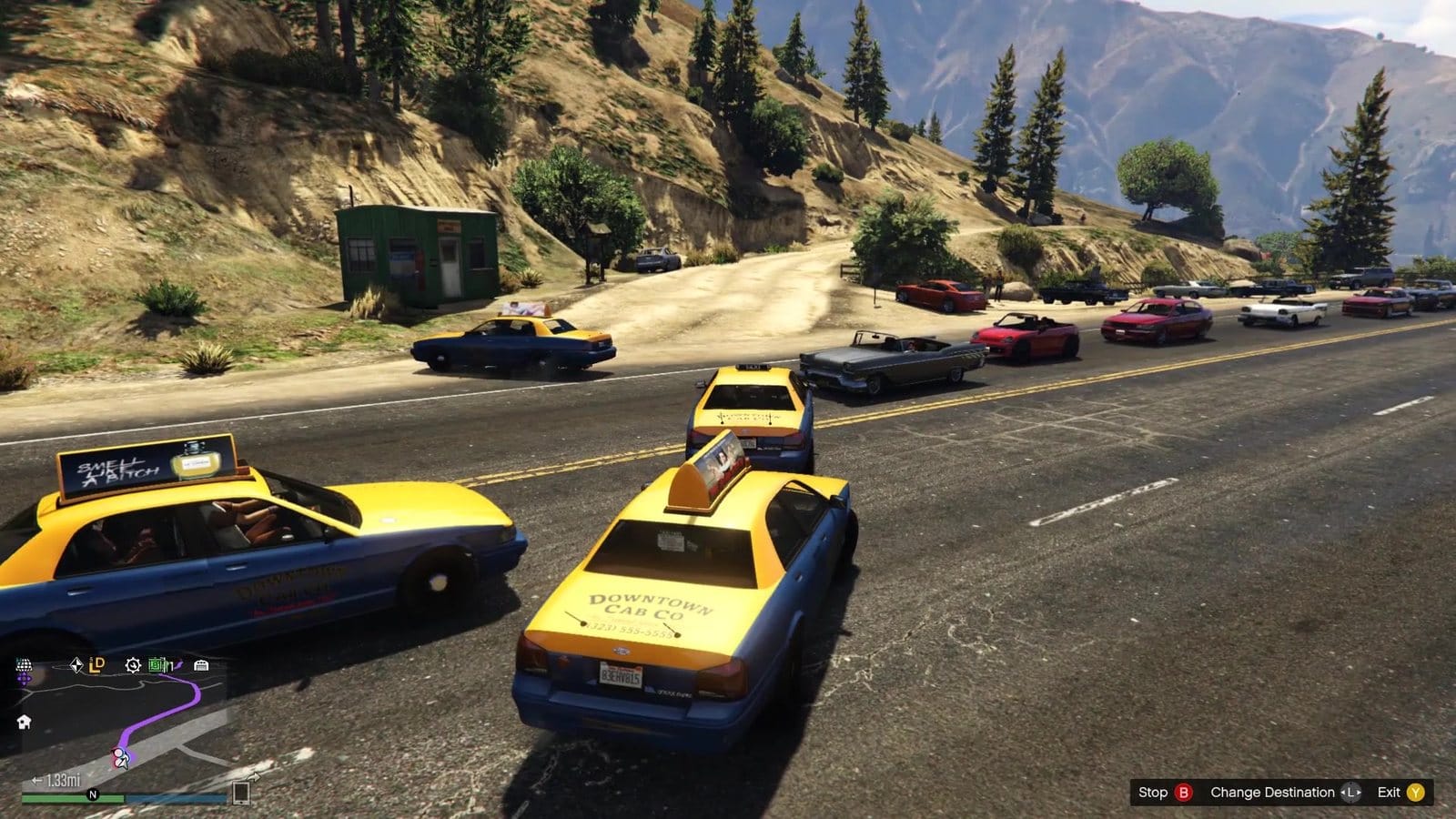
His new work, You Are Currently in a Session on Your Own, is named for the message the game shows when you load into a session with nobody else in it. Sheely tells me there's a bit of a conundrum with GTA: play with others and suffer hackers and griefers; play alone, and the generative social dynamics completely disappear. So, the short film inhabits those contrasts with moments of chaotic spontaneity and mirth, tailed by longer sequences revisiting the scenes of the crime when nothing is happening. In one sequence, the crew drops off a sole hiker after a taxi ride, and in the next, back in the same Angeles National Forest homage, the hiker continues her walk, alone, unbothered, but not unobserved.
Sheely and I talk about Los Angeles' addiction to self-promotion, how COVID-era loneliness deeply impacted his work, and what virtual worlds dream about when no one is watching.
There are many online communities, but GTA Online is the one you keep coming back to. How did you first get in?
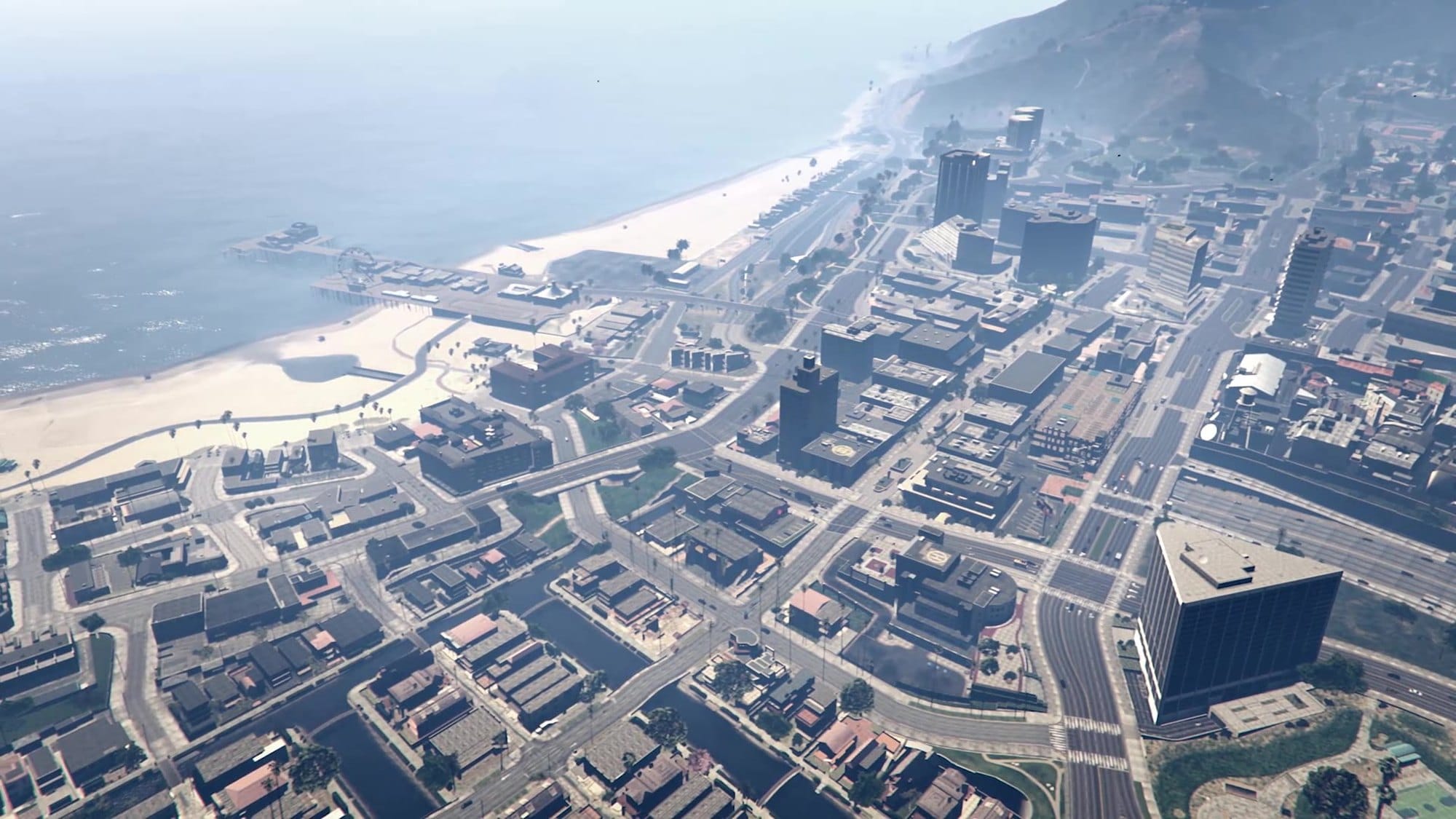
I didn't get on board until I moved to Los Angeles in 2015. I'd played GTA IV when I lived in New York. The GTA games have never been my favorite, but the loop is addictive. What I enjoyed most was wandering places that were simulacra of places I'd actually been. I was learning the map of Los Santos at the same time I was learning Los Angeles.
I had a similar thing. I played GTA IV in New York, and when GTA V came out, I was dating my wife, who grew up in Los Angeles. She hadn't played many games, and she was moved by how much it reminded her of home. Living here now, I get to connect the dots. It's like film. You move to Los Angeles, and certain sequences jump out at you.
There's a great documentary about that, Los Angeles Plays Itself. It's along the same lines as the way GTA plays with space. It condenses things. It designs the map around the landmarks people think about, and the rest is filler. There are back alleys that look like every other neighborhood in Los Angeles, and you maybe visit them once in the story. Greystone Mansion is in the game, but it's mashed together with the Playboy Mansion. I'll still visit a new part of L.A. and think, hey, I've been here.
Leaked footage suggests a map for GTA VI that's significantly larger. Create the place one-to-one, and it gets less interesting. What's interesting are the creative decisions, how you capture the psychogeography of moving through a place. I'm more interested in their approach to Miami than in "we recreated Miami."
That's part of why I'm not as excited about six. I've been to Miami once, and I was at the airport.
There's also a tinge of sadness in how these cities get made now. They send a core team to study a place, but much of it gets built by artists elsewhere working purely from photos. That handcrafted piece is getting less and less important.
You can tell where they spent their time. Santa Monica is a small part of Los Angeles, but it's crafted far more carefully in the game. Some blocks are one-to-one. That's where tourists go.
Be fulfilled by Jane Schoenbrun's TEENAGE SEX AND DEATH AT CAMP MIASMA. By flesh and fluids, and pure filmic pleasure.
Starring Hannah Einbinder and Gillian Anderson, this MUBI Release is bloody genre-bending bliss from the visionary director behind I Saw the TV Glow. Now streaming exclusively on MUBI.
Get 30 days free to stream great cinema like this and so much more.
Let's talk about the piece itself. The title comes from the message GTA Online shows when you load into a solo session. Why start there?
That message comes up when you join a session with no other players. GTA Online became infamous for hackers and griefers. They build a space where they want you to play with strangers, and then you can't accomplish anything, because a plane spawns on top of you or some guy on a flying bike blows up your cargo. The game wants you in a public session, then punishes you for it.
I started playing with friends around 2016 or 2017. We did all the heists together, and people rotated in and out, since a mission only takes four. Then people move on to other games, life gets busy, and you're left choosing between strangers and a bad time, or a solo session. The game wasn't originally built for multiplayer, but it became so much more vibrant with other people. Take them out and it feels hollow, even creepy. Almost a liminal space, before the backrooms co-opted the phrase.
The history matters here. GTA Online was a flop at launch. It was super buggy, and I logged on once and never went back. Since then it's become arguably as successful as World of Warcraft for Rockstar. Usually a game's single-player and multiplayer are different maps, or different products entirely. GTA puts you alone in story mode, alone in an online instance, and with other people, all in the same space.
The clips of other players in the piece are things I captured over the years, and I wish I'd recorded more. It's the same melancholy as wishing you'd taken more pictures with your family. I stood in those same spaces again, and it feels like you're standing in the void. I did want the piece to feel sad, even heartbreaking. But everyone in it is someone I still play games with, just not GTA. When I finished it I told them, I don't want you to feel bad. I'm not trying to guilt any of you into coming back.
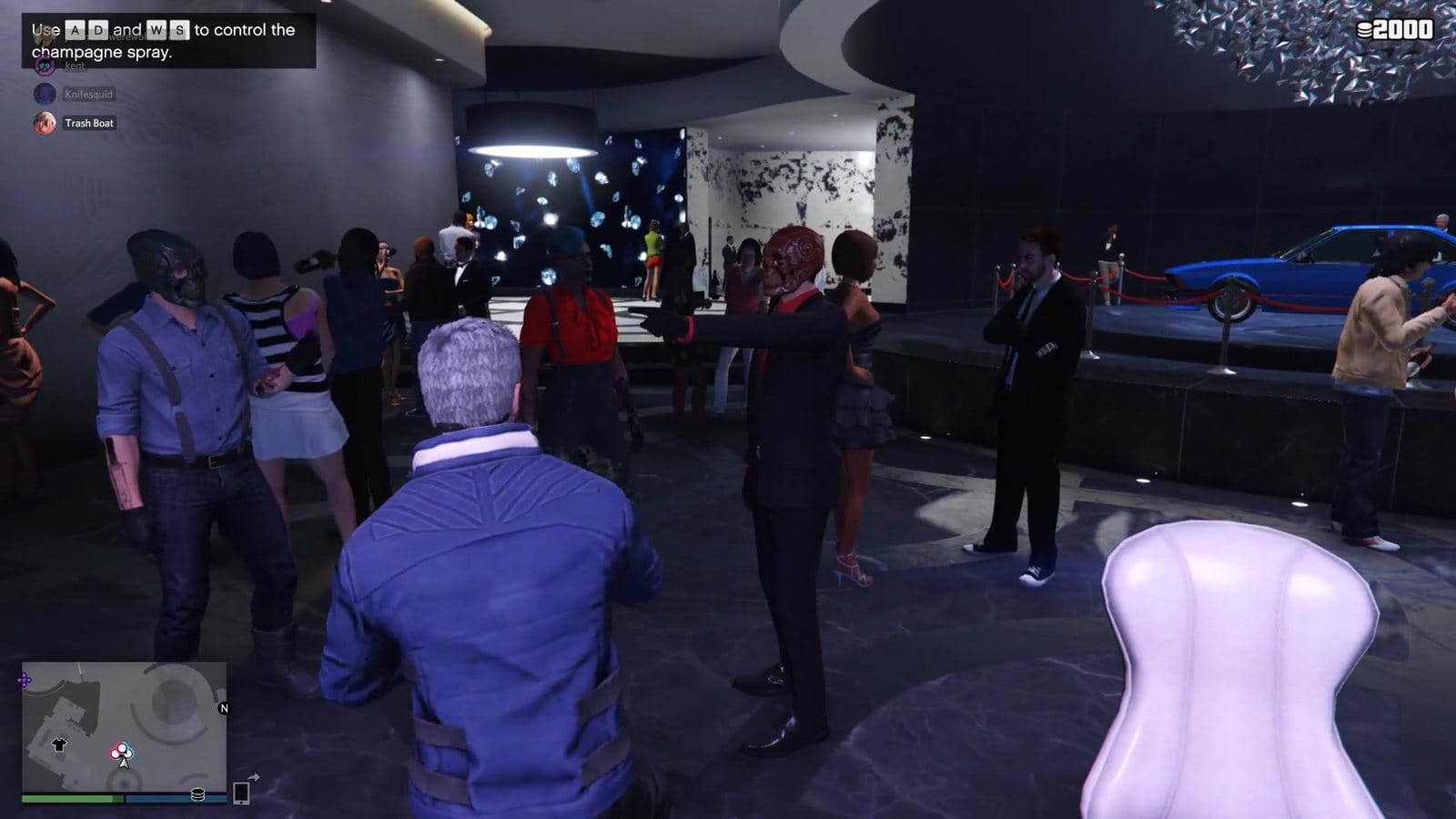
It's a bit like a hiking club. Everybody stops coming, and now you're walking the same trails by yourself. What stood out most, standing in Los Santos alone?
How the space loses its color when there's nobody else there. It reminded me of the beginning of COVID, going down to the beach or the Third Street Promenade and finding it empty. The COVID era informed a lot of my work from there on. I don't think things have come back to normal, and the way it changed the world also changed my practice. That night-and-day shift between the emptiness and the fullness of a space was probably the biggest influence on this piece.
Early in the pandemic, we did a walk in Santa Monica from a book of urban walks, and the quiet was profound. Driving past the TCL Chinese Theatre, I thought this might be the only time in its history it had ever been empty. No performers. Not a single person on Hollywood Boulevard. Extremely disorienting.
Exactly. I made a couple of other pieces about that, and I didn't realize until just now how much it shaped them. In one, I modified the office map from Counter-Strike and filled it with plants, nature reclaiming it.
But a Counter-Strike map left alone is just empty. Los Santos keeps going. There's a sequence where you follow a lone hiker who will keep walking whether you watch or not. Mario will stand on the opening screen forever until you push right. Here the game has its own wants and desires, and it keeps generating the world whether you participate or not. You're watching the machine imagine itself without us.
That shows up a lot in my work. What I like most is rejecting narrative, watching the game at rest, and letting it be itself. One early influence was Miltos Manetas. He has a piece where Mario gets bored, sits down and falls asleep, and you linger on Mario sleeping for six minutes. I'm drawn to the meditative side, basically unplugging the controller and letting the game exist as an object.
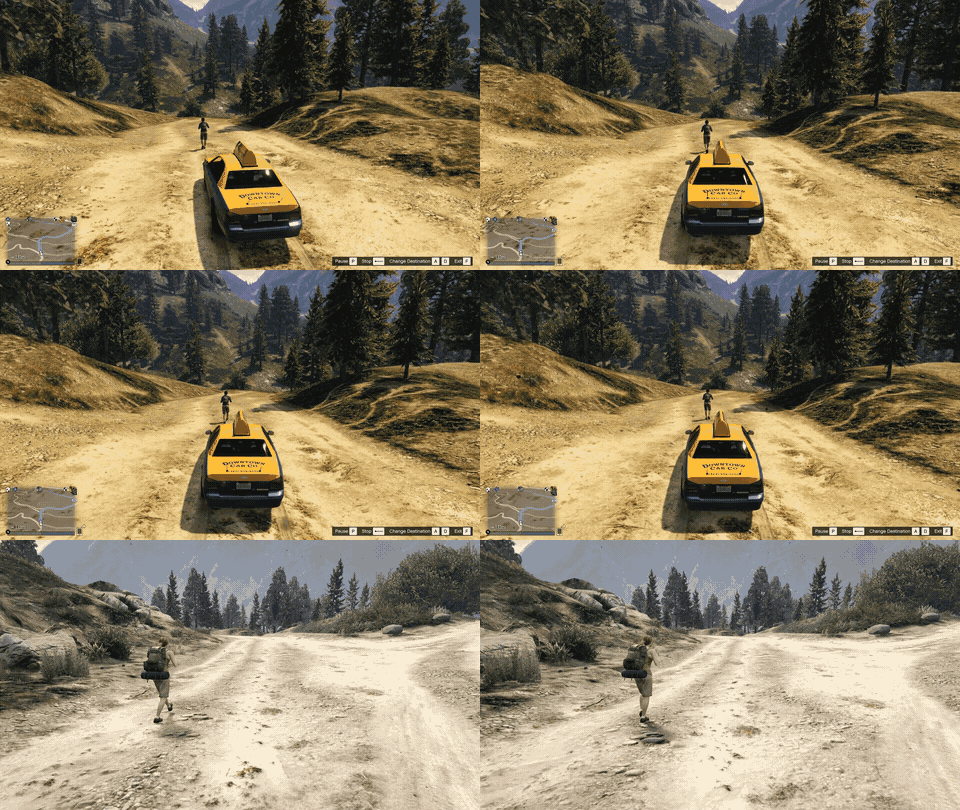
You've said there's sadness in the piece. But the public lobbies were miserable. Is there a reading that's less about loneliness and more about relief? Finally, you can be by yourself.
It's definitely not necessary to read it as sad. I don't like to force an emotion into something. I put my feelings in and leave it open. I've spent so much time making art in GTA by myself, and that's how I am as a person. I like being social, but I need downtime. I'm sentimental because I have great memories of my friends there, but I do enjoy being by myself in games.
How did you build the cut? It moves between impromptu moments, like building a ramp off another car and jumping into the L.A. River, and slow panoramic shots.
First I edited the action as if I were making a highlight reel, picking the most exciting moments and building a rhythm. Then I took the last moment of each sequence, traveled to that spot in the game and set myself up where I'd been when I filmed it. I'd sit with it, look in the same direction the camera faced, then turn around to see what it wasn't seeing. Then it cuts right back to the action. I wanted a staccato, where you get hyped up and then you're forced to step back and take time.
Who else has influenced the practice, from media art or from film?
Besides Manetas, Peggy Ahwesh, who pioneered machinima. Her She Puppet, shot in Tomb Raider, rejects the nature of gameplay. She just moves the character and camera through the space. It's almost like watching someone who's never played a game play the game. Outside games, I couldn't give you a list of cinematographers. But Los Angeles Plays Itself has been a big influence.
The new GTA is coming. Does this close a chapter? Is it an elegy for GTA V?
I was going to bring that up. It's a two-part farewell. There's this, and a photo book called Crime Time: gameplay shots of my friends mixed with glitch screenshots and digital collages. Whenever our friends got together, someone in Discord would say "crime time." The book opens with a collage of every time somebody said it. This video was supposed to be the final thing. Then I went through my old screenshots and thought I could make a book. Maybe that'll be the capstone.
This interview has been edited and condensed.
This week’s Playlist was a free taste: a film built from years of other people’s company, watched after they left. Next Friday’s pick, Messhof’s Blood Dungeon, goes to members only, along with every one after it.
Membership is $55 for the year, locked at that price for as long as you stay. It rises to $96 on 31 December. The first month is free.
Radar is the short one — three news items, every Monday, Wednesday and Saturday. It started in August, after most of you had already signed up, so you were never added to it. Ticking one box fixes that.