Horizons
We’re being conditioned to think of virtual reality as “a new medium,” which it may someday be. In the meantime, developers are trying to transmute all that promise into playable experiences. Here are a few of the most exciting.
Private Eye
Jake Slack
Private Eye wasn’t invented for virtual reality. Jake Slack, a developer from Brighton, UK, originally envisioned certain elements of the game for tablets before he discovered the head-mounted display. In three weeks, he finished a proto-type of Private Eye—his first proper game.
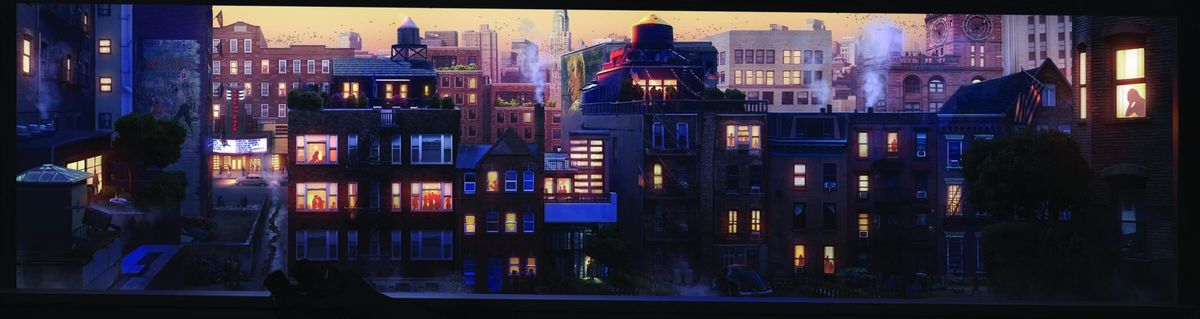
In Private Eye, you play as a 1950s New York detective who’s survived an accident only to never walk again. You’re bound to a wheelchair. Armed with a pair of binoculars, voyeurism becomes your retreat, a means for coming to grips with your situation—and remembering what you forgot through a fog of amnesia. With only a pair of binoculars, you have to catch a killer.
“Private Eye’s primary mechanic is the sense of voyeurism and the thrill of watching others,” said Slack. “The physical action of moving your head to dictate where you are looking with the binoculars closely simulated the real-world action.”
That freedom with the Rift, however small, is stunted in VR. Whatever sense of mobility you have in real life disappears. Your legs refuse to work when they did minutes before.
“The game has been rebooted for the full title,” said Slack. “The core element of voyeurism and exploration by looking is still the focus, but it has matured into a cinematic, narrative-driven experience.”
In Private Eye, players are no longer passive observers, he said. Doing something we shouldn’t in games is one thing; we’re all too eager to cross that line. Really feeling like we’re participants inviting danger is another. And it’s set in your own neighborhood, where a murder happens on your doorstep—not in a faraway world of castles or dragons. Private Eye hits much closer to home.
“We are trying to mimic the everyday and real world, to blur the lines between what is real and virtual,” said Slack. “The player naturally won’t be moving around when they play Private Eye, so it makes sense that they won’t be able to move in Private Eye. When they look down, you will see yourself, and when they pick up an object, you will see your hand.“
“The control scheme has been designed such that to interact with your left hand you will have to squeeze the left trigger and the right, the right trigger. This tactile feedback linking what you do in the virtual world to a sensation in the real, although subtle, helps up the feeling that the experience is real.”

![Riding a Bike Through San Andreas [Podcast]](https://storage.ghost.io/c/25/84/2584b75d-4bd6-4cce-8259-f1d1c65abbb5/content/images/size/w600/2026/08/brunoabib_films_mea-02.png)