David Blandy's avatars join a 200-year survey of walking
Backgrounds, a father-son stroll through pixel-drawn landscapes, joins Friedrich and Gallen-Kallela at Serlachius in Finland.

- When
- Sept. 26, 2026 to Feb. 21, 2027
- Where
- Serlachius Headquarters, Mänttä, Finland
- Cost
- 16 euros; free for under 18s
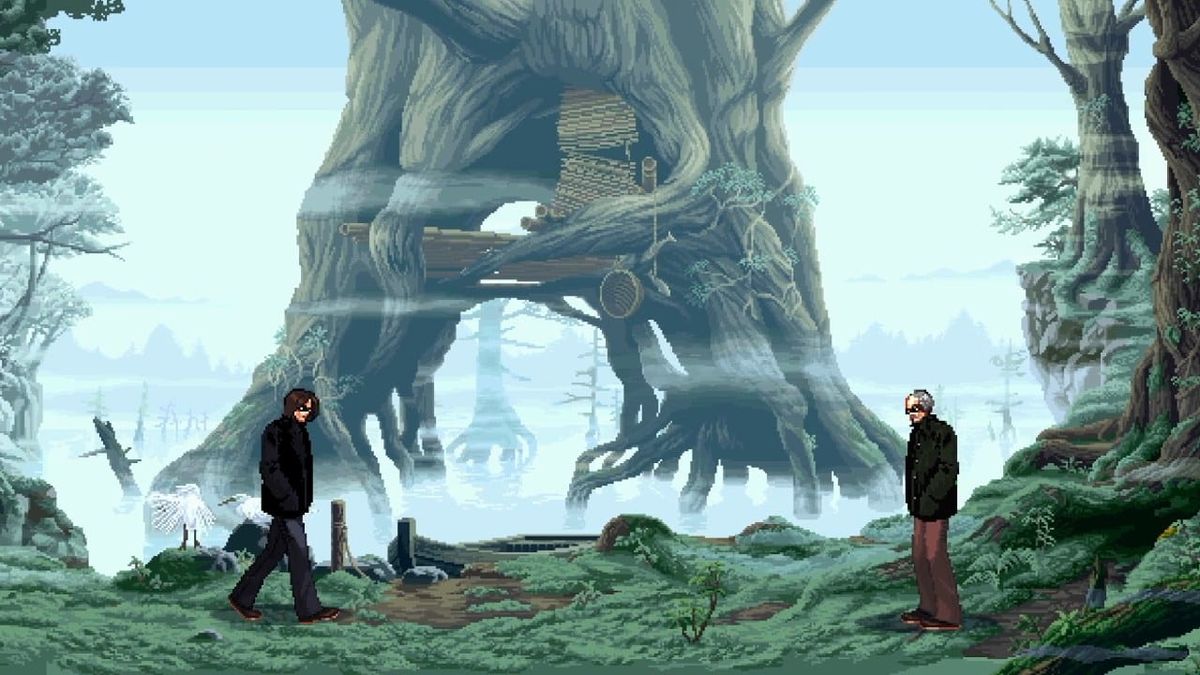
The film is nine minutes of two pixel-drawn figures strolling through snow-covered temples, rainforests and ruined cities, talking about art. The figures are David Blandy and the artist's father, John—Backgrounds (2013) stages a real father-son conversation inside landscapes built like the ones that scroll behind a fighting game, right down to the dialogue portraits, two lives in art measured against each other while the scenery loops. Seventeen Gallery has the full film.
Excerpt from Backgrounds (2013). The full nine-minute film, with sound, is on Seventeen Gallery’s Vimeo.
Blandy is bringing it to Finland. Per the announcement, Backgrounds shows alongside a series of films in which Blandy's onscreen character walks through the painted landscapes of Caspar David Friedrich—the Romantic who fixed the image of a figure seen from behind, facing a horizon. A game avatar doing laps through Wanderer above the Sea of Fog territory is about as clean a statement of the practice as exists: Blandy has spent two decades sending borrowed bodies through borrowed worlds.
The occasion is On Foot, opening at Serlachius Headquarters in Mänttä-Vilppula on Friday, September 26 and running into late February 2027. The museum bills it as the first comprehensive examination of walking in a Finnish museum—two centuries of the subject, from Akseli Gallen-Kallela and Marcus Collin to Elina Brotherus and Mark Wallinger, curated by Tomi Moisio and Carlos Idrobo.
Games handed art back its oldest verb and then spent a decade arguing about it—we were asking whether "walking simulator" deserved to survive as a term back in 2016. Serlachius answers from the other direction: hang the avatar's gait next to 200 years of painted walks and the question stops being whether it's a game, and becomes what kind of landscape it is.
Killscreen has spent 15 years tracking what happens when game bodies wander into museums. The free newsletter is where that coverage lands first.