Code is a plaything in Daniel Temkin’s esolangs
Natasha Chuk’s new essay reads esoteric programming languages through Oulipo, Aarseth’s ergodics, and Getting Over It with Bennett Foddy.

The new issue of iidrr mag—Issue 04, Whisper—opens with Natasha Chuk’s essay “Instructions for the Subpossible,” and it starts, of all places, with Getting Over It with Bennett Foddy. Chuk’s claim is that the hammer-and-barrel game and esoteric programming languages are the same artform: both place resistance directly into their structure, both make constraint “the very substance of the experience.” The post asks the question outright—what happens when code becomes a form of play?
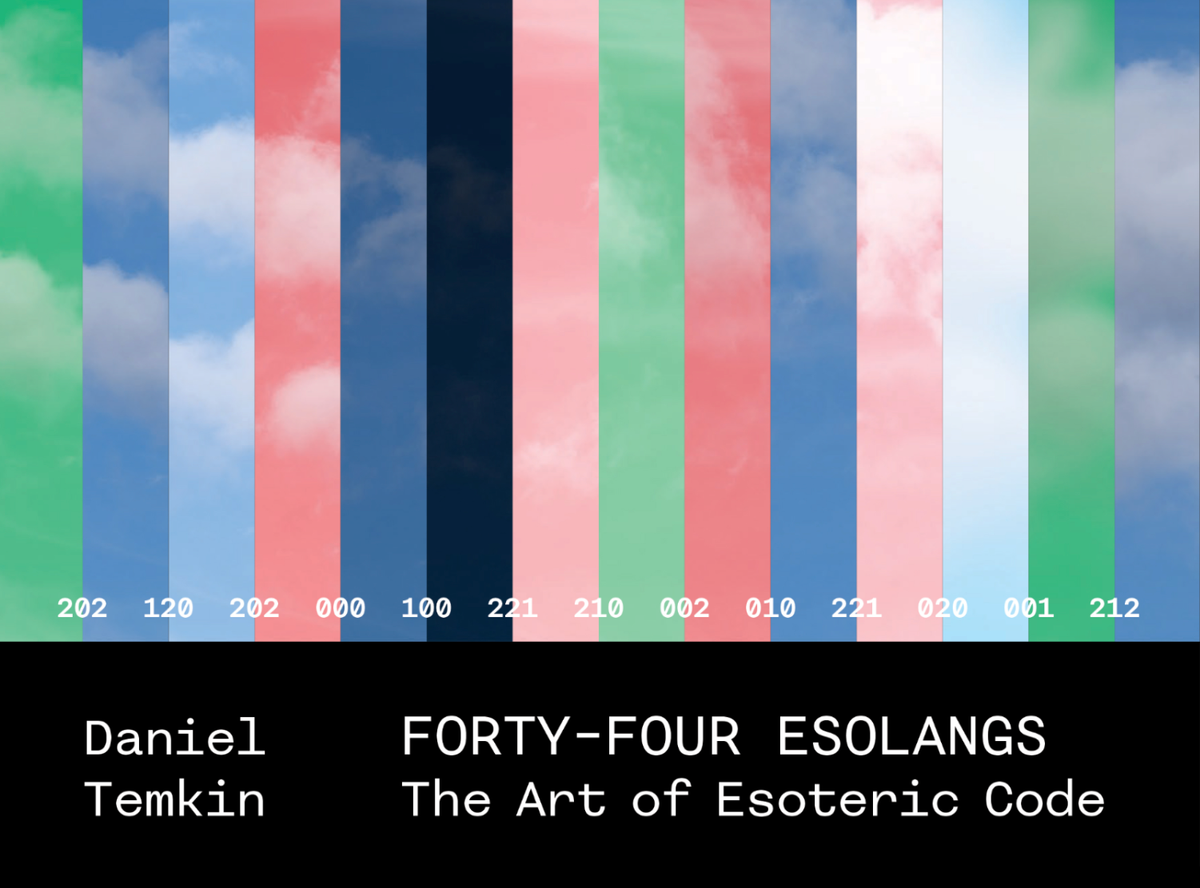
Chuk’s subject is Daniel Temkin, whose Forty-Four Esolangs (MIT Press, 2025) is the first artist’s monograph of programming languages. Temkin’s languages are games in everything but name. Folders write code as empty directories. Velato asks for a MIDI melody that is also a program. In Entropy, data decays each time it’s touched, so you say what you mean before it rots. Captive descends from Oulipo’s prisoner’s constraint: only the tall lowercase letters carry meaning, so every text ever written becomes a runnable program. Chuk reads all of it through Espen Aarseth’s ergodics—the “nontrivial effort” games scholarship uses for texts you traverse rather than read—and locates the pleasure in “the game-like struggle they produce in the exposure of the system’s playful arbitrariness.” Temkin, in the essay, on the book’s prompt-like language sketches: “The prompt is thus meant not to be realized as a functioning language, but rather to reflect on what it means to name something.”
We covered Temkin’s Light Pattern, a language written in photographs, back in 2014. Twelve years on, the argument has graduated from curiosity to monograph, and Chuk’s essay is the best case yet that the esolang belongs beside the puzzle game and the Oulipian novel: a rulebook whose only prize is the thinking it forces.
If a programming language can be an artwork, someone should be on that beat. Killscreen has been since 2010—Radar delivers the evidence free, three times a week.