


At that moment, Lisa Jamhoury was making a piece about loss; she, too, was losing an unimaginable part of herself. Pressed cheek to cheek, breath to breath, she prepared to say goodbye to her mother as she prepared to grieve what would come next. "I could have never imagined the world without my mother; it feels so empty," she told me. "It's like I've lost an appendage."
She had been working on what would become Lossy for some time already—a walkthrough installation that premiered at SXSW this spring—but it was her mother's passing that gave the work its emotional center of gravity. "The work itself is about losing what it means to be purely physical. It's losing the physical body in the age of the digital body." In a sense, Jamoury was now letting both of those bodies go. Lossy is the culmination of Jamhoury's five-year investigation into what she calls "living through capture"—the increasingly strange condition of experiencing ourselves primarily through our digital representations.
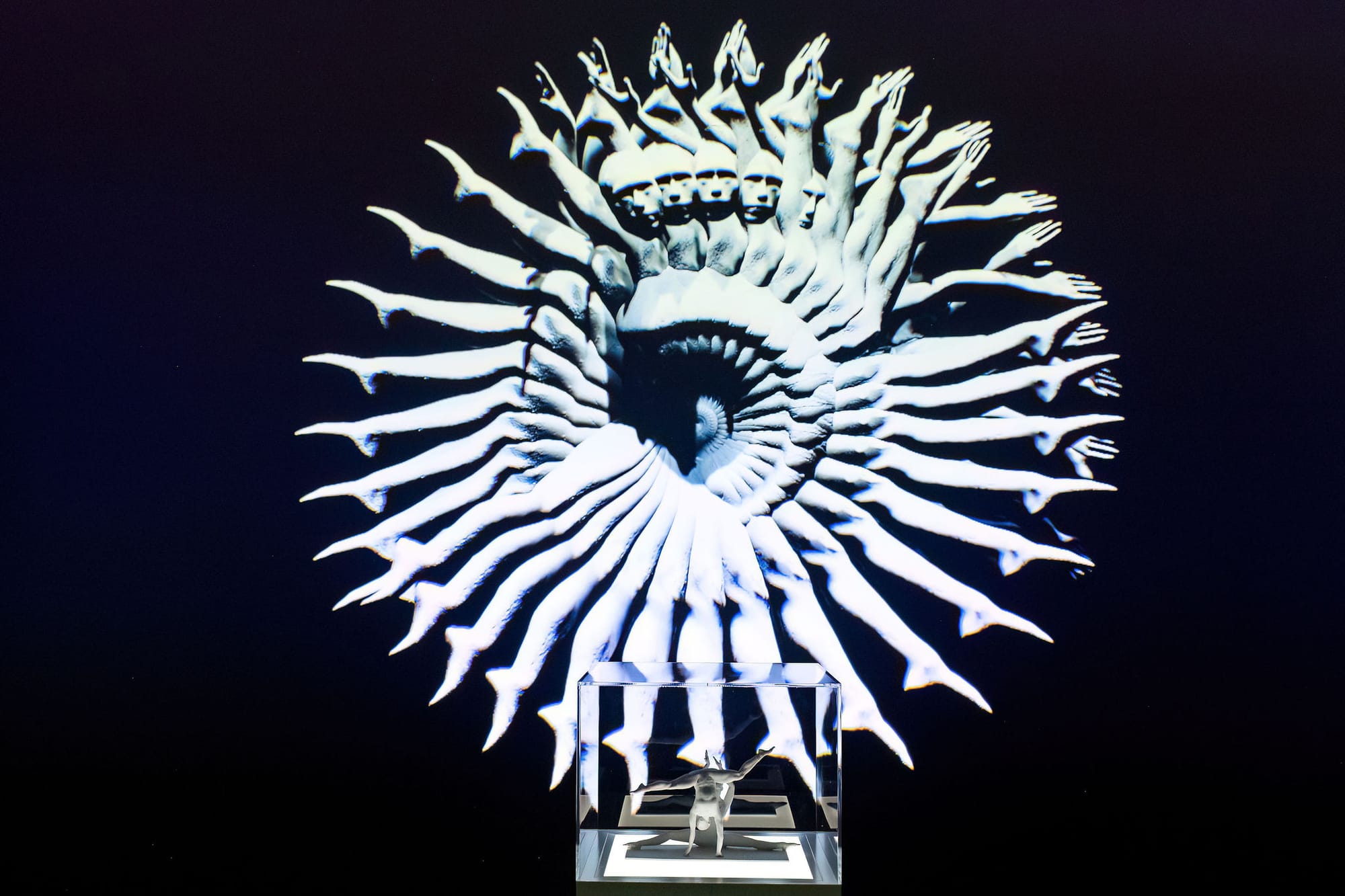
At SXSW, the installation was a three-sided room with three screens displaying Unreal Engine animations of sculptures built from fractions of a second of motion-captured contemporary circus duet. That exact moment is transmuted into a 3D-printed photogrammetry avatar of the two performers, frozen in the position that generated the sculpture behind them. Visitors wear motion-tracked headsets and walk through a spatial audio landscape of 24 sounds and three of Jamhoury's poems, blending the composition with their own bodies. The piece loops endlessly. There is no beginning or end. The figures gesticulate ad infinitum.
The title is itself a small act of defiance. Lossy describes compression that permanently discards data—a JPEG, an MP3, a webcam feed during a pandemic. Jamhoury kept getting the word edited out of her drafts by non-technical readers who found it confusing. "I love the term lossy. I've always just thought it was so descriptive and so beautiful," she said, but after "the fourth or fifth time it had gotten edited," she rebelled. "We're just putting this in the title, and then no one will edit it out ever again."
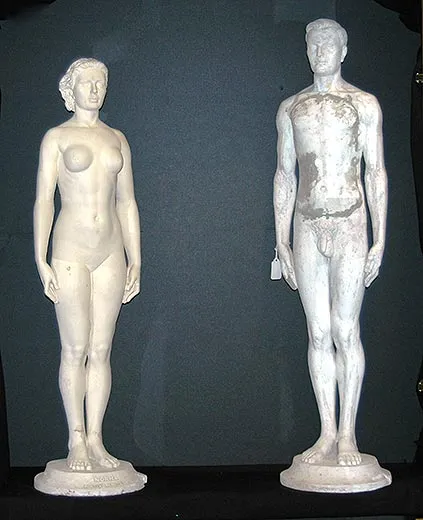
The Capture Series began with a sculpture Jamhoury encountered while working as an experience designer at Adobe—Norma, a 1940s figure created by a gynecologist from the averaged measurements of 15,000 white women aged 21 to 26. Norma was then displayed in doctors' offices and Time magazine as the perfect American female body. Thousands of women submitted their own measurements to a "Miss Norma" competition. No one matched, thus setting up generations of failed idealized beauty standards.
But the story that emerged was not simply that the average was an absurdity, but for Jamhoury, a vestige of a way of thinking she encountered in the digital domain. "Coming from a software design background, I know that this is still how we design hardware and software," Jamhoury said. "We design for the center of the bell curve." Coming out of the pandemic, the topic of how our bodies are represented on-screen had a renewed resonance, with the shouts of the erstwhile Metaverse filling public discourse. "If we're all pushing ourselves into these forms that are created right at the center of the bell curve, what are we shaving away?" she mused.
The answer the piece offers is ineffable. "We've become so used to identifying with our photos and our videos—these things that sort of almost look like us—that we have started to sort of replace our vitality with that." We stop being present in our own lives because we start identifying so much with the vision of ourselves. But Lossy is not only about what's shaved off. "What I'm playing with in the piece is there's sort of this horror of not being able to be yourself, but then there's also this beauty that comes out of," she tells me.
Lossy is part and parcel of our contemporary reimagining of digital bodies after decades on the internet. Just as there's a delicious oddity to those first round of AI-generated images that were fantastically surreal, Jamoury's figures play with the same sense of surreal, but to a different end. The images are not idealized versions of ourselves, as they've never existed, but new ways to think about what could be if we are not committed to capturing reality bit-by-bit. "What if we play with what digital can do and have fun with that and build on those affordances?," she says. "What if we know that we're losing part of ourselves, what if we focus on what's actually different and what we can gain?"
Jamhoury used photogrammetry to capture the poses
Throughout Lossy's poems, a refrain recurs: so it goes. In Slaughterhouse-Five, the phrase is repeated by the book's protagonist whenever he encounters death, big (the over 100,000 killed in Dresden) or small (a single unhoused person). It's his compulsive tic that's shorthand for horror and the unfathomable and a coping mechanism. "It really encapsulated this feeling of like, there are just no words. But there is a feeling, right?" Jamhoury points out that Vonnegut also uses it as a memento mori. Which is where, for Jamhoury, the phrase begins to twist. "We can die physically, but we cannot die digitally. My mom's Facebook account is still up and going."
There is something specifically late-millennial about all of this—about the position of being just old enough to remember being non-digital, just young enough to be fluent in everything that followed. Like me, Jamhoury describes herself as on the cusp. The last people to come into the world without the internet, without smartphones. She is mourning, in Lossy, a version of herself and her generation that has been quietly compressed away. "I'm holding space for this way that we have been and who we have been."
The "so it goes" points at the absurdity of it—the fact that the decisions that produced our condition were never democratic, never voted on, and were made by a handful of people in Silicon Valley. In the current sociopolitical climate, she said, it is very easy to imagine Lossy as the opening scene of a sci-fi horror movie. "Is this the end of our corporeal freedom?"
If these figures are in fact harbingers of the apocalypse, we can at least take solace that they are wholly human, imperfect and impossible as can be.