
Beyond the Sword of Damocles
One of the signature inventions in early VR is collecting dust in an Orange County apartment.
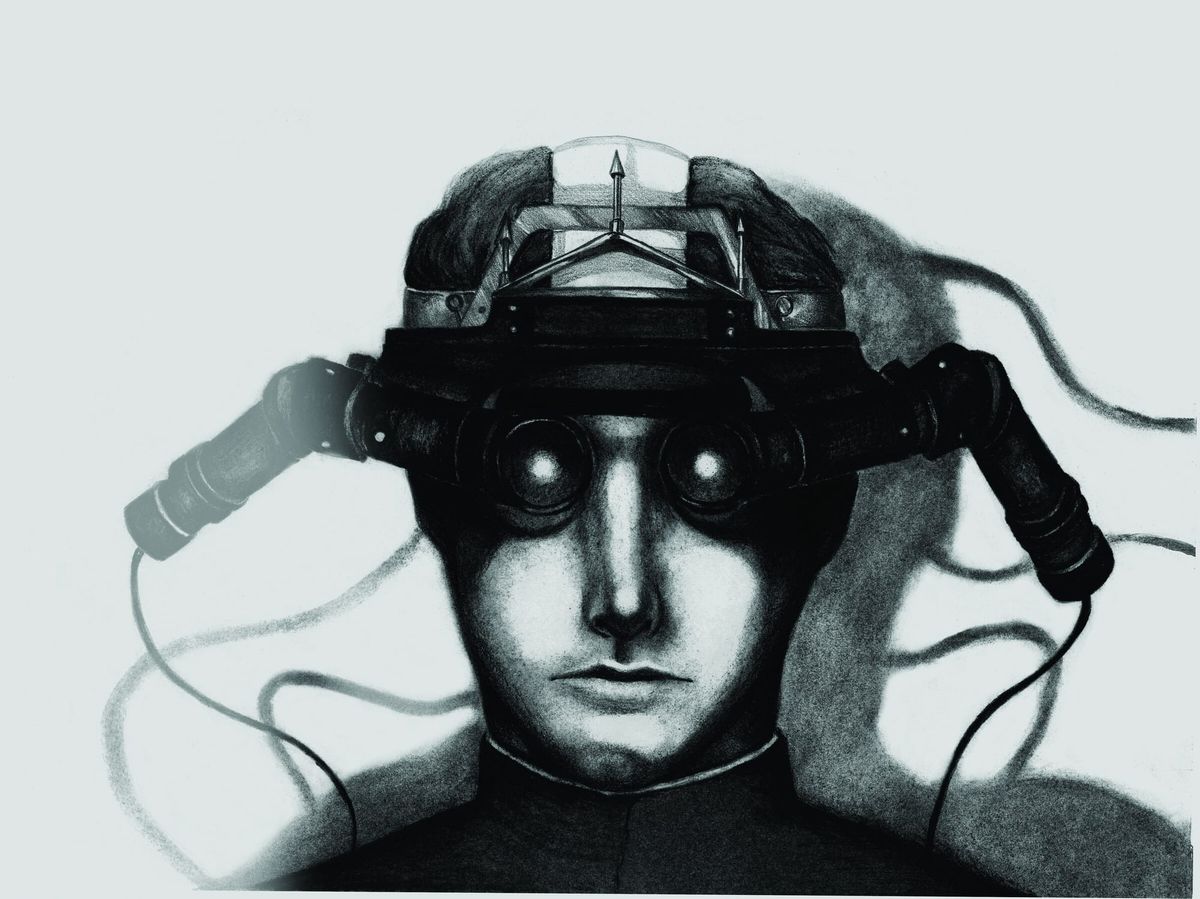
In an apartment in Orange County sits an artifact of virtual reality, a prototype of a mask engineered to project another world. It belongs to Marianne Heilig, whose husband, Morton, passed away in 1997. Forty years prior, as televisions were filling with color, he was imagining the future of cinema, and it was tangible with an apparatus he sketched on paper. “It will be observed,” his 1957 patent says, “that by placing one small television tube and peripheral vision lens system before each eye of the user, one ear phone by each ear, and one air duct before each nostril, the spectator is given a complete sensation of reality, i.e., moving three dimensional images, which may be in color, with 100% peripheral vision, binaural sound, scents and air breezes.”
That patent for Morton’s “stereoscopic-television apparatus for individual use”—later called the Telesphere Mask—was official in October 1960. Though it’s one of the most cited inventions related to immersive technology, the mask sits, today, in his wife’s apartment. And in a garage in Los Angeles County is Heilig’s larger and oft-cited invention from 1961, the Sensorama, once a penny arcade hit that offered immersive cinematic experiences—from a motorcycle ride to an airplane landing, sounds and smells included. It was proto VR, just like the mask.