A “Woke” GTA That Dreams the End of Capitalism
Utopia isn’t all it’s cracked up to be. (Actually, it is!)

Playlist 297
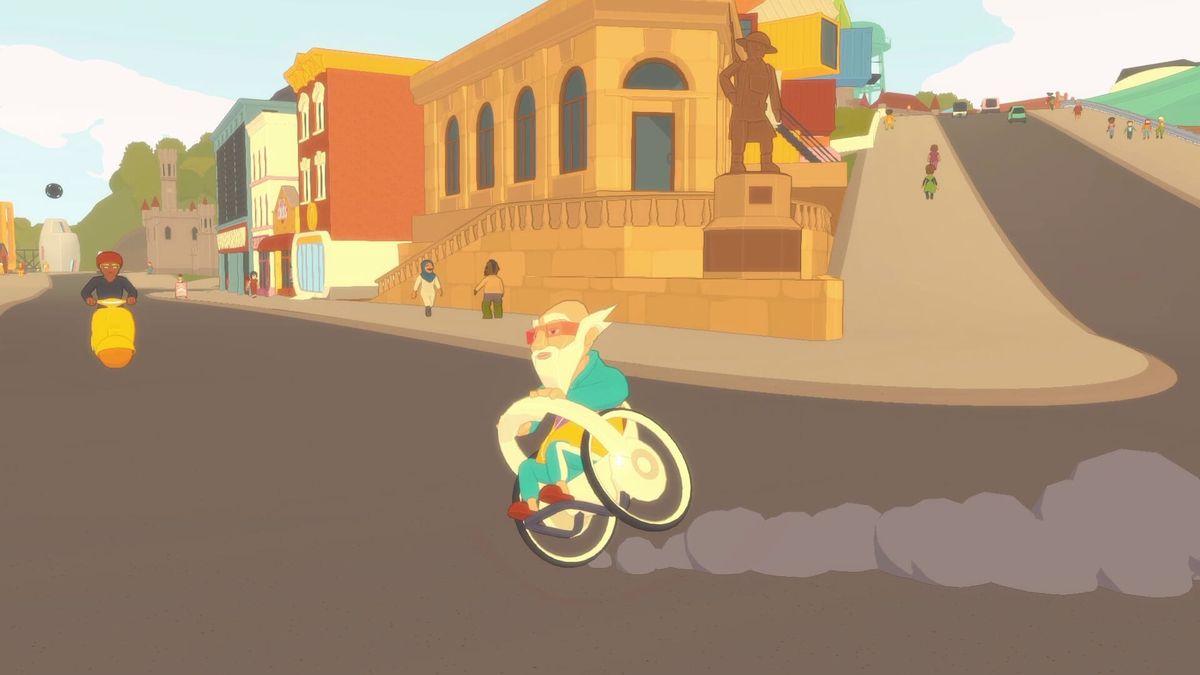
Future? No Thanks! (2026)
Molleindustria (Paolo Pedercini)
Play Time: 3 Hours
In Ursula K. Le Guin’s 1973 short story “The Ones Who Walk Away from Omelas,” we are presented with an ideal society. It is a place of unbridled joy and plenty, where horses run free, and there is “religion, but no clergy.” There is also quite a bit of free love, open orgies where the offspring are cared for communally. There is no king, and there are no slaves, and the city gets on without “the stock exchange, the advertisement, the secret police, and the bomb.”
But this being Le Guin, there is a catch. In a thought experiment familiar to many, there is a basement where a single child sits, neglected and wasting away emotionally and physically, with barely any food and covered in its own waste. It is, Le Guin writes, “too degraded and imbecile to know any real joy.” People visit the child once they learn of its plight, but in their eyes, they are helpless to do anything. The punishment of this child is the centerpiece of this society, and to save this one soul would be to endanger the perfection of all. Some who encounter this child are so moved that they leave the society altogether. In Paolo Pedercini’s Future? No Thanks! (2026), we find a similar type of bargain, but instead of a young child, it is an old, angry Boomer.
At the beginning of FNT, there is a Chekhovian inversion—Harvey Huffstone, an octogenarian and former health insurance claims denier adjuster, has decided that he wants to die. Why he’s ready to submit to euthanasia is unclear, and he is in perfect health (“You’re like a ship of Theseus of organ transplants!” a nurse tells him.) But it is apparent that the society he lives in thrives on free choice of all kinds and is happy to oblige. After declining to submit his own bucket list, his chipper “end-of-life doula” tells him an AI generated a closure list from his past preferences that reads like a Frank Sinatra chorus: eat a steak, drink a Coke, have sex, smoke a cigar, get into a fistfight, and drive a combustion engine. Unlike Vonnegut's Federal Bureau of Termination from his 1962 short story “2 B R 0 2 B" that thanks you for helping to curb overpopulation, Huffstone simply has had enough. There is no greater good, and it is telling that Huffstone’s items are self-centered, over, say, reconciling with the daughter he abandoned or making amends for past sexual harassment. (He is banned, for example, from entering the college campus because of a restraining order—“Always getting in trouble for being myself,” he snorts.)
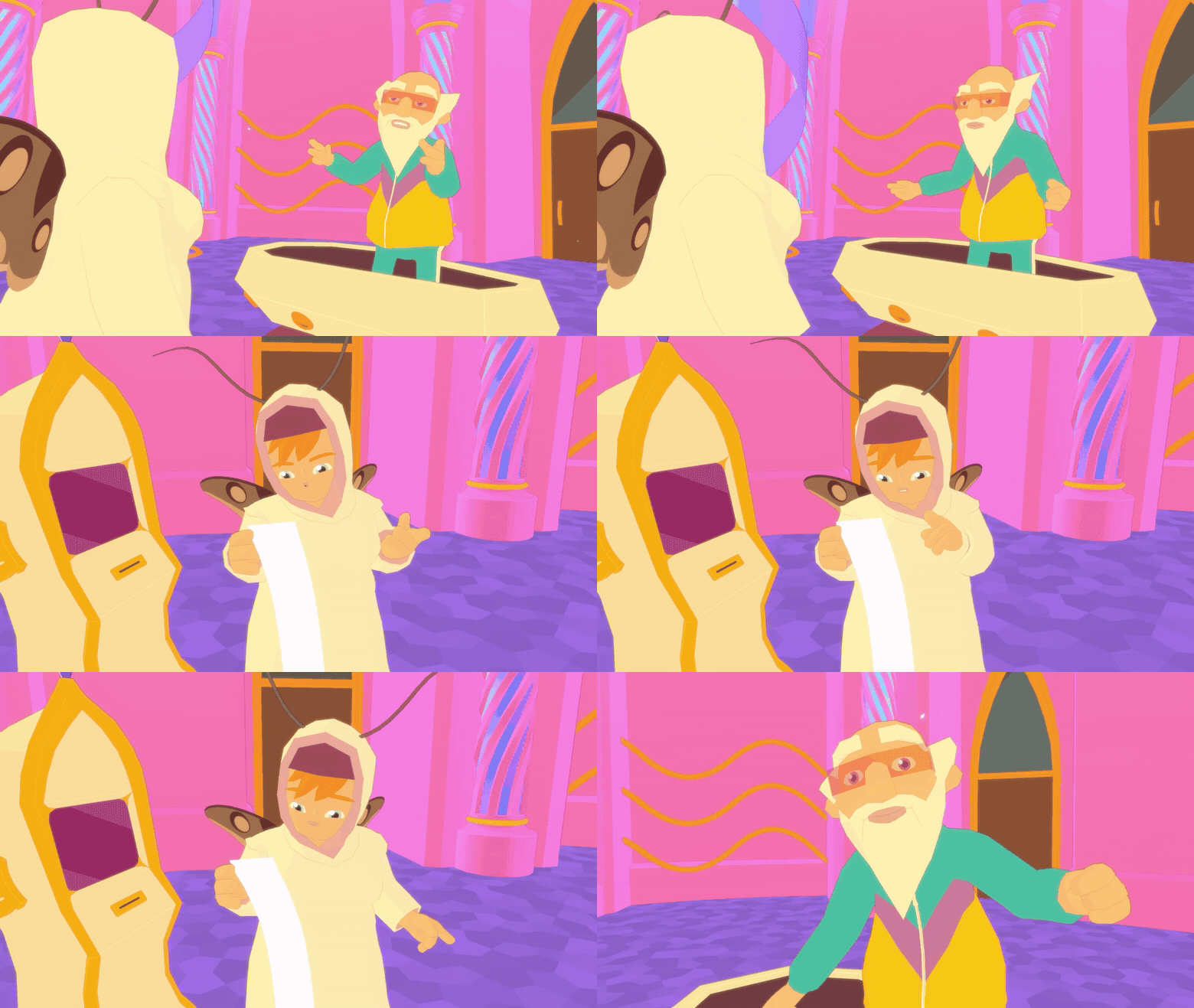
The bigger problem for Harvey is that things that are so easy for us in the 21st century have become nearly impossible in Pedercini’s near-future speculative fiction. Sugary sodas are almost abolished as relics found in malls that succumbed to the forces of nature; the world has become vegan, meat is only for “religious minorities,” and the world has abandoned fossil fuels. It sounds like a dream, but for Harvey, it is hell. Harvey’s predicament is, at heart, the same one that Le Guin took up 53 years ago. When utopia is here and present, what joys must one sacrifice as an individual in the service of everyone else? “Another world is possible,” that popular slogan from the World Social Forum crowed in 2001, and Pedercini shows you what it could be.
The catch, of course, is that it is a satire, an absolutely rare genre found in games. Pedercini has tackled serious subjects in a serious way, as in Phone Story (2011), which looked at industrial labor practices behind smartphone production, and Unmanned (2012), one of my favorite games ever made, which juxtaposes the quotidian life of a drone pilot with the daily violence enacted on his and the U.S. military’s victims. But coming from the Flash/Newgrounds generation of game makers, he is no stranger to comedy—The New York Times Simulator (2024) looked at how the process of editing headlines manufactures consent. The conceptual turn for Pedercini is that in FNT, the left has won. They are not the outsiders; they are the mainstream.
When I asked Pedercini about the shift, he noted that post-2008, he found the tenor of the country shifting. Whereas Margaret Thatcher nakedly stated that “there is no alternative,” this month’s midterms in the U.S., where Democratic Socialists of America candidates won House seats and dozens of state and local races, point to signs that “capitalist realism” is no longer a given. “You don’t need another game about how bad capitalism is, because we are kind of all on board at this point,” he says. The sociologist Erik Olin Wright would describe what’s next as “real utopia,” a world of ideals that are held up “without embarrassment or cynicism.” This new world, of course, is not without its troubles—Harvey finds the endless deliberation tedious, and you might be tempted to skip ahead when offered to listen to “the Abridged, Simplified, and Newly Revised Robert’s Rules of Order Procedures for Time-Constrained Deliberative Assemblies, Version 3.5,” which passes unanimously. The difference is that this is not deliberative bureaucracy to no end; it's the machine through which this new world functions, and quite well, at that.
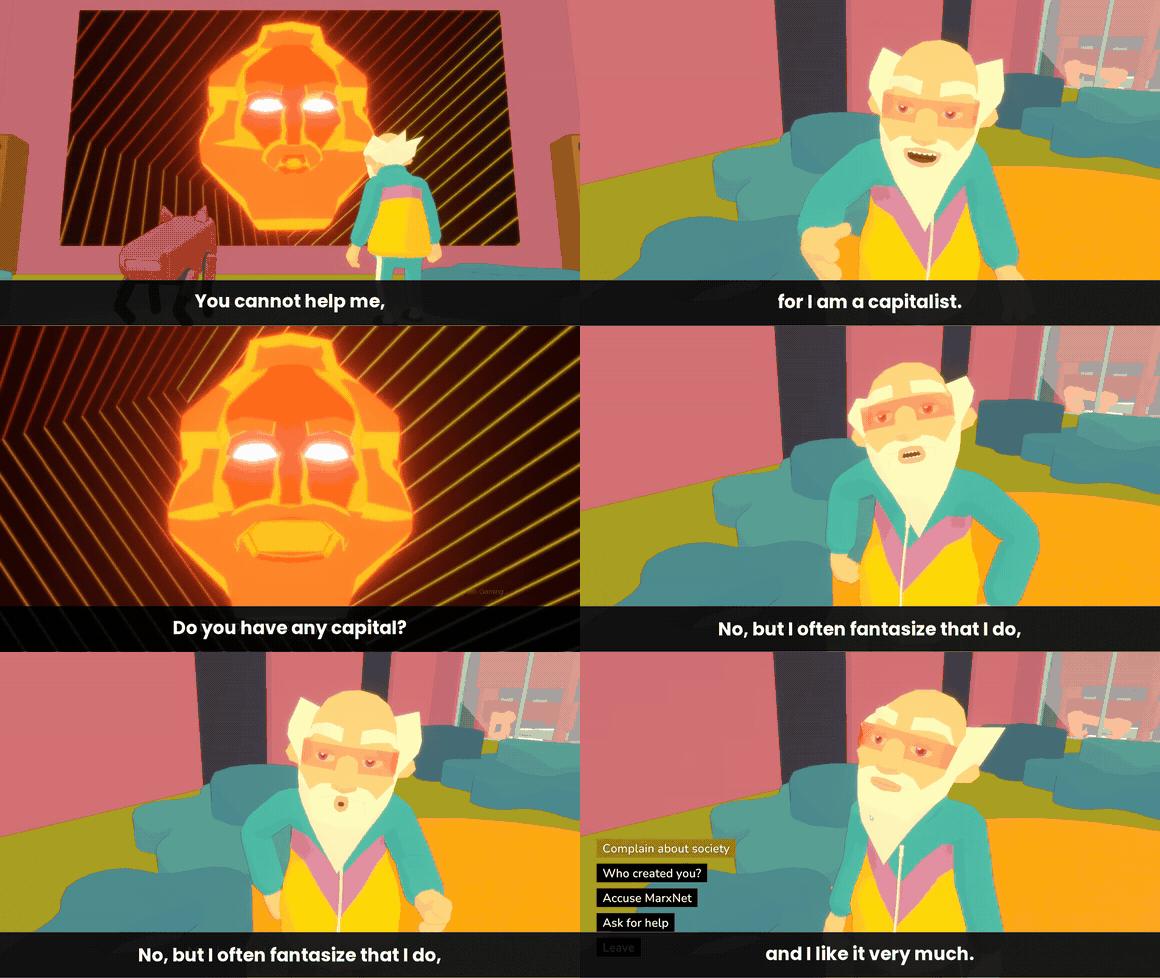
As cheeky as talking genderless toilets and a cop dressed as a pig advocating for de-escalation across “race, class, gender, and fandom” is, the world that Huffstone hates so much is earnest and full of joy. The narrator of Jonathan Swift’s A Modest Proposal, who earnestly and monstrously suggests we eat the poor, works as satire because we don’t share his premises. Harvey is a Swiftian narrator in that vein that Pedercini lets you inhabit, if only to moonlight as a boomer conservative in a perfect world he simply detests. When interacting with benevolent omniscient AI that controls the world economy, Harvey scoffs: “You cannot help me, for I am a capitalist.” To which MarxNet asks, “Do you have any capital?” Harvey is unfazed. “No, but I often fantasize that I do, and I like it very much.”
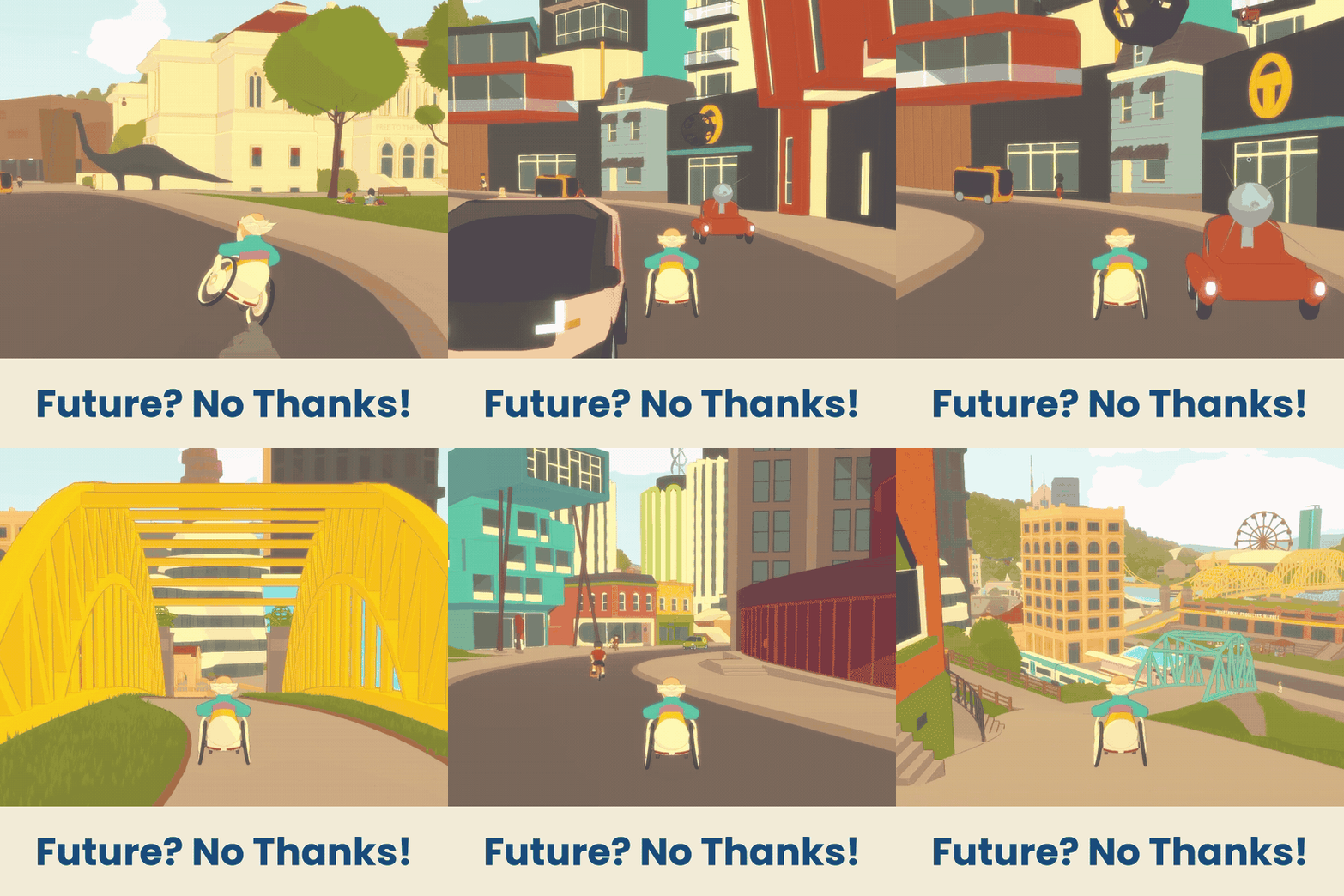
Part of the joy of wandering comes from the game’s layout, modeled after Pedercini’s adopted hometown of Pittsburgh, where he teaches at Carnegie Mellon. It lovingly draws on the psychogeography of the Grand Theft Auto series. I’ve always loved how Rockstar compresses cities like New York, Los Angeles, and now Miami, eschewing perfect simulation for a soft portrait of a place's ineffable feel, like magic hour in the Santa Monica Mountains or the majesty of the Brooklyn Bridge. Pedercini shares that sentiment. There are the two rivers and the districts, but more importantly, Pedercini says that unlike other shiny and frictionless visions of the future, it was important to capture one that is possible with what we have, with the structures and relationships we already have, rather than something alien. Utopia is here; it’s just not evenly distributed. And at the very least, he jokes, there’s a subway now.
Spatially speaking, though, centering the game in the city gives FNT an opportunity to work through all of the centers of contemporary capitalism. Harvey starts in a hospital bearing a monument to all who’ve fallen to the American health care system, tracks down his grandson at a school where the students have unionized, a robot factory now organized by an autonomous AI called MarxNet, and the city center of finance where a group of techno-libertarians unsuccessfully plot to create chaos. Pedercini originally pursued something more directed as a point-and-click; the spontaneous encounters and lack of hand-holding mirror Harvey’s own vertigo, his discomfort with not knowing where he is.
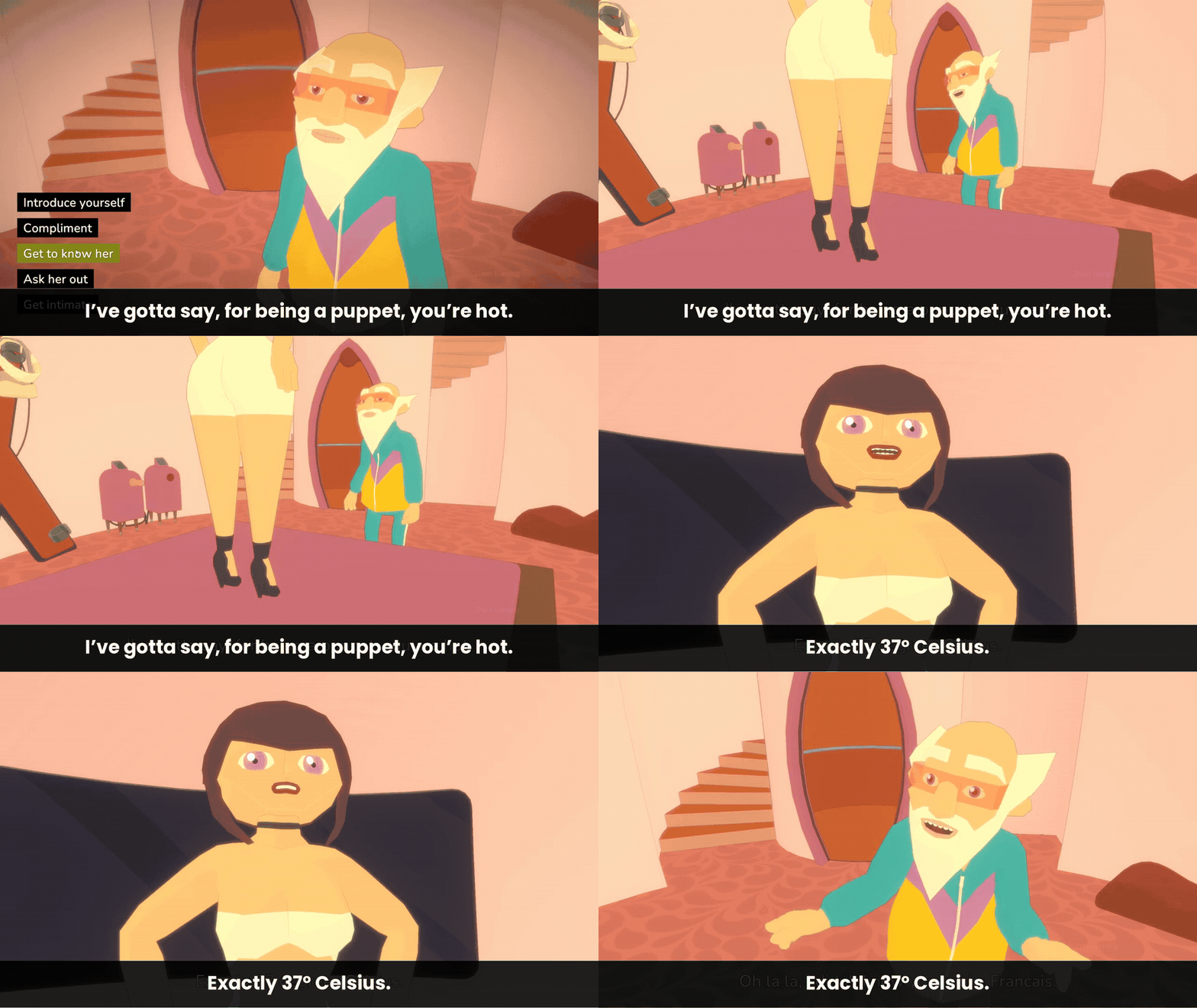
Like many my age, I try not to talk politics with parents, but one interaction with my father-in-law, a dyed-in-the-wool MAGA supporter, stuck with me. He uncharacteristically shared some sympathy about the rising cost of living that was different from when he could attend college for next to nothing. “Everything is just changing so fast,” he said, a rare moment of vulnerability that serves as an explanation, but not an excuse. Huffstone shares those sentiments as he’s utterly bewildered by everything on offer—there is no cash, and human sex workers sit alongside robot ones. The left has even reclaimed gun culture with affection and the help of fancy gun sommeliers. (“It only counts as a Kalashnikov if it comes from the Izhevsk region of Russia,” one tells him. “This is just a sparkling assault rifle.”)
And suddenly, euthanasia isn’t looking so bad after all. Fredric Jameson famously wrote, “It is easier to imagine the end of the world than to imagine the end of capitalism.” And Huffstone agrees; rather than live a life of peace and pleasure that he has to share with others, he would rather exit of his own accord as a perfectly healthy old man. At the end, when his doula asks about his self-reflection, he replies, “The discovery is that I’m an asshole,” before he enters his space-age funeral device and unceremoniously pushes the big red button to end his life. Yes, we know, Harvey. Goodbye and good riddance.
This issue is open to everyone because Molleindustria cut the game’s price for Killscreen readers. Most Fridays, Playlist goes only to Helping Hand members, and next week it’s Carson Lynn’s A bronze anvil falls to the earth. (2023), a short film shot inside Bloodborne.