


Most games treat history like set dressing. A Roman column here, a weathered scroll there, all rendered in exquisite detail but ultimately just a backdrop. Florence Smith Nicholls approaches the relationship between archaeology and games from the opposite direction. After seven years working as a professional archaeologist in London—documenting sites before developers paved them over, assessing archaeological potential in planning reports—they started asking a different question: what if games themselves are the archaeological sites?
Below is an edited transcript of our conversation from our podcast released today.
You spent seven years working as a professional archaeologist before making your way into games. What led you to archaeology as a profession?
Back at secondary school, I studied Classical Civilization as an A-level—that's between the ages of 16 and 18 before going off to university. I really enjoyed that because it gave a general kind of overview, looking at archaeology, history, all these things to do with the classical world. I realized I wanted to look at classical archaeology specifically.
I came out of university and needed to get a job, so I got one as a field archaeologist in London. I did that for several years, working on construction sites, areas that were going to be developed, doing various bits of field work on those sites. Then I was a heritage consultant, also in London, doing reports on the archaeological potential of sites in the planning process, gauging what kind of archaeological work needs to be done in advance or during specific developments, depending on what the archaeological potential was.
In the United States, the classical work we have is mostly indigenous artifacts. In terms of urbanization in the last 300 years, the cities that we have, the ancient cities that we have in the United States, do not map directly onto where ancient cities were in terms of size and scale, unlike say Mexico City. I suspect that there are more of these issues with European cities where there's less space, people have been building on top of certain areas for a long time, as opposed to maybe places in the Americas where there might be more space for people to move around.
Every tour guide in Rome always tells you, "Rome's like a lasagna! You can't build here. There's always something to dig up."
Yes, exactly. Yeah. The different layers. That's it. Yeah. No, that's totally true.

When you say "classical archaeology," what does that mean—the method or the time period or both?
That was more the time period. Classics as a whole—very broadly, that would be ancient Greek and ancient Roman periods. But I was really interested in Bronze Age Greece specifically, from around roughly 3000 BC to 1100 BC. It's bad because I specialized in this a while ago, so I'm always thinking, okay, I need to remember the dates for these things. It's not what I'm thinking about these days. But I was quite interested in pre-classical Greece, actually, weirdly enough.
When you started thinking about engaging with games, did your colleagues in archaeology understand what you were thinking about?
I discovered video games archaeology, or “archaeogaming” as a thing in the mid-2010s on Twitter. When Twitter was, you know, still toxic in some ways, but not what it is currently. It was very much an online community. There were a few archaeologists here and there who were very interested in this area.
In terms of my day-to-day work, the people I was working with had never heard of this, not surprisingly. When I'd bring it up—I was doing my own independent research on the side—some people were just a little bit confused or kind of like, "Okay, why are you doing this?" It just didn't seem relevant to them. But there were people who were curious about it and maybe could see where the applications were. I think over time it has become more and more—people in the archaeological community do see the relevance or value in it. But especially in the mid-2010s and onwards, people were very confused. It's a very niche little thing, which does make sense.
I guess that's true. I think with games, sometimes there is a perception for people coming from outside or in academia—there's obviously very serious siloing that happens inside the academy. People like to have their thing. And when you start thinking in an interdisciplinary way, you're sort of stuck between worlds. I believe that the study of games has been very challenging because the application of it is really spread across—there's obviously the engineering and technical side.
Still, you can look at games as literature. You can look at it as poetry. You can look at the visual elements. There are interactive systems. It's almost like games as a medium are almost so rich it becomes very hard sometimes to—if you just want to focus on one specific thing, sometimes the place that you're coming from may not recognize where it is that you're trying to go.
Yes, definitely. And even though I always think, "Well, surely we're past that at this stage," but honestly, even now, all the time, I will talk to people, and they don't understand games as being something beyond something very specific for them. They have these very entrenched ideas of what they are and who they're for and what they can be. I know that also is a thing in games discourse and people in the industry who always feel like they want to be taken as seriously as film or something. But it's true. People don't—I've met people who are like, "Oh, you could do game studies? Like film studies?" It's like, "Well, of course, yeah!" But to them that just doesn't make sense. So it's interesting that that is still a prevailing misconception.
How has your hands-on excavation experience shaped how you approach game analysis?
It's a really interesting question because I think there is a disconnect between this idea of archaeology and video games. Archaeology is very much about materiality. If you are a field archaeologist, it is literally that embodied experience of being on a site, even just touching soil—that's a way of gauging different contexts and things like that when you're thinking about digital space, that can be challenging because by definition, you're thinking about an immaterial space in a way.
However, the way it has influenced me is to think of play as not just what happens on the screen. Play always has a context. There's always a person or people—they may not always be in the same room, but they are physically playing with hardware. I think about the specific context in which people access and play these games. What is the materiality of that play, even if it's still very much an immaterial experience in some ways?
There's an article by T.L. Taylor called "The Assemblage of Play" which was very influential for me because she really talks about this idea of when we play, there's always an assemblage of the player, the hardware, the software. But also thinking about, well, what time of day are they playing? Is someone playing on their phone? What else do they have going on in their life at the same time? How does it form part of the routine of their life? Or how is it influenced by other things that are going on? That's something I try to think about a lot.
Tell me about the Elden Ring paper. What led you to it, and what did the work entail?
The reason why I chose Elden Ring is actually funny. I never played any of the other FromSoftware games, and they actually really scared me. I found these games very intimidating as someone who doesn't necessarily see themselves as a gamer, to say the least. I think this isn't the only reason obviously, because there were things about the game that meant that it was interesting to study in this way, but that in a strange way made me think, "Okay, I'm going to try and study this game." I guess it was a challenge to myself, and I was very curious about it.
It's become a bit like spicy food or hot peppers, you know, where it's like, "Well, this is extremely spicy. The Scoville units are off the charts. I don't think it's for me, but maybe I should try it. I'm not going to enjoy it."
Yeah, that's true. Yeah, I know what you mean. In a strange way, it made me think, "Okay, I'm going to try and study this game because it was a challenge to myself.”
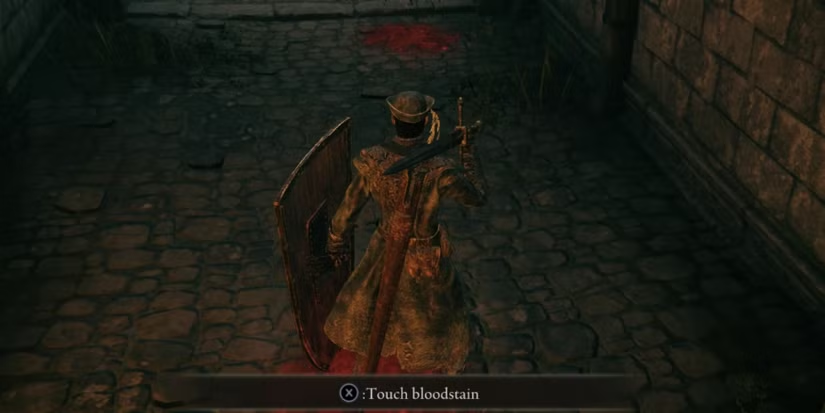
I understood that there was this kind of what they sometimes call asynchronous multiplayer features—messages that you can see and also player bloodstains. Even though it is predominantly a single-player game, there are these traces that other players leave behind in the landscape. That already suggested an archaeological approach—thinking about these traces of people's activity in this virtual landscape. How can we record them? What can we learn from that? In some ways in my work it's probably the clearest translation of thinking about archaeological methodologies and transferring that to digital space.
These messages and bloodstains—they're accessible to all players in the world?
Yes, exactly.
And these messages that players can leave at any moment—they're accessible to all players in the world, and they have a variety of a mixture of humor and fact. I mean, I guess like any notes left in a real world, on a bathroom wall, it's a mixture of...
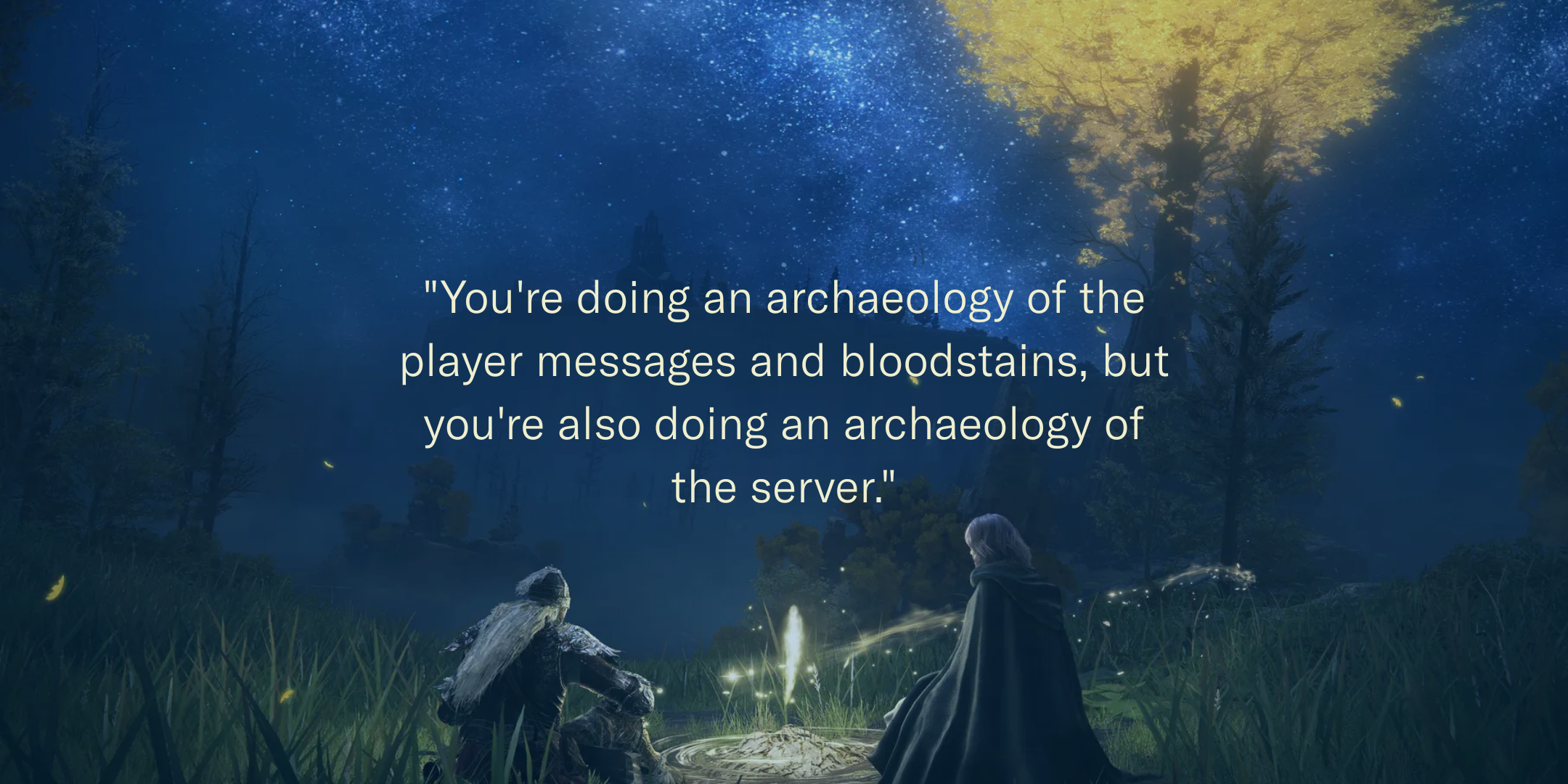
And with the messages, it's interesting because the server will give you what seems to be—we don't know—a random selection of them in any given location. They load in and out. When you're doing an archaeology of the player messages and also the bloodstains, which also load in and out, you're also doing an archaeology of the server. There are almost different levels to that because as you're observing this and they're loading in and out, I'm thinking, "Well, how is the algorithm for this game—which presumably there is one—deciding on what it shows you and at what point?"
There is no data about that, or we don't know how that works. Only FromSoftware knows for sure. People have tried to hack it, but even then, you can see there's a recency bias in terms of when messages were posted. Other than that, I don't think we have a complete understanding of how that works.
You collected this data manually?
Yeah. This is the interesting thing about it.
Is this a skill set for being an archaeologist? Doing things manually is a part of the process.
It was a very laborious process. I chose two sites that weren't too big, but they were kind of self-contained in a way. One of them is the Church of Elleh, which is a very early game location where there's a Site of Grace—that's a place where you can save your game and stuff like that. Then there's also a merchant, and somewhere you can upgrade weapons. It's the first area of this kind you encounter as a player, and it feels like a little mini hub inside this church.
Then I chose an area inside some catacombs, just a corridor, underground, because that felt very contrasting, and there were some enemies immediately before and after you'd get to this corridor. So it felt like a much more intense space. We were looking at having two areas that were quite different.
As part of this, I drew a to-scale plan of each location. This was done right around the time when the game was first released, so in March 2022. I didn't use any mods or anything for this, which people have asked me about—that would have potentially made it a lot easier. But there are problems with using mods and being in the online mode and getting banned, and all this kind of stuff. And also, I just wanted to see if I could do it.
The way I figured out how to do that was by using the player's foot as a unit of measurement. It just kind of made sense. But that meant it was quite laborious to draw it all out. Even going through that process was really interesting because it made me have to be in that space in a very particular way and think about how is this church is it being constructed from? Where have they duplicated something here? So it was a very fine-grained sampling of these two areas, which is like looking at a grain of sand in terms of Elden Ring as a whole. Of cours,e it's always very limited, but it was always supposed to be a proof of concept and a sample of the game, especially at that particular time when it had just come out.
Within these plans, I drew where we saw messages and bloodstains, and then also had spreadsheets transcribing the contents of the messages, how many times they were praised—people can upvote things in a way in the game—so how many appraisals they get, any associated assets, and then also screenshots. Thinking about these different ways of recording something and having those things all inter-reference each other or support each other as a later archive.
Were there moments where your methodology wasn't working the way you wanted?
Yeah, that's a good question. An interesting thing happened in the process. In archaeology, there's this concept of context. If you were digging and you found someone had dug a pit, that would have its own context. You give it a context number. The reason we have this is that you will build this idea of stratigraphical layers. Generally speaking, something that's further down is older, higher up is younger, and more recent. It gets more complicated than that, but that's the general idea.
While thinking about digital space and context, and especially Elden Ring, I was like, well what does context even mean in this space? Is that a useful thing? But I was interested not just in where we were finding these messages and bloodstains, but also in how we were experiencing them as players slash researchers. Because as we were doing this, we were still players. That's the interesting tension in doing this work—you are also thinking about, you're almost sampling your own experience as a player as well.
I was thinking, at what point are we seeing these messages and bloodstains filter in and out? I quickly realized that the bloodstains would appear and disappear very rapidly. It's very difficult to record them because they would just be going in and out. It was like, okay we gotta rapidly record these as a group.
I ended up coming up with context numbers which were based on the date in which we'd done that specific survey, but then also the number of times that we could observe that there was sort of a—I don't know if that's really the right way to refer to it—but almost like a server refresh or just an update in the landscape in that specific area. If we'd seen that several more messages had loaded in at this point, and if they loaded in together, then that would be a separate context. It was trying to adapt the methodology to actually what it is that we are experiencing in the game in a way that made sense.
You've written about "generative archaeology games." Can you explain that concept?
This is an interesting one. I used the term "generative archaeology games" more at the beginning of my PhD. At some point I realized everyone thought I was talking about Generative AI! This was a real problem for me. I was like, I have to not talk about it like that anymore because people were really confused and I think they thought I was talking about using Generative AI. Actually, I'm talking about procedural generation in some cases.
In terms of what I originally meant by that, I was more specifically looking at games with procedurally generated content—algorithmically generated content. I was interested in the idea of games that would encourage the player to interpret environmental storytelling, but also to record what they encountered in the game. Games that encourage players to, I would argue, role-play as an archaeologist even if they're not being told that they're role-playing as an archaeologist specifically. They are interpreting the environment and what happened there in the past or trying to figure out things based on material culture, and then being encouraged to maybe take notes or make records of what they found, which in a way is also a record of their own gameplay.
You mentioned playing as an archaeologist. One thing I'm very interested in is that much of how we publicly understand games is self-taught. It's not taught in schools, right? One of the benefits of studying the arts, taking an art history or art appreciation class, whether at the university or at a local library, is that it helps connect the chain of this virtuous cycle. People come to new experiences with some understanding, some thinking of the good, on top of their own individual tastes and preferences.
We mentioned film studies earlier. But there's at least an expectation that they should think critically about the work, whether it's Love Island or Sinners or whatever. I think there's an understanding by the public, "Oh, I'm going to see a piece of media, I should think about that media." And that is reinforced by having stuff in academia and public training.
With games, there's none of that stuff. It all happens informally. It's on forums, it's in conversations, it's at cons. You may go into game studies someday, but there's no sense that you should be talking about your work in that way. So that's a long way of asking, from your perspective, what guidance would you give to someone who's looking to think about games in an archaeological manner? How should you approach a game in a new way through that lens?
I was at the Queer Games Conference in Montreal last month and I was talking about this idea of anticipatory archaeology—the idea of trying to record, anticipating something that we might want to record in terms of player experiences and games or community events, something like that. Almost like there's this sense of needing to anticipate it already, record it in the present for the future.
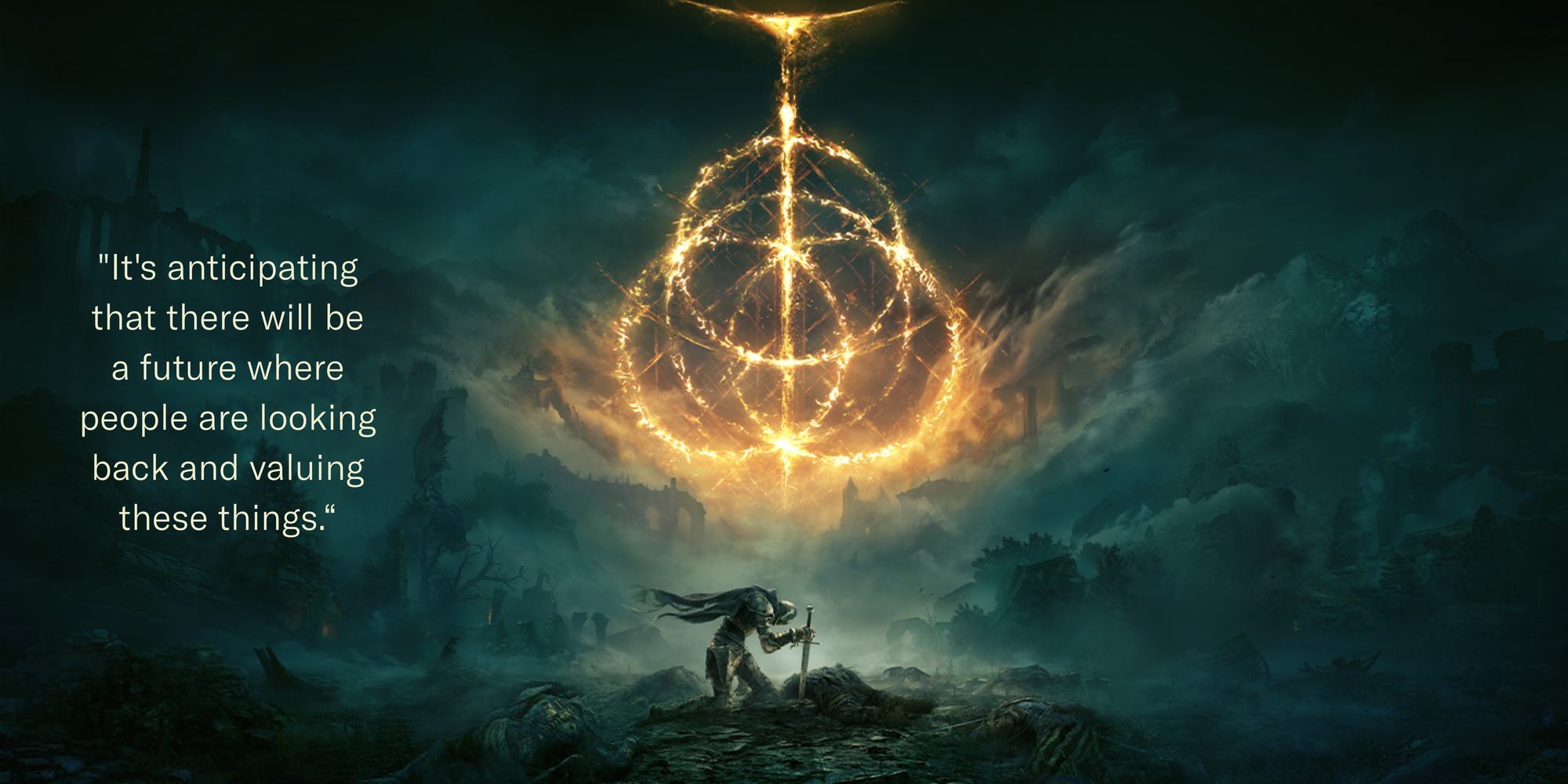
I was talking about anticipatory grief, actually—this idea of anticipating that people in the future will grieve if they don't have these things recorded. Someone mentioned to me ho,w actually in some ways, that was quite a hopeful outlook, which I hadn't really thought about. But their point was that actuall,y you are anticipating that there will be a future where people are looking back and valuing those things.
It's kind of dark of me to say that I don't know what the future is gonna be even in like 50 years. Sometimes I think about this in terms of the work I do. Will there be people in 50 years who are looking back and value these things that have been recorded? But I guess that is something that I do hope for.
Given that we already look back on games—even not even from that long ago, like even from a few years ago which we can no longer play—and people want to understand how games were experienced in the '80s and things like that, I think and I hope that this kind of work will give people a deeper understanding of why games were important to people in the future. I don't know what games will look like in the future. That's also interesting. I don't know where they will fit in whatever media landscape will exist then. It's kind of hard to think about, but I hope that it will—it's nice to think that people will understand why games were so important, but also just how ephemeral and changing those experiences were.