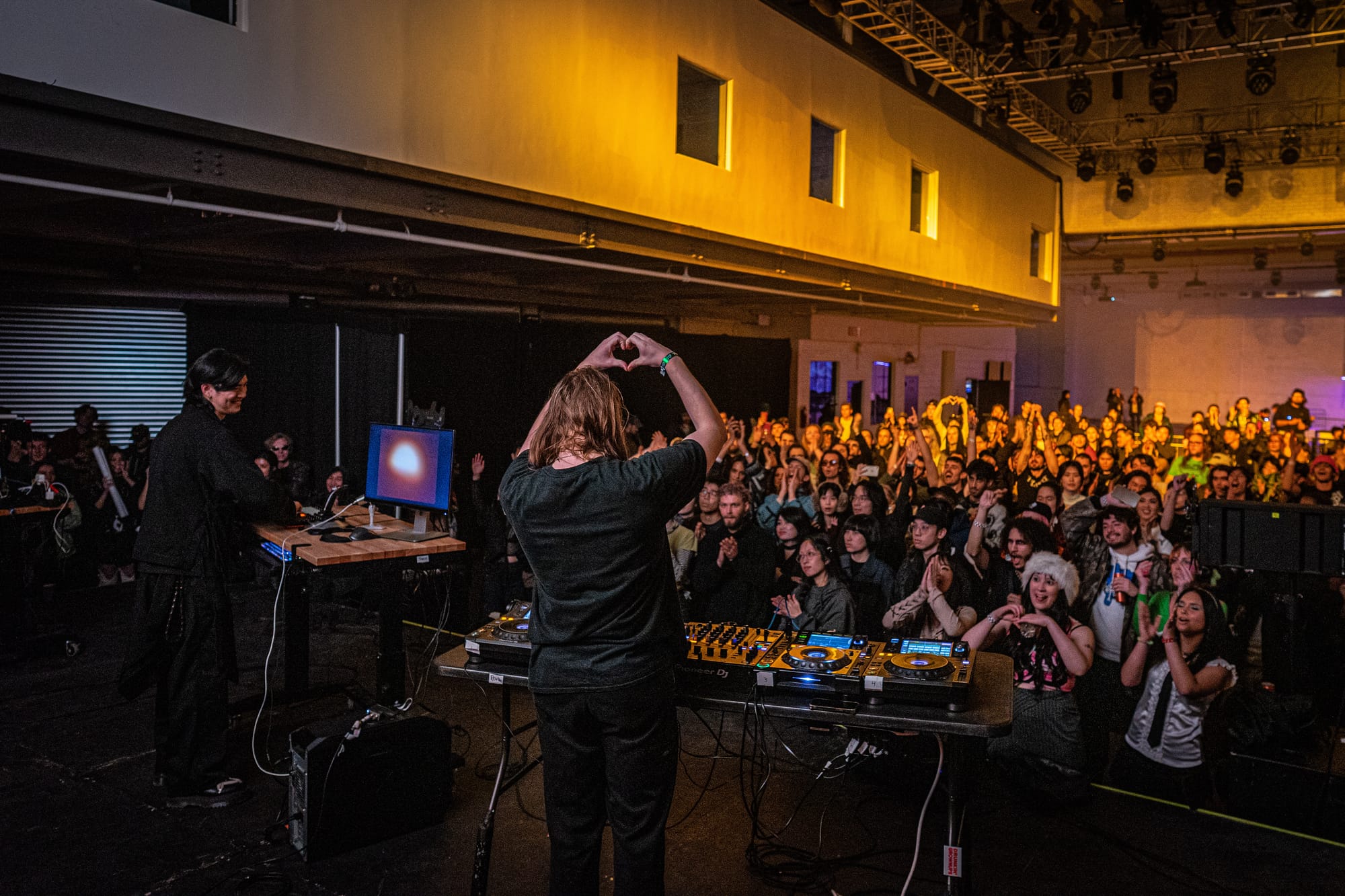


When I ask Sam and Andy Rolfes, Jen Sillen, and Kevin Peter He to describe Diskokina to me, they are both opaque and extremely specific.
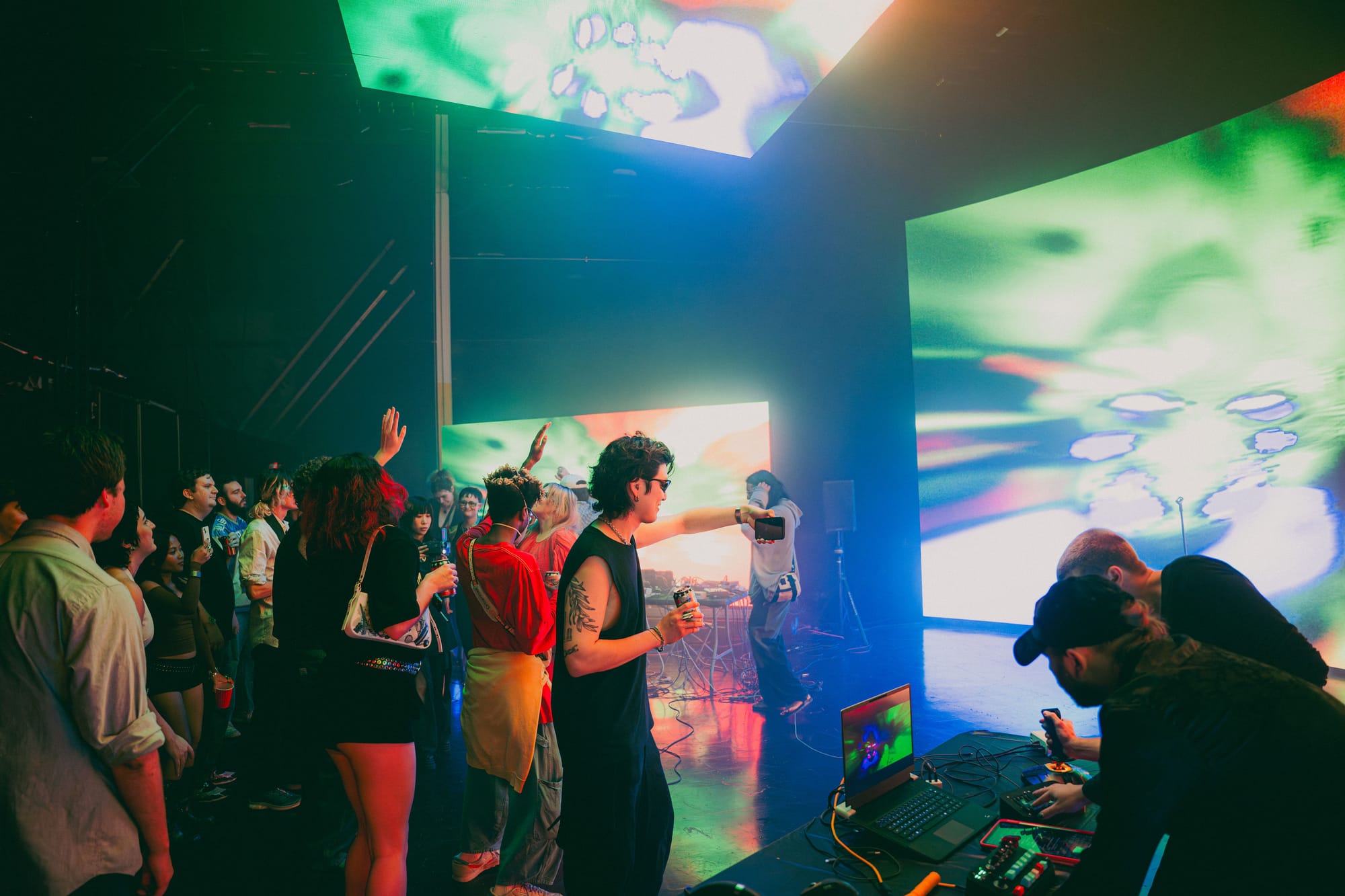
Opaque—because it’s hard to fully convey the raucous nature of a three-night interactive performance-cum-dance-party at a 10,000 square foot production space with a dozen performers, a 30-ft LED wall, custom controllers mounted to lighting rigs, a real-time motion-captured host named Kina, an active LAN party, bighead cat-themed dancers, and, of course, an open bar. Sam puts more succinctly.
“Virtual club theater” is what Sam Rolfes tells me. Honestly, I’m bummed I couldn’t make the July debut in Los Angeles to mint a clever moniker on my own.
In talking to the team this fall, I'll see that this vibrant clash of real-time technology and multidisciplinary performance is not an isolated experiment. Across New York and, increasingly, in cities worldwide, artists I've followed for years—people trained in painting, dance, theater, and cinema—are converging on an unlikely common language: game engines. Not to make games, but to create a form of live performance that existing institutions don't quite know how to categorize, much less support.
What I’m seeing at Diskokina is the absolute vanguard—live performance using real-time game engine technology, staged for audiences that might stay for six hours or 30 minutes. It's a hybrid form that draws equally from commedia dell'arte, variety shows, music festivals, VTubing, live-action role-play, and broadcast television, powered by tools designed for video game production.
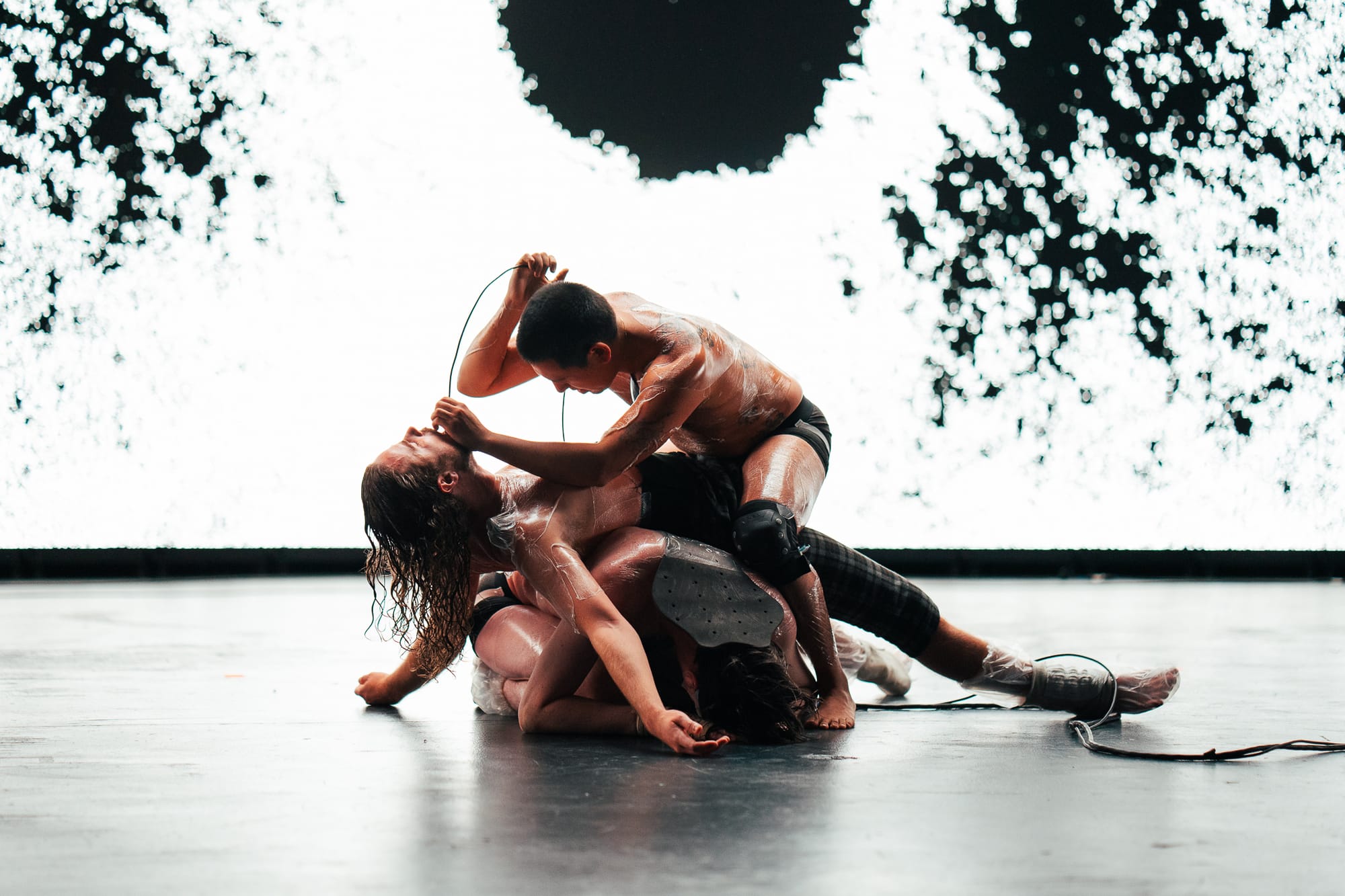
The work matters deeply and fascinates me equally, because it demonstrates how artists are appropriating the visual language and technology of games to privilege aesthetics and liveness over the challenge and mechanics that dominate gaming culture. But to do that, the Diskokina has to build from the ground up. They're manifesting infrastructure—touring logistics, venue relationships, audience vocabulary—for a medium that technically exists but has no mature industry to support it. “We’re bringing the tech, but we’re also painting the stage,” Kevin Peter He says.
As institutions like Lincoln Center begin offering fellowships and platforms for this work, a question interests me as someone who's spent years covering the intersection of games and culture: Can live performance using game engines escape the "tech art" categorization and claim space in theater, dance, and visual arts? Or will it remain trapped in gaming discourse, legible only to people who already understand Unreal Engine?
Commedia at the Club
When Jen Sillen mentions commedia dell'arte in our conversation, I can’t say I’m surprised. The 16th-century Italian street theater tradition may seem anachronistic for describing game engine performance. But as she explains it, the parallel is precise.
Comprising bands of itinerant actors, commedia solved several problems for performers seeking to make their way through Renaissance Europe. It was an efficient way to collect money away from physical theaters and enabled a dynamic, flexible performance method that prefigured improv theatre. But more importantly, commedia’s novel use of masks to indicate the actor’s roles gave each scenario specific structures that could be replicated again and again. You didn’t need hundreds of years of drama theory to understand the motivations of the miserly Pantalone and braggadocious Capitano or why you should root for the innamorati’s star-crossed romances.
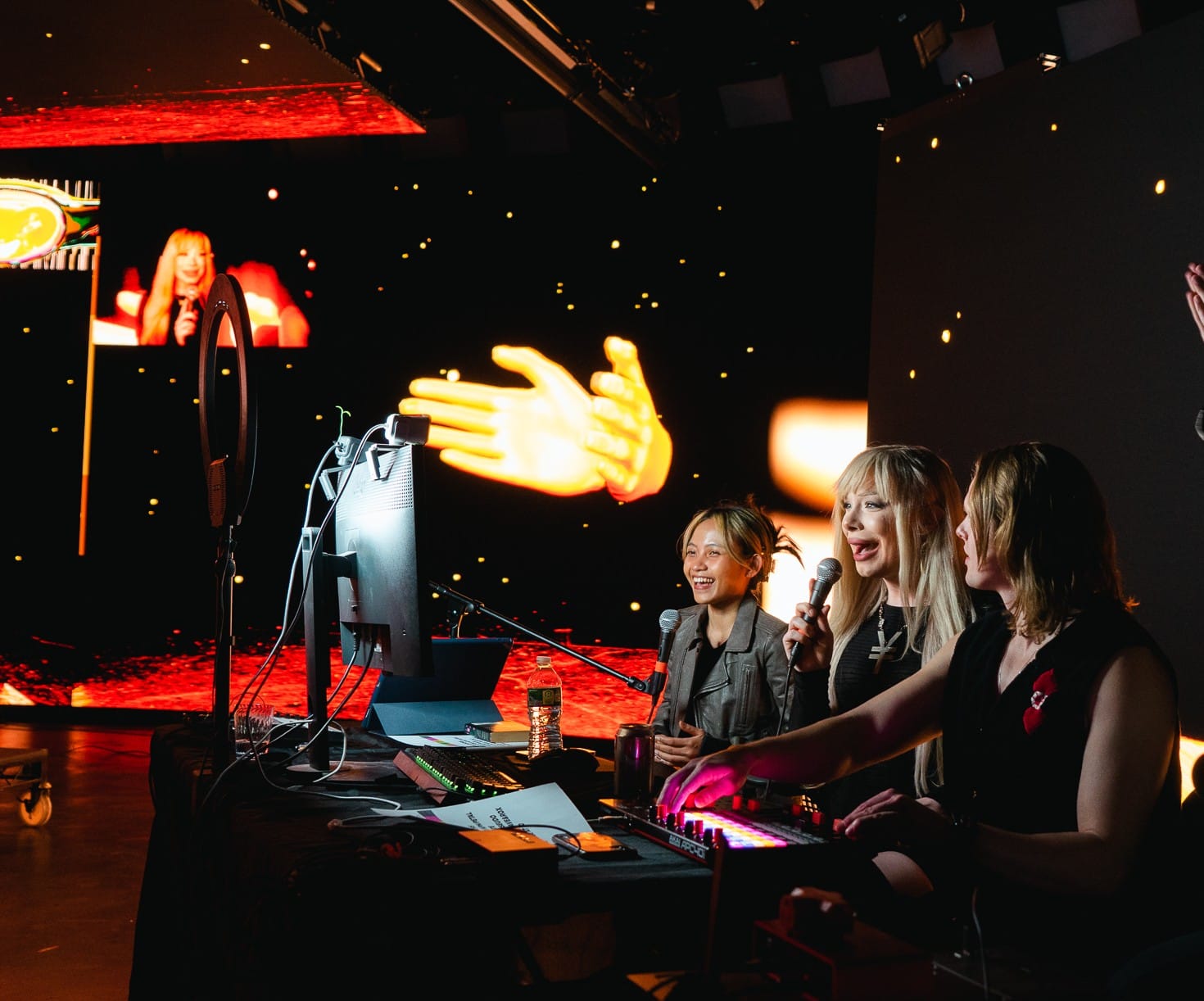
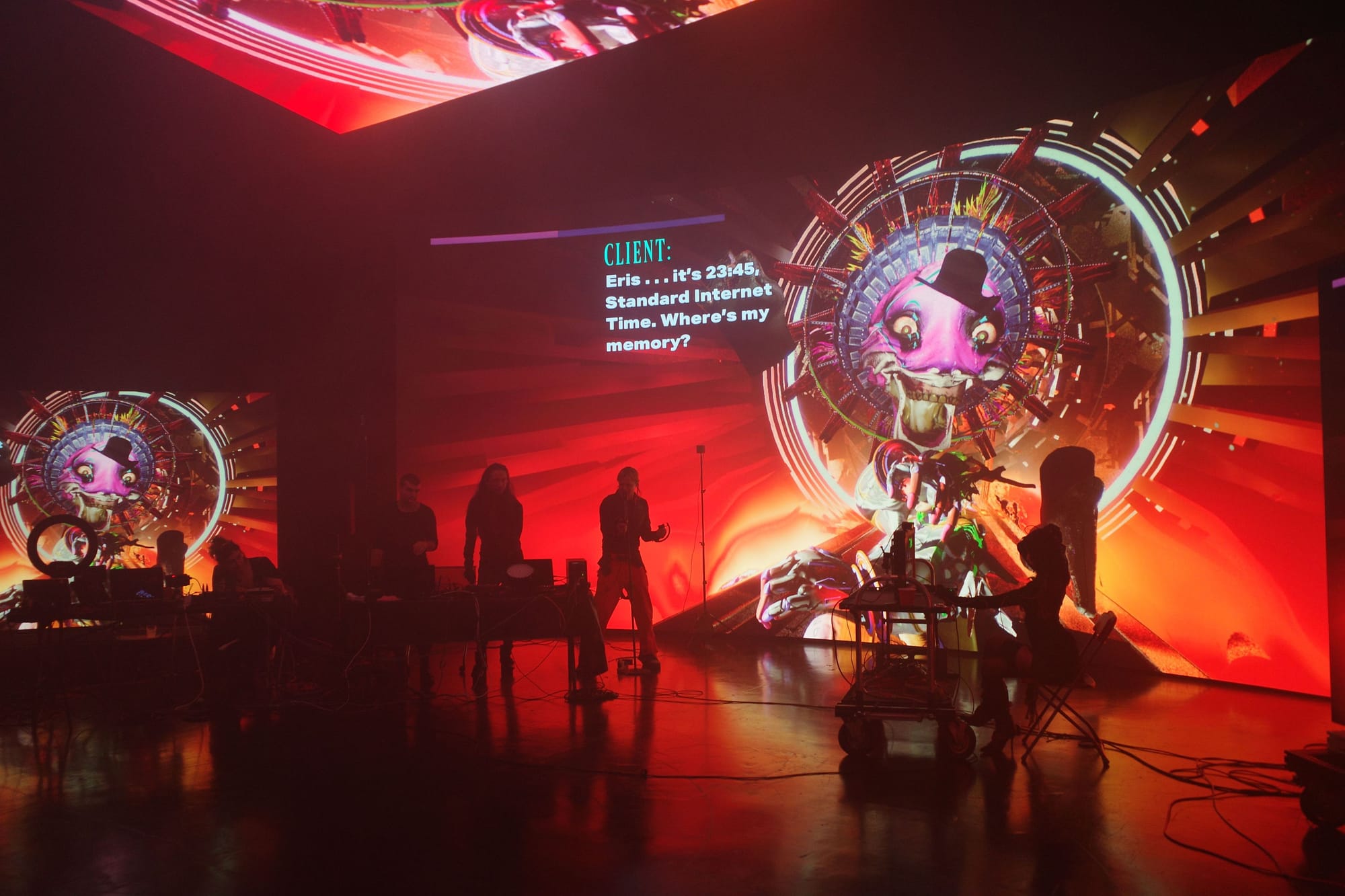
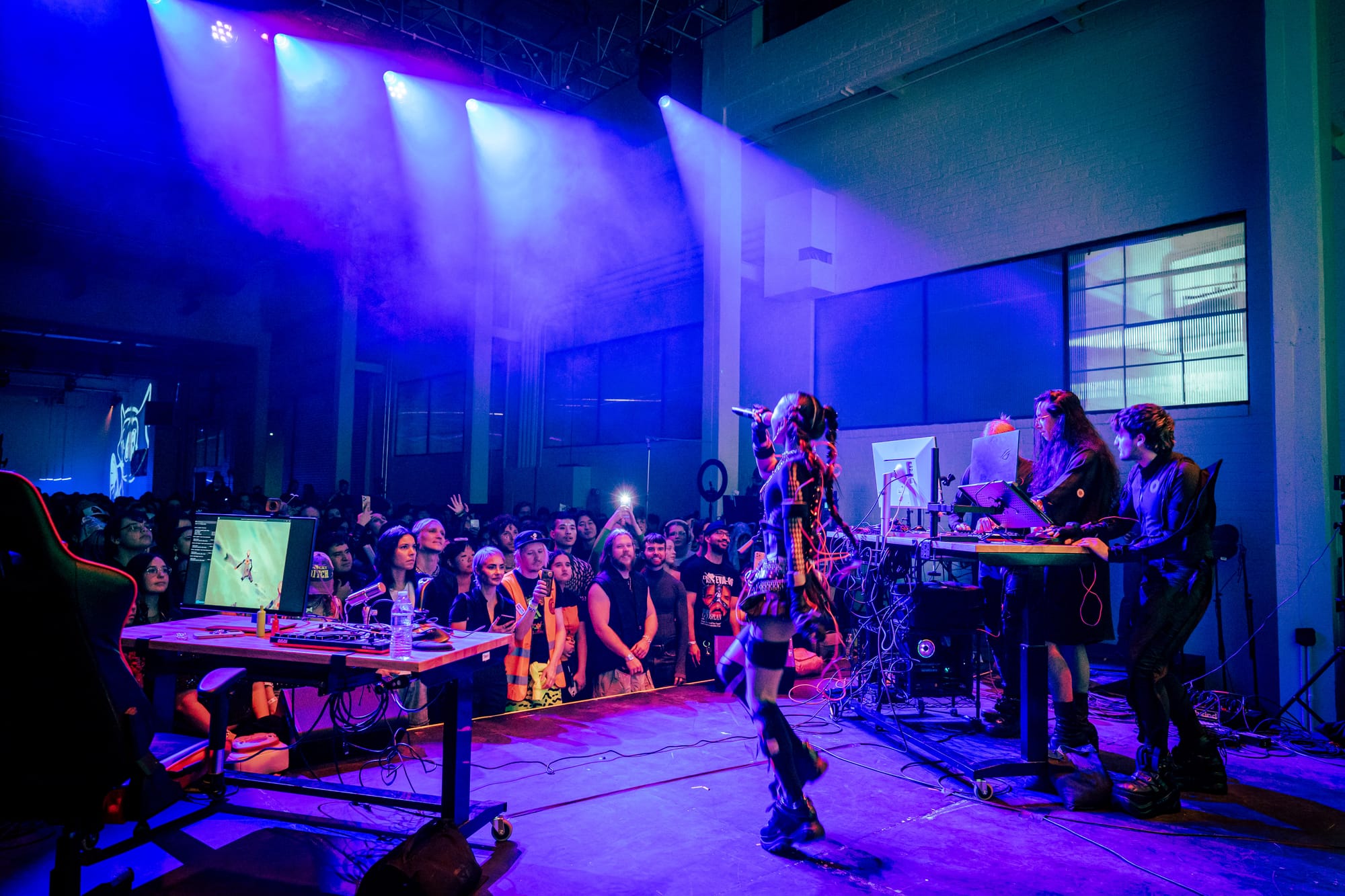
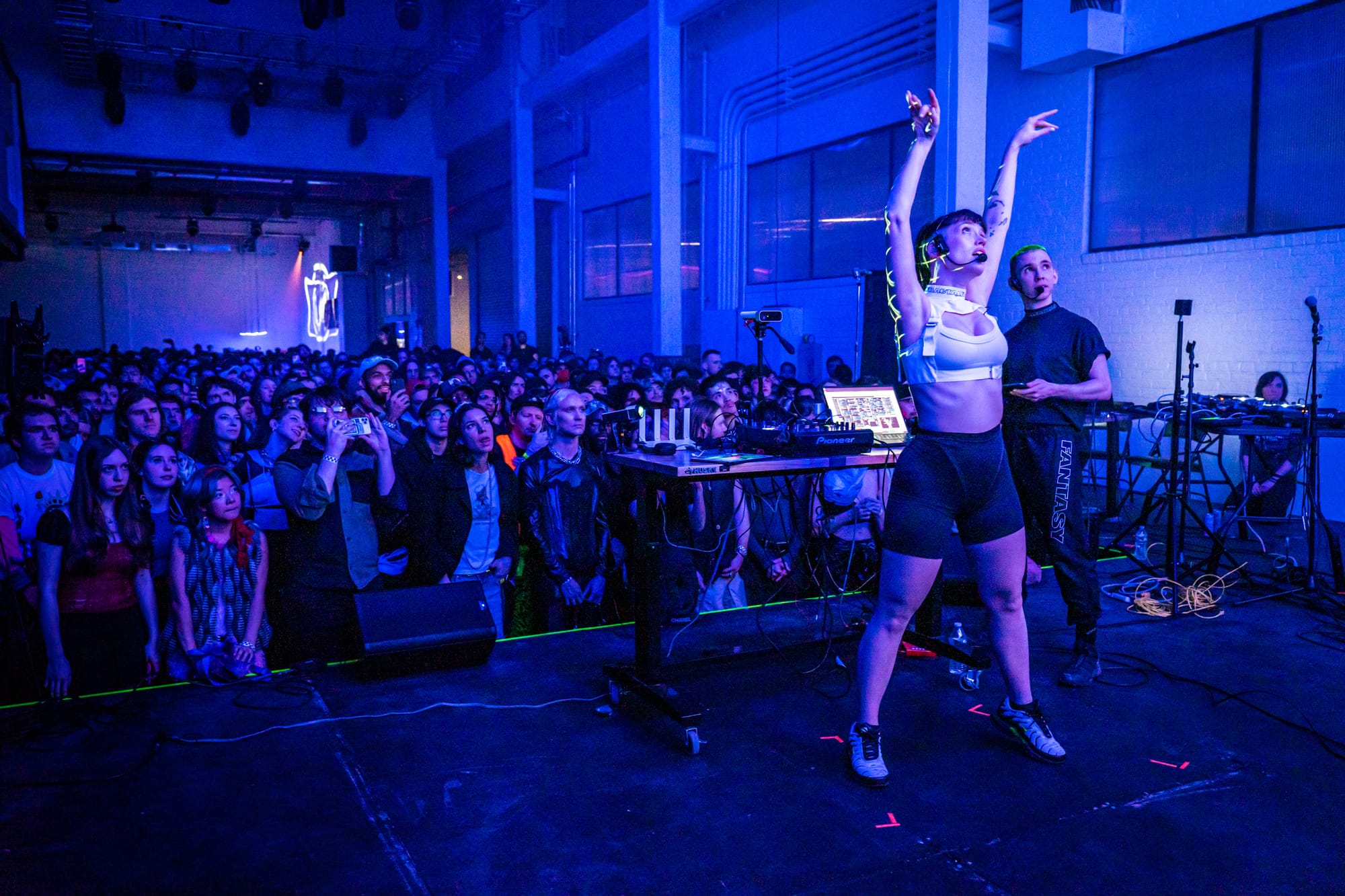
Like those traveling troupes performing in market squares, Discokina needs stock characters recognizable within 30 seconds, narratives that work for audiences who arrive mid-show, and formats portable enough to travel from town to town—or in this case, from Brooklyn to Berlin to Los Angeles. "You can't reach the complexity that you get with a Broadway show where you have 25 minutes to set up characters and dialogue and relationships," Sillen tells me.
The format must accommodate people who need to go to the bathroom, get drinks, talk to friends, and want to dance. “There’s not an existing format for it outside of Diskokina,” she adds. "Creating that context for an audience to come and get the vibe is helpful. It's a very new way of telling stories to crowds." So Diskokina leans on interstitials to advance the plot, and also gives their team a chance to swap out great. “We have good PAs,” Andy Rolfes jokes.
The subtitle system for 321Rule, one of Diskokina's recurring shows, highlights their audience-first problem-solving approach. Sillen walks me through how it functions simultaneously as karaoke-style dialogue prompts for performers who move from city to city and as subtitles for the audience. Meanwhile, she notes, Broadway exhausts itself with pre-recorded LED wall content that cuts out stage design and live elements. Diskokina is what she calls "an antidote"—technology that enhances rather than replaces theatrical craft.
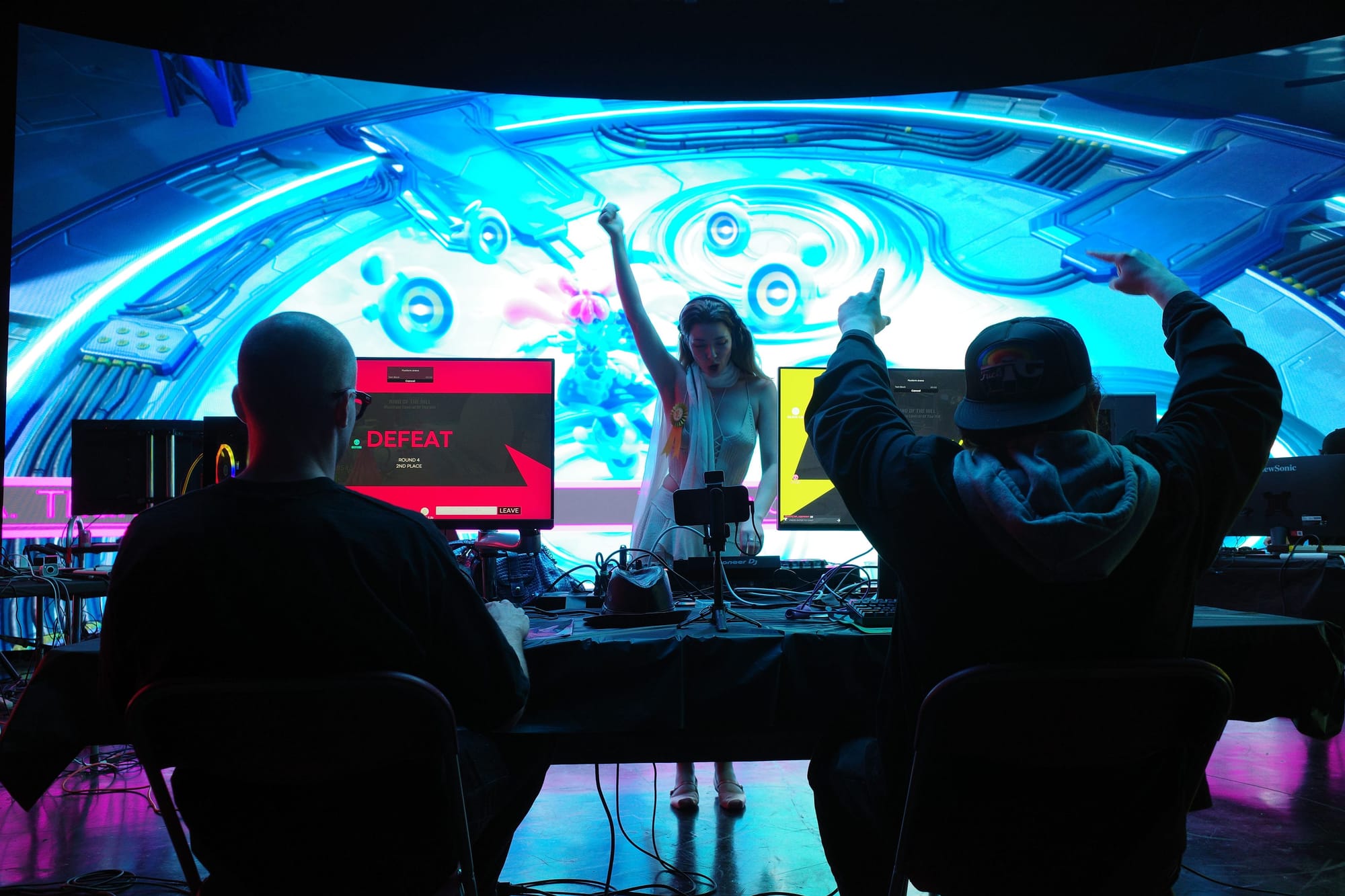
But I notice the word "theater" itself keeps coming up in our conversations. Not "real-time art." Not "interactive experience." Theater. One of the challenges of interdisciplinary work with games is that it resists categorization because it touches on a variety of disciplines. But when approaching audiences or funders, artists are required to put game-based art and practice into some type of container. For them, the theater fit the nature of the work the best. “It’s not like a traditional audiovisual show where there’s a lot of pre-rendered eye candy,” Sam Rolfes says.
Kevin Peter He points out that gravitating to theater is a matter of creative community. Sillen was a huge musical theater fan, and there are references for theater kids sprinkled throughout the show. Because so much of the film industry now looks to virtual production, “there’s just this proliferation and cross-pollination of [theater] evolving the medium,” Kevin Peter He says.
When I ask Sam Rolfes about this choice, he argues the term captures something essential: "Theater is essentially live. We make non-live stuff, but even the music videos we do—because it's real-time, the essence is still live,” he said. “We're performing character mocap; we're performing VR puppetry. The liveness and the messiness and the comedy that comes out of that is essential to the entire thing."
Building DIY Infrastructure
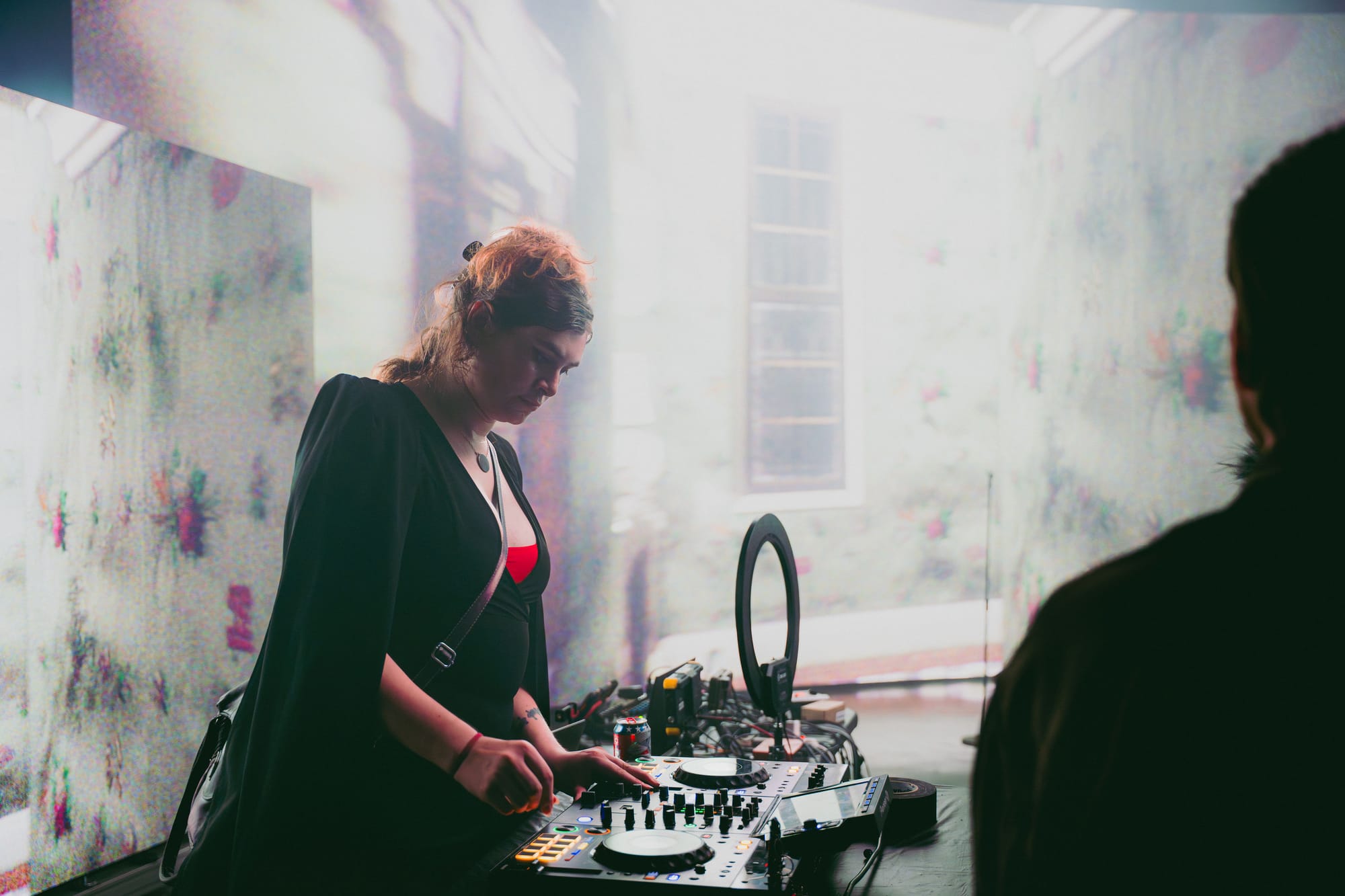
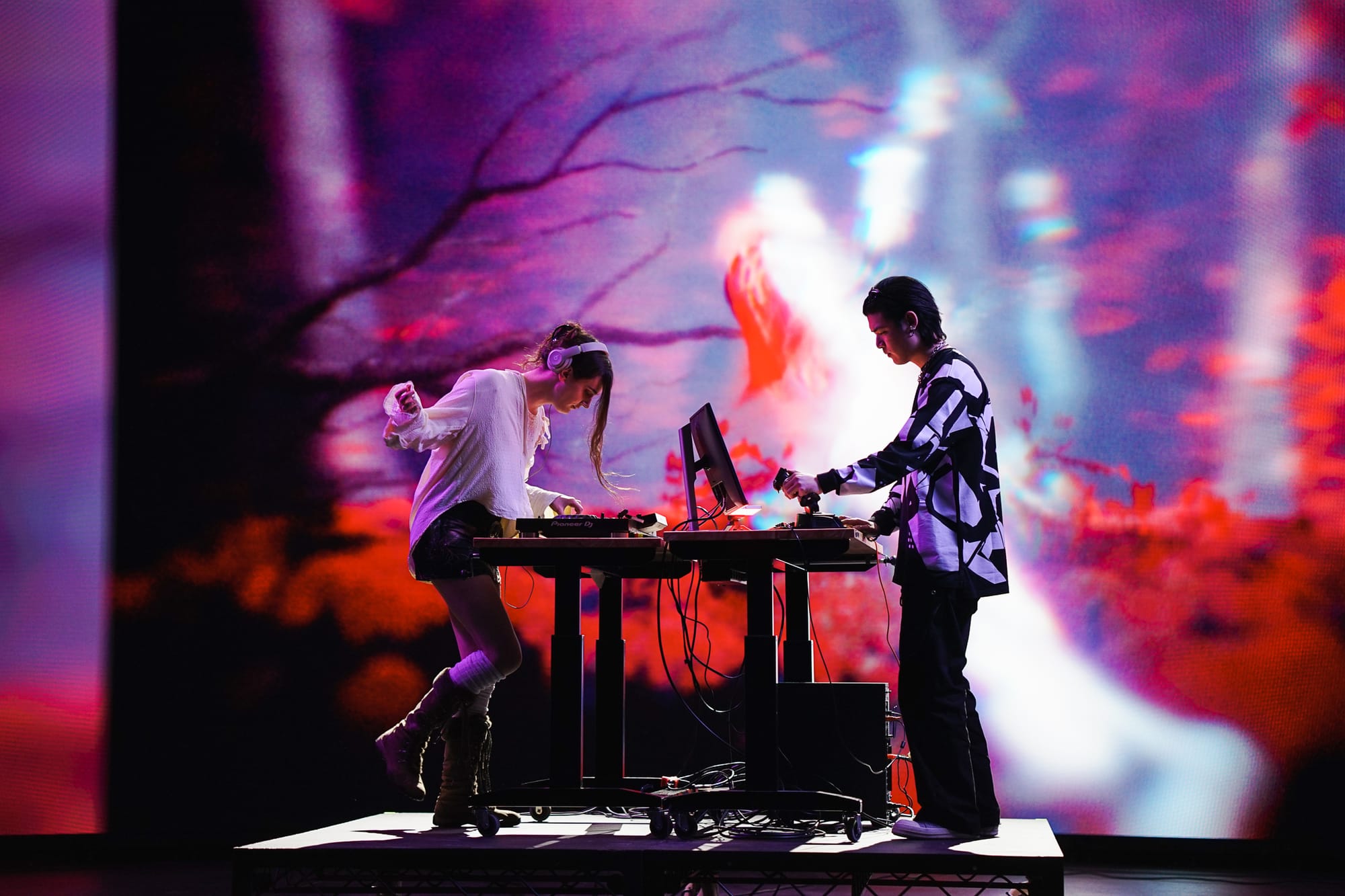
One of the challenges for games historically has been communicating the technical artistry required for performance. Kevin Peter He and I talked about this in his interview, where the talents of competitive gaming are crudely mapped to mice and controllers, invisible to the participants. A key part of Diskokina’s appeal is the foregrounding of technical performance. He’s camera arm looks professional when you see it in action. I assume it costs thousands. He laughs when I ask about the budget. "It's sub $100," he says. "It's a 3D printed body with a bunch of electronics inside and sensors."
When I ask about technical constraints, expecting complaints about Unreal Engine's limitations, Sam Rolfes redirects me. "Unreal can do cool stuff," he notes, "but in a world where everybody's using Unreal, it's more about how do we convey a story that is not just pure eye candy." The real challenges are logistical: What's realistic to tour with? Which motion capture systems play nice together? How do you communicate to venues what you need?
This DIY ethic, I learn, extends throughout Diskokina's operation. “We bring almost everything in-house,” Sillen says. The collective totes almost everything but the LED wall—motion capture suits, computers, custom controllers, and the rolling table system that enables those seamless changeovers I witnessed. “It’s like a television broadcast room, except half the people are also doing dialogue, playing music, and running Unreal,” she says.
Diskokina's Non-Traditional Fingerprints
Sam and Andy Rolfes started with drawing and painting, moved to ZBrush for its tactile, sculptural quality ("pushing and pulling digital clay," as Sam Rolfes describes it), then discovered Unreal Engine in 2015. Their first music video for Amnesia Scanner was "take 32," a work of improvisation and discovery that treats virtual space like a painting surface.
Kevin Peter He’s background surprises me most. His practice, he explains, hinges on his dance training. He interprets music and breaks it down, but through controllers and visual art rather than his body. "Most people don't know that I'm a dancer," he tells me. “I keep thinking about dance from a performing arts standpoint, right? Like, do I want to be a dancer on stage? His current work slips between operating controllers and explicit choreography, slipping between dance, performance, and technical acuity.
Sillen emerged from New York's club world and musical theater. During COVID, she tells me, Club Cringe's virtual streams on Twitch and Second Life evolved into radio theater, with 10-hour slots, giving it space to experiment with narrative in ways club music bookings never allowed. Diskokina is a natural extension of the IRL community building she had already been creating.
The fingerprints show once you know what to look for. Sillen’s theater training shapes the writing, structure, tone, and stage management. Team Rolfes's painting background informs its aesthetic sensibility, privileging what you see and hear over mechanical complexity. Kevin Peter He’s dance practice manifests in his relationship to music and rhythm through hardware interfaces. And the guest performers fill in everything else.
Game engines serve as a lingua franca across many creative fields. Unlike game makers who primarily work with other game makers, this collective proves that people from painting, dance, and theater can collaborate through a common technical language while maintaining their disciplinary perspectives.
Building the Network
When I ask about audience response, the Rolfes tells me something striking: After the first Diskokina at Zero Space in Brooklyn, dozens of artists approached the collective who “didn't even realize this was an option," Sam said. It was praise, but also a provocation for other artists who could see a new practice evolving before them, like seeing the Velvet Underground play punk or DJ Kool Herc gesture towards hip-hop. These are performances but also signposts for the future.
This response, I realize, reveals the core challenge: the interest is there but the infrastructure doesn't exist. I’ve had this experience operating my own game-based arts space in Los Angeles. Unlike live music, there's no established format, no booking agents specializing in virtual club theater, no venues designed for six-hour performances mixing narrative and dance music. You have to build every single node, hand by hand, relationship by relationship, performance by performance. It is the work of relational autonomy–all together, all apart.
The New York scene matters specifically, they explain. The city offers theater infrastructure at multiple scales (from Broadway to black box), education programs at NYU ITP and Parsons that funnel students into game engine experimentation, and a Net Art lineage from the 90s forward that normalized experimental digital work. The approach reads as distinctly American as well, even distinctly New York—different from the more reverential, less comedic tone of European festivals. When Team Rolfes took 321Rule to CTM Festival in Berlin, Rolfes tells me, locals shushed people laughing at the comedic elements. Different cultural contexts require different negotiations and comedy, in particular, is high context. “The tone and our perspective is shaped by the subcultural scenes that we came out of in NYC, I think,” Rolfes reflected.
As I talk to each member of the collective, a pattern emerges: none of them came to game engines through gaming. It’s such a welcome confirmation of what I’ve always wanted from the games over the last twenty years of looking at them as a writer and critic. My hypothesis about what comes next is that it won’t emerge from the games industry itself, but from the sensibilities, and more importantly, the technologies that power them. Games solve complex interactions between players and computers, and as it turns out, it’s helpful to have non-gaming expertise to know where to push.
Diskotina is a welcome place for those orthogonal to games, but who don’t quite fit in anywhere else. “There was no place for us in the arts once we graduated,” Sam Rolfes tells me. “The art industry was a mess, we were forced into the commercial world, and we just had to create a practice out of that.” And now, as Sam Rolfes and Kevin Peter He are named fellows at the Lincoln Center, it seems that fringes are marching towards the center.
But there are still new horizons to pursue. Sillen muses, “One day, we’ll be on Broadway.”