

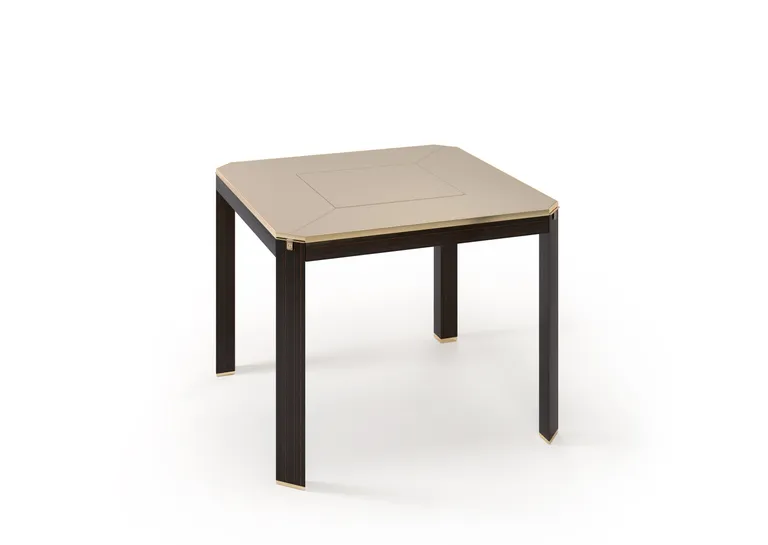
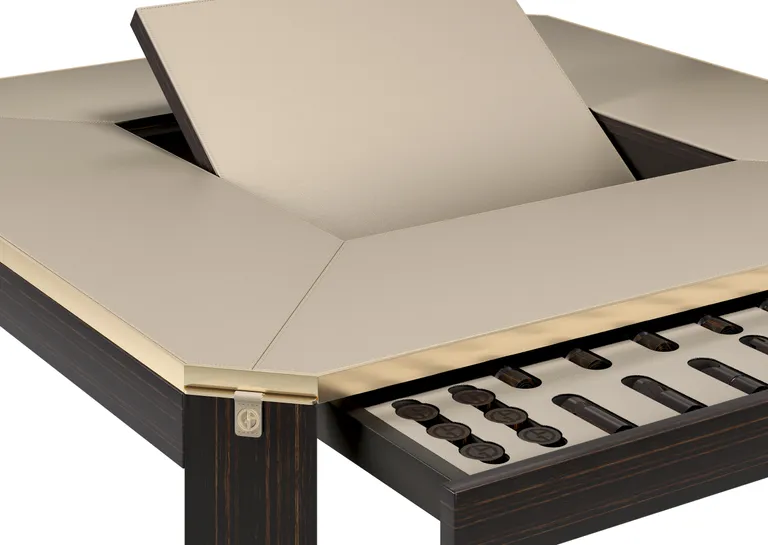
Check out the Armani Casa "Borgonuovo" games table, an art deco-inspired ebony wood piece adorned in luxurious taupe leather, but it boasts a central top that spins to reveal the playing surface It's named after the Milanese street where Giorgio Armani lived, and it debuted at Salone del Mobile 2026 as a kind of love letter to chess and backgammon—two games whose spatial footprints have barely changed in centuries. There are hidden drawers for pieces, pull-out cup holders, and satin-finished brass edging. It's gorgeous.
Not to dismiss the many chess and backgammon enthusiasts out there, but allow me to ask the question: So why don't we design furniture for the games the rest of us play?
Chess and backgammon have become furniture archetypes precisely because their boards are fixed, their dimensions predictable, and their material needs stable. When you find an old chess set with a table, you know exactly how it should look. A designer like Jean-Michel Frank can build an entire aesthetic language around those constraints. The game becomes a formal problem with a known solution. That's a gift for furniture design.
But walk into any modern game night, and the reality is chaos. Wingspan sprawled across a dining table never meant to hold four player mats and a bird feeder tray. Gloomhaven consumes an entire room for weeks. Settlers of Catan's hex tiles slide around on whatever flat surface you can find. The contemporary board game renaissance has produced an explosion of spatial and material diversity, and furniture hasn't kept up. We're still playing on dining tables, coffee tables, folding tables—surfaces designed for eating, not for play.
There's an entire cottage industry trying to solve this. Companies like Wyrmwood and Rathskellers build beautiful custom gaming tables with recessed vaults, magnetic rail accessories, and reversible play surfaces. These are thoughtful, often stunning objects. But they're designed as generic play containers—a nice box to put any game in. What I'm more curious about is the opposite question: What would it look like to design a piece of furniture around a specific game the way the Borgonuovo is built around chess?
Imagine a table whose surface is contoured for Azul's factory displays and pattern-building boards. Or a console designed to hold Pandemic's world map at a slight angle, with integrated slots for city cards and cure markers. It sounds absurd, and maybe it is—the diversity of modern tabletop games makes standardization impossible. But that impossibility is also what makes the question interesting. Chess got a table because it stayed still. Our games won't sit still, and that restlessness might demand an entirely new relationship between play and the objects we play on.