What Would You Do If You Had to Find the Last Surviving Bees?
The Athens-based artist Kyriaki Goni on a woven basket gifted to her at 18, the ritual of telling bees about deaths and births, and building a speculative video game set in a near-future Aegean.

Currently Making is a series with artists and game-makers who have a work in-process.
Jamin Warren: Telling the Bees has this remarkable origin story rooted in a single found object — a basket you were given when you were 18. I'm curious about the long arc from receiving that object to deciding, years later, that it could be the seed of a whole speculative universe. Can you take me back to that first encounter?
Kiriaki Goni: It's a big story that emerged from one object. I was 18, hiking on Ikaria, an island in the southeastern Aegean archipelago. I was walking through a village when I met this lady who invited me to coffee. In her kitchen, I noticed this weird object—a basket woven from thin branches—and asked her what it was for. She told me they use these baskets to swarm or host bees. In Greek, she used the word smarologos, and smari is "swarm." Then she said, "You can have it."
I took the gift back to my hometown, Athens. When we eventually managed to travel back after a long ferry strike, I took a picture at the port holding this basket, really happy to finally be going home. I mean, don't get me wrong, it was a perfect island—but staying against your will on an island for so many days is kind of weird.
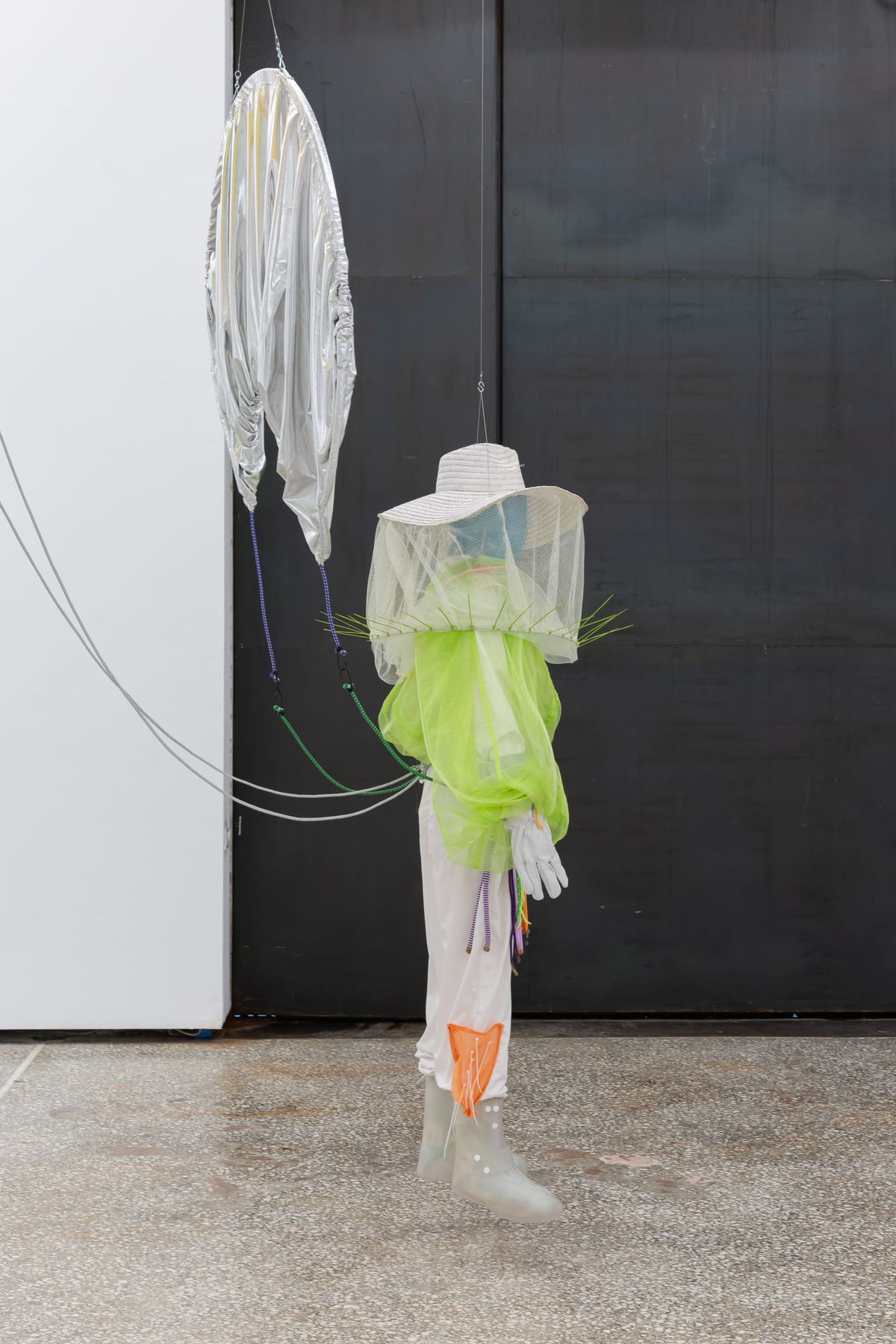
I kept the basket with me for years, in different studios and apartments. About three years ago, I started thinking about making something of it. Most of the time, these baskets hang from trees upside down, with the cone base up, but I started thinking: what if I could make it look like a backpack? So I started designing straps and mending them a bit, because they were old. I was invited to be part of an exhibition, and I said, OK, I'm going to work on this object and allow a story to take form. Eventually, I came up with this character, the Beeseeker, who is gifted the basket, as if she's following my own story, and embarks on a mission to find the last surviving bees.
I later researched the basket and found it has been used widely across cultures, before the box beehive. People made them from whatever was in abundance around them: branches, clay, textiles. The earliest reference is a cave painting from 7,000 years ago near Valencia, depicting a female figure holding a basket surrounded by bees. Not this basket, but the form.

A Future Where the Bees Have Already Left
The Beeseeker's costume has a near-future register: Inuit-style snow goggles, sandals cut from discarded tires, boots for rocky terrain, a parachute to catch the wind. The whole rig reads as survival gear for a specific kind of collapse. How did you arrive at that visual language?
I started by writing the story and, as a case study, imagining the Aegean archipelago in the near future. There's a specific group of islands in the Aegean with cliffs, dry landscapes, strong winds, and harsh sunlight. I had that in mind. That's why I used a parachute to harness the strong wind, or the goggles to protect from the sun. But there's also a connection to what's happening right now on these islands: overtourism and habitat loss for many organisms, including bees. It should be a big discussion, but it's not. In the story, you see hotels and infrastructure almost collapsing because people had huge ideas of building huge infrastructures on tiny islands.
What is it about that gesture — the idea that nonhuman life has a right to be told what's happening — that you wanted to bring into the work?
I came across it while searching online and said, This is going to be the title. The ritual is observed in many rural cultures: people introduce the bees to what's happening in the household, or the bees will fly away. I remember an article in The Guardian about Queen Elizabeth's passing, where the Royal Beekeeper told the bees the Queen had died.


The Ritual of Telling — and Who Gets to Know
Bees are extraordinary subjects for an interactive work, partly because so much of their behavior is already a kind of language. As you've been developing the gameplay, what does it look like to take that bee-logic and turn it into something the player has to actually do with their body?
They're quite ambitious. A central part is how bees communicate with each other, like the waggle dance and the round dance, which transfer information about direction and distance to food. I'd like to introduce it into the game by using the player's physicality as input. I'm also thinking about sound as a bodily element: in order to unlock an asset, you have to hum like a bee, or perform the waggle dance.
Another feature I hope to incorporate is bee vision. The character uses a bee antenna and sees the world the way bees do. A different part of the spectrum cab change the whole landscape in terms of color. For the show at The Breeder, I created an AR version of the antenna, so visitors could wear it on their face through the phone camera.
How does the game sit alongside the other work in the exhibition?
The intention is to create an environment where the digital and the physical overlap—not a distinct experience, but a world that is both at once. Most of the objects in the Beeseeker's inventory are tangible in the installation: the basket, the parachute, and soon the tire sandals and boots. There's sound, and there's smell — I use beeswax and lemongrass, an essential oil that attracts bees. It's a multi-sensory experience for the whole body.
Where is the game itself, in terms of production? I watched some of the footage you've shared—the menu screen, the inventory views—and it has the texture of something genuinely in motion rather than concept art. What's actually built, and what's still ahead?
The game design and gameplay are in place, though things will change as I work. The honest answer is that the holdup is funding. It's a project that requires more money than a simple art installation. The final game will be a first-person experience: a 3D environment where you can move around and enter an abandoned hotel and a shrine. The landscape is so present that it functions almost as a character itself.
Is it modeled on Ikaria, where you were gifted the basket?
I don't name a specific location on purpose. I started with the Aegean as inspiration, but I'm using the archipelago as a case study as a biodiversity hotspot threatened by overtourism and extractive practices. I don't want it tied only to the Aegean. This comes from my anthropology background. The case study and the fieldwork are connected.
You studied social and cultural anthropology before coming to art?
Yes — bachelor's and master's of science. Then I had a break, worked on completely unrelated things, and eventually studied fine and digital arts. My master's was in the Netherlands, and one of my field theses looked at the body in public space — and dance.

Kiriaki Goni's solo exhibition Telling the Bees was on view at The Breeder, Athens. The game is in development.