


I've been thinking a lot lately about what happens when you treat language itself as an interactive system—something you don't just use but play with, the way you'd play a game. Anna Nygren's blush / river / fox, just out from Milkweed Editions, does exactly that, and the way it came together feels closer to collaborative game design than traditional publishing.
Nygren is a Swedish writer, artist, and translator, and this is her first book published in English. Rather than treating her non-native fluency as a limitation, she and her editor Morissa Young leaned into the gaps between languages as generative space. Translation became a kind of mechanic: a word in Swedish carries a sound that echoes an English word from a completely different context, and suddenly those words become what Nygren calls "parallel siblings"—linked not by dictionary definition but by feel. It's the sort of emergent meaning you get from a well-designed system, where the interesting stuff happens in the interplay rather than in any single element.
What really caught my attention in the interview with Electric Literature, though, is how Nygren describes the editing process. She and Young worked through the manuscript over Google Docs, and for Nygren, that collaborative back-and-forth felt like meeting as "careful strangers" in a shared "word-world." (I loved that term.) Young describes the editorial process as building an internal grammar together—one based on wordplay and linguistic overlap, where they'd break rules to expand the language and follow them only when things got too slippery. It's less copyediting and more co-op puzzle-solving.
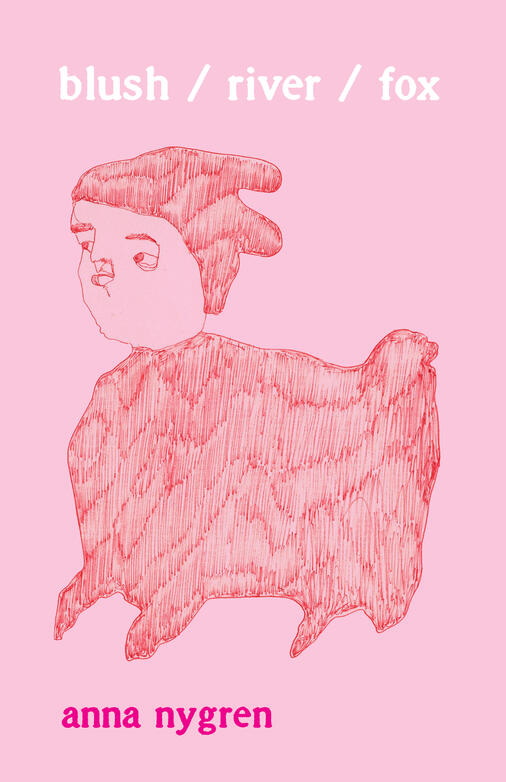
The book is divided into three sections—blush, river, fox—each with its own emotional register and mode. Blush deals in childhood and desire. Fox grapples with more-than-human language. River sits between them as translation itself: stitching and tearing apart simultaneously. The whole collection is threaded with drawings and the color pink, which Nygren connects to an extraordinary web of Swedish wordplay involving roses, crayfish, cheeks, and the sea:
“The word PINK, and also the word KISS, means PEE in Swedish. The Swedish word for the color pink is ROSA, like a rose is a rose, but it is also one of the most common names for cows, like individual cows named Rosa. There is another, maybe older, word for ROSA that is SKÄR. SKÄR also means CUT. It is like a soft cut and a blushing cut a rose a romantic thingcolorword cutting across. SKÄRKIND is the name of the village where I was born. KIND has a meaning in English yes! In Swedish KIND means CHEEK, so SKÄRKIND is like a pink cheek like blushing but also a cut, in the cheek. It is like hurting. SKÄR also means a rock in the sea, I don’t know the English word, it is like a stone a thing in water it is cutting it is a rose and it is. And the sea.
It's a reminder that some of the most interesting interactive work right now isn't happening on screens at all. Here's one section from Poetry:
7.
one day
we find
a dead
rat under
the hay in
the stables it
pulls
somewhere inside me
we bury it in
in the grit
it gets
a pile where the ground
don’t want it inside it
